

It’s 5am when we crawl out of our tents.
The catbirds are calling and the night sky is fading to dawn, as we prepare to head into the bush. We’re surrounded by the towering eucalypts of southeast Queensland in search of a small, native mouse called the pookila.
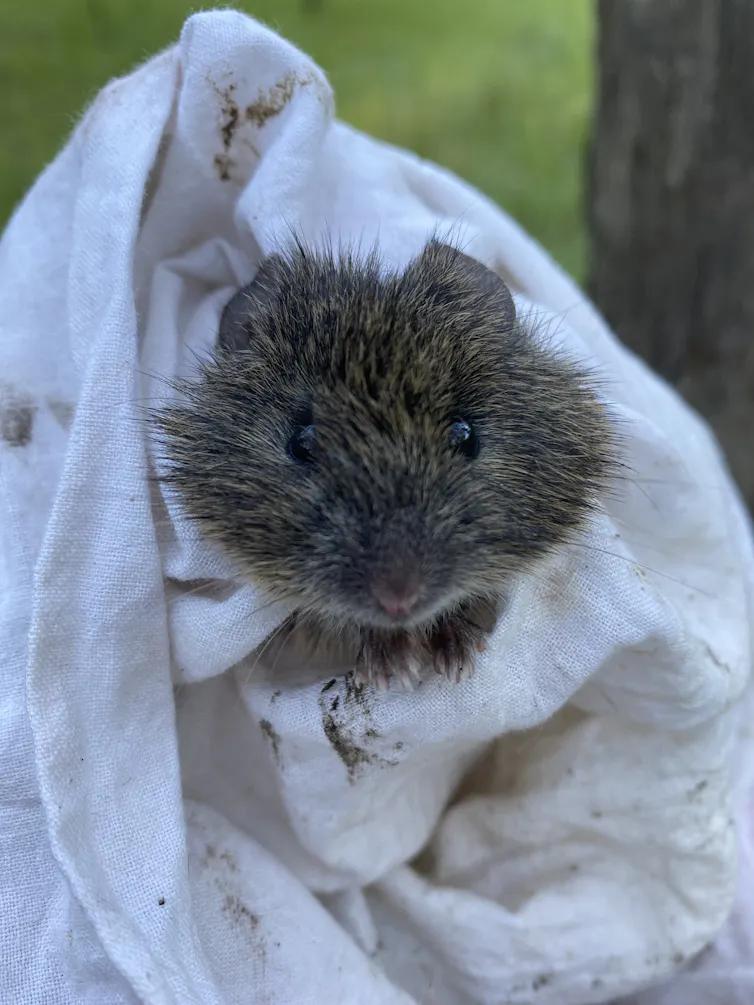
Also known as the New Holland mouse (Pseudomys novaehollandiae), the pookila is about the size of a small chocolate bar, weighing less than 20 grams. These mice spend their nights foraging for seeds and fungi, and their days tucked away in a burrow.
We don’t yet understand what the pookila’s preferred habitat is in Queensland. But these mice can be found in patches along the east coast of Australia, from Queensland down to New South Wales, Victoria and Flinders Island in Tasmania.
Read more:
Meet 5 of Australia’s tiniest mammals, who tread a tightrope between life and death every night
However, this little mouse is under the pressures of habitat destruction, climate change and predators, among others. These threats have lead to declines and local extinctions in southern pookila populations.
In the past, pookila have been found incidentally at ten locations in southeast Queensland. But these surveys, many of which were conducted several years ago, weren’t solely focused on searching for pookila.
For our new study, we visited most of these sites over a 31-month period to better understand how pookila are living and what threats they are facing.
Here’s what we found.
Pursuing the pookila
To find the elusive pookila, we revisited seven locations west of Brisbane in southeast Queensland where they had been previously found.
At each site, we camped out for four to five nights at a time. And over our nearly three-year study, we set a total of 10,666 traps.
Each afternoon, we’d set out with our trusty box traps and a healthy supply of peanut butter balls – a commonly used enticing snack for small mammals. We then identified suitable spots to place the traps, ideally where we might find different types of native rodents. We covered each trap with leaf litter, and placed a delectable peanut butter ball inside.
Read more:
Why don’t people care about Australia’s native rodents? The problem could be their ugly names
The next morning, we’d return to those same traps, crossing all fingers we’d caught some mice. On some days, the rodents were everywhere. Other days, there were no mice in sight. We worked in all sorts of weather, sometimes basking in sunshine and sometimes powering through drenching rain. On particularly wet mornings, all we could do was trudge back to our tents, soaked and exhausted.
But every now and then, the cheeky resident possums would locate our stash of peanut butter balls and steal them right from out of our traps. That made us smile, or cry.
We repeated this process of setting and checking traps over 31 months, all in search of a tiny native mouse.
During that time, we only found and trapped a single pookila.
Abby Dennien
So, where are they all?
It’s hard to know exactly what happened to Queensland’s pookila population. Since 1996, only around 125 of these mice have been captured in Queensland. So we currently lack the data needed to understand how the species has fared over time.
But our findings suggest pookila may be facing local declines in Queensland. These mice may also be becoming harder to find because specific populations are shrinking or changing where they are living. Queensland’s pookila could also be facing similar threats to their southern counterparts, including habitat destruction and climate change. Indeed, it may be a combination of all the above.
In any case, our results raise serious concerns about the pookila’s long-term survival in both Queensland and across the country.
This is why continued monitoring is crucial. Resurveying our study sites, and other sites across Queensland, will help us track any trends in pookila population numbers. And if we catch more individual mice, we can learn about the species’ preferred habitat and unpack what factors may be driving local declines. We can also identify what conservation actions will be most effective, such as undertaking planned burns to restore habitat.
Meg Edwards
Other animal encounters
While pursuing the pookila, we encountered several other native rodent species. These include the endangered Hastings River mouse (Pseudomys oralis), graceful eastern chestnut mouse (Pseudomys gracilicaudatus) and stocky swamp rats (Rattus lutreolus).
Native rodents are a crucial, but often overlooked, part of Australia’s ecosystems. They fill various ecological roles, including helping plants and fungi reproduce by scattering seed and spores and aerating the soil by burrowing and foraging.
Our data could tell us more about how Queensland’s other native rodent populations are changing over time, and how we can better protect them.
But we can also help on an individual level, particularly by keeping cats indoors. Pet cats are skilled predators and collectively kill many native animals each day. So ensuring cats are contained will keep both our pets and native wildlife safe.
We can also conserve the habitat of all our native rodents. We still don’t fully understand what kind of habitat each species prefers. But to protect the pint-sized pookila, landholders and conservation groups can start by maintaining fallen logs, native grasses and other forms of shelter.

Abby Dennien

The post “We set 10,000 traps in search of a rare native mouse. Here’s what we found” by Meg Edwards, Senior Lecturer in Wildlife Science, University of Southern Queensland was published on 07/21/2026 by theconversation.com