

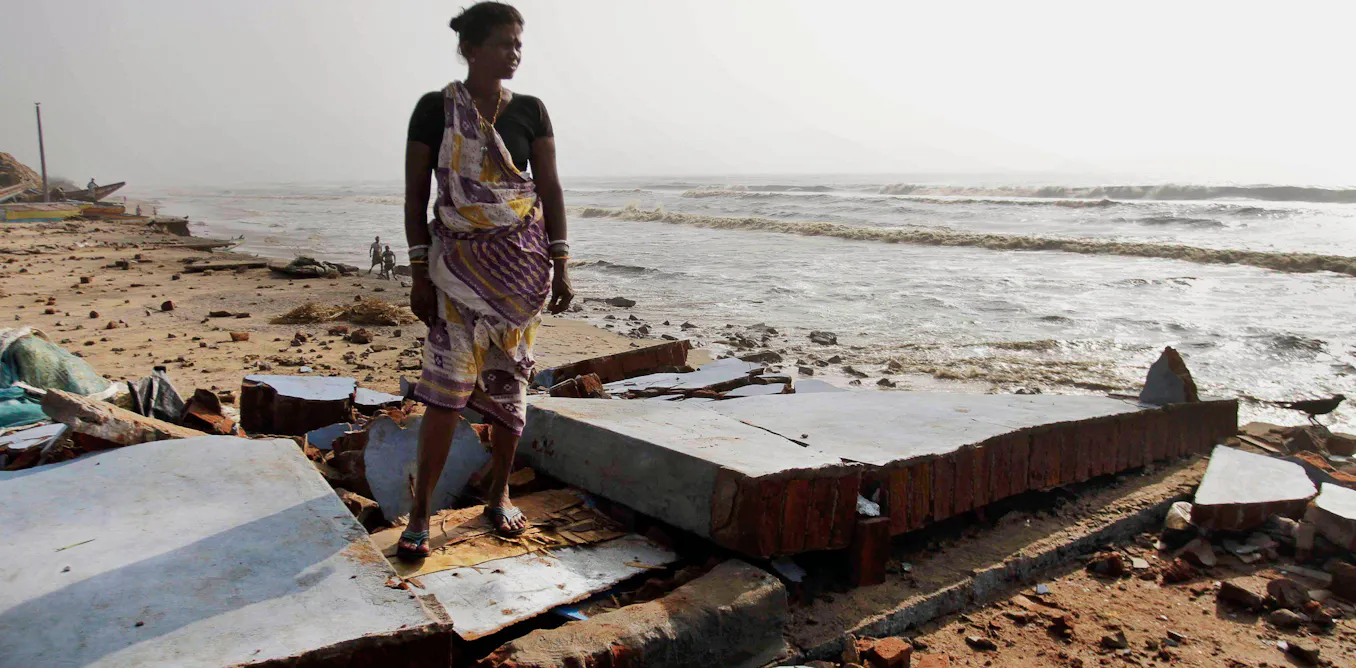
The abandoned houses of Old Podampetta on India’s east coast tell the story of a small fishing village that no longer exists. Families once woke up to the sound of the sea and made their living by reading the tides and winds. But years of coastal erosion and relentless cyclones eventually made staying impossible.
Similar stories are playing out across south Asia. Bangladesh and India recorded nearly 8 million people displaced within their borders by rapid-onset climate hazards in 2024 alone. Most were emergency evacuations before or after disasters such as cyclones, with people hoping to return home as soon as it was safe.
But for some communities, returning is no longer possible. Instead, they may undertake what is known as planned relocation: permanent movement away from places where climate change has made living increasingly unsafe. Some relocations are initiated by communities themselves, while others are planned and supported by governments.
Planned relocation may be an alternative to repeatedly being displaced and in some cases being forced to move to overcrowded and precarious urban settlements. But our research in Bangladesh and India shows that a successful relocation only becomes a durable solution when people can rebuild their livelihoods, relationships and sense of belonging.
More than a housing project
Nihal Ranjit
For people who previously lacked secure housing, relocation can provide shelter and legal recognition. In Bangladesh, an official address can help people access social security benefits and other government support, and secure loans or skills training. As one person we interviewed in Khulna district in the south-west told us:
Earlier, we were living as tenants. We lived in other people’s houses. From time to time, we lived in different places. We did not have a settlement in one place. We did not have a fixed house.
But a house alone is not enough. Another participant said their fear of cyclones had eased, but added: “Here there are no roads … Every time it rains, there is waterlogging in front of our houses.”
These experiences reflect a broader problem of reducing one risk while creating others. Relocation schemes by the authorities have often been poorly compensated and carried out with limited engagement with affected communities. Too often, they focus on moving people to safety without ensuring they can rebuild their lives.
Safety means secure work too
A new house does not replace a lost livelihood. Over the past few years, as part of a project investigating migration as a climate adaptation strategy, we’ve interviewed relocated residents from sites in Khulna and Chattogram, south-eastern Bangladesh, and Kendrapada and Ganjam districts of Odisha, a coastal area in eastern India.
Some households had better access to markets or housing. Others lost the land, forests, fishing grounds or informal work that had sustained them. One relocated participant in Kendrapada explained:
Even if someone wants to do farming they will not be able to do it. We were not compensated for lost agricultural land, we got land only to build a house. There is no work in this village.
They added: “We are having to buy everything here. We never had to buy rice, vegetables or fish [in the place where we lived before].”

Nilles Laurent / Alamy
In some places, the increased dependence on cash income and the lack of local livelihood opportunities encouraged people to migrate to other parts of Bangladesh and India. Family members working in these places sent back remittances which households use to improve their homes at relocation sites. Relocation does not necessarily end migration – it often changes what form it takes.
This helps explain why some communities resist relocation in the first place. Fishing households, for example, may remain on eroding coastlines because moving inland would mean losing access to the sea. For them, relocation would also mean a move away from work.
Jobs, transport, schools, healthcare and more all influence whether people are able to thrive in their new home. People also need opportunities to maintain cultural traditions at the same time as developing a sense of belonging in their new communities.
What makes planned relocation fairer?
“Is there a sadness greater than having to leave your place of birth?”, one relocated participant in Odisha asked us. They described leaving behind their farmland, trees and home, and arriving somewhere with “not even flowers to offer the Gods”.
Cultural losses such as these shape whether people feel settled, respected and able to rebuild.

Photovoice participant
Our research suggests things are more likely to go well when communities help plan their own futures from the outset, rather than having decisions imposed on them. But even where communities have limited control over their relocation, it’s still better when people can adapt new spaces to their needs, creating areas for children to play and shared spaces for community activities.
New settlements also need to reflect local climate, culture and everyday life, with homes that support cooking, privacy, livestock and social interactions. And they of course must protect people from hazards such as extreme heat, flooding or cyclones.
The move is only the beginning
Planned relocation should only happen once people can no longer adapt safely where they already live. When it is unavoidable, governments need to plan for more than the move itself – they must help ensure people no longer face displacement-related disadvantages after moving.

Google Maps, CC BY-SA
Bangladesh has already begun to recognise this. Its 2021 National Strategy on Internal Displacement Management and the action plan that followed both adopt a rights-based approach to planned relocation, treating it as more than an emergency response.
One of the key lessons from those documents for future climate change-related relocation is that moving people away from danger is only the beginning. The people of Old Podampetta mostly moved to New Podampetta, a site just inland from the sea which the community themselves played a central role in choosing. Their new homes are safe from erosion and cyclones, and the proximity to the sea meant minimal disruption to their livelihoods.

Divyanshi Vyas
Podampetta’s story is an example of how relocation can be approached more thoughtfully, by keeping community needs central and designing policy around them. After all, the real measure of success is developing relocation policies that allow affected communities to live with security, dignity and the possibility of a future in which they can thrive.
The post “Climate change is driving some entire communities to relocate – but simply moving isn’t enough” by Ricardo Safra de Campos, Senior Lecturer in Human Geography, University of Exeter was published on 08/17/2026 by theconversation.com