

Both major U.S. political parties regularly tout their commitment to working-class Americans and claim to be the party of the working class. However, neither the Democrats nor the Republicans nominate many candidates who spent substantial time in working-class jobs.
This near-absence of people from working-class jobs in the halls of power matters. According to research in the U.S. and in other democracies, safety net programs are stingier, business regulations are flimsier and protections for workers are weaker than they would be if people from working-class jobs went on to hold office at higher rates. Working-class people can sometimes influence policy in other ways, but the fact that so few former workers hold elected office means that working-class interests often fall by the wayside in the world’s political institutions.
We research the causes and effects of the shortage of politicians from working-class jobs. We define working-class jobs as manual labor jobs, like construction worker, service industry jobs like restaurant server, and clerical jobs like receptionist.
We don’t include small-business owners or people who work in jobs that require extensive formal education. Instead, we focus on people in jobs that offer employees little stability or security.
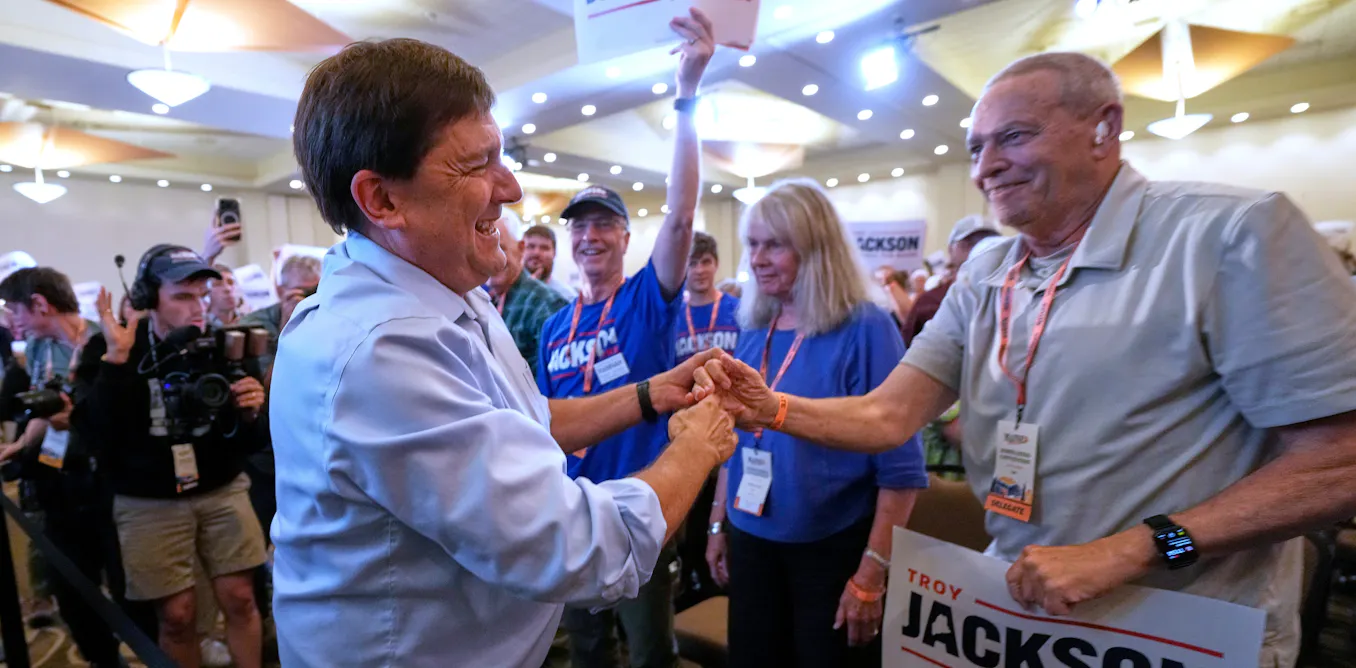
There are, of course, a small number of notable politicians from these kinds of occupations. U.S. Rep. Alexandria Ocasio-Cortez, a New York Democrat, was a bartender before she became a lawmaker. Troy Jackson, Maine’s Democratic Senate candidate, worked as a logger before entering state politics. Indiana state Sen. Jim Tomes, a Republican, worked as a truck driver and union steward.
There are also examples outside the U.S., such as Stefan Löfven, the former prime minister of Sweden, and Luiz Inácio Lula da Silva, the president of Brazil.
Politicians like these often attract outsized media attention, but overall, people from working-class jobs are sharply underrepresented in political institutions.
The working class rarely holds office
By our count, about half of all Americans in the labor force have working-class jobs. However, people who last had working-class jobs when they got into politics make up only about 1% of the average state legislature, regardless of their party affiliation. The same goes for Congress.
And the U.S. isn’t alone. Starting in 2016, we partnered with a team of researchers to collect data on 97 of the 103 democracies with more than 300,000 citizens. Like the U.S., the average global democracy draws just 2% of the members of its national legislature from people who last had working-class jobs.
People sometimes blame the shortage of working-class people in office on features of American elections, such as soaring campaign spending or the decline of labor unions.
But even in Germany and Belgium, which offer public financing to candidates, or Finland, where the vast majority of the labor force is unionized, people from working-class jobs make up around 5% or less of the national legislature.
What keeps workers out of office?
There doesn’t seem to be any shortcoming on the part of working-class Americans that would explain why they so rarely go on to hold office.
Working-class candidates tend to be about as qualified in the ways we can measure as white-collar professionals, about as interested in running for office and about as likely to win when they run.
Our new book, “Keeping Workers Off the Ballot,” shows that what keeps working-class Americans – and their counterparts around the world – out of elected office is that they so rarely run. And that’s because campaigning anywhere for any office at any level of government is personally burdensome, as we show in our book. It takes time and energy, it entails personal risks ranging from embarrassment to physical violence, and the outcome is always uncertain.
In surveys in the U.S. and other democracies, working-class people are significantly more likely than equally qualified professionals to say that they cannot run for office because of concerns about taking time off work and being unable to pay their bills during months spent on the campaign trail.
This inequality is magnified by a second process: In elections everywhere, parties and interest groups play key roles in recruiting and supporting candidates. These gatekeepers understand that working-class people have a harder time running for office.
As a result, party leaders – even those who care deeply about the working class – pass over qualified workers and instead favor the white-collar professionals they think will have an easier time on the campaign trail.
AP Photo/Steven R. Groves
Reforms that help workers are possible
We believe there are ways to overcome the obstacles that keep working-class people out of office.
In a report we wrote for the American Academy of Arts and Sciences, we outline a range of options. Some of the reforms we’re proposing would help in the short term, such as creating candidate training programs or political scholarships that target working-class people. Some examples already exist, such as the New Jersey AFL-CIO’s Labor Candidates School.
Other options, which admittedly might be less likely to happen in the current political environment, would create long-lasting paths to office for working-class people, such as the creation of party or institutional quotas for people from working-class jobs, or randomly selected citizen juries that advise policymakers.
But without serious reform efforts that target the factors that keep workers off the ballot, our research suggests that working-class people will never make up more than tiny fractions of elected officials in the U.S. and in democracies around the world.
The post “Why working-class people account for around 1% of lawmakers in the US – and only 2% in the average democracy around the world” by Noam Lupu, Professor of Political Science, Vanderbilt University was published on 08/20/2026 by theconversation.com