

Temperatures have warmed dramatically across the equatorial Pacific Ocean in 2026, signaling the onset of a strong and potentially historic El Niño. These events can affect weather around the world, and the intensity of recent El Niño events is raising alarm that, as global temperatures rise, they are becoming stronger and more destructive.
To understand how these climate patterns are changing, we need to understand what happened during El Niño events in the past, but observations go back only a few decades. So, my colleagues and I went to the Galápagos Islands – at the heart of the El Niño pattern – to find answers from some of nature’s best record keepers: corals.
In records preserved by living and ancient fossil corals, we found that, on average, El Niño events have been stronger in the past 40 years than at any time in the past millennium, with higher temperatures that lead to more powerful effects on weather.
That intensification also coincides with human-caused global warming.
Our results, just published in the journal Science, suggest that the 1982-83 and 1997-98 El Niños – two of the strongest in recent memory – may be harbingers of more extreme events to come as the planet warms.
Our World in Data, CC BY
El Niño comes for the Galapagos
One of the strongest El Niños hit in 1982, with devastating consequences for the Galápagos Islands. It triggered a marine heat wave that reverberated through one of the most distinctive and unspoiled ecosystems on the planet.
Exceptionally warm surface water blocked the usual upwelling of cool, nutrient-rich water that fuels the food chain for marine life. The result ravaged communities that rely on the ocean – fish, birds, marine mammals, and people who fish for their livelihoods throughout the eastern tropical Pacific. In the extraordinary heat, more than 95% of Galápagos corals died.
The heat wave was caused by an exceptionally strong El Niño event, part of a climate pattern that begins in the eastern tropical Pacific Ocean, around the Galápagos Islands, as the trade winds shift. El Niño’s warm ocean water alters the atmospheric circulation above, diverting storm tracks and changing patterns of floods, droughts and tropical storms around the globe.

Greg Asner/DivePhoto.org
The 1982-83 El Niño contributed to climate extremes worldwide, from flooding in Kenya and Peru to drought in Indonesia and Brazil, costing the global economy as much as US$4 trillion by some estimates. A similarly strong El Niño in 1997-98 resulted in 23,000 deaths from disease and climate disasters.
But we wanted to know: Are such powerful El Niño events unusual in the context of history?
Even in 1983, scientists were surprised to find that such a strong event had been underway. Historical records of El Niño are sparse before the era of satellite observations. Fortunately, long-lived corals growing in the tropical Pacific can provide a history of El Niño that extends our view into the past.
How corals record history
As corals grow, they preserve a record of local ocean temperatures over time. In the Galápagos, because of their location, that record reveals the history of El Niño events and of their cooler counterpart, La Niña.
Like trees that produce annual growth rings, corals add skeletal layers of calcium carbonate year after year. The alternating bands of higher and lower density reveal changes in the coral’s growth rate during each year and can serve as a timekeeper. The history of the ocean temperature is embedded in the chemical composition of the skeleton itself.
To track the history of water temperatures, we measured two chemical parameters – the ratio of heavy to light oxygen isotopes and the ratio of strontium to calcium – both of which reflect the seawater temperature in which the coral grew.

NOAA
In the Galápagos, because of the islands’ location, the sea surface temperature swings between warm El Niño years and colder La Niña years, when upwelling of nutrients is stronger.

Julia Cole, based on original illustration by the Woods Hole Oceanographic Institution

NOAA Climate.gov, based on SeaWiFS data provided by Norm Kuring, NASA GSFC
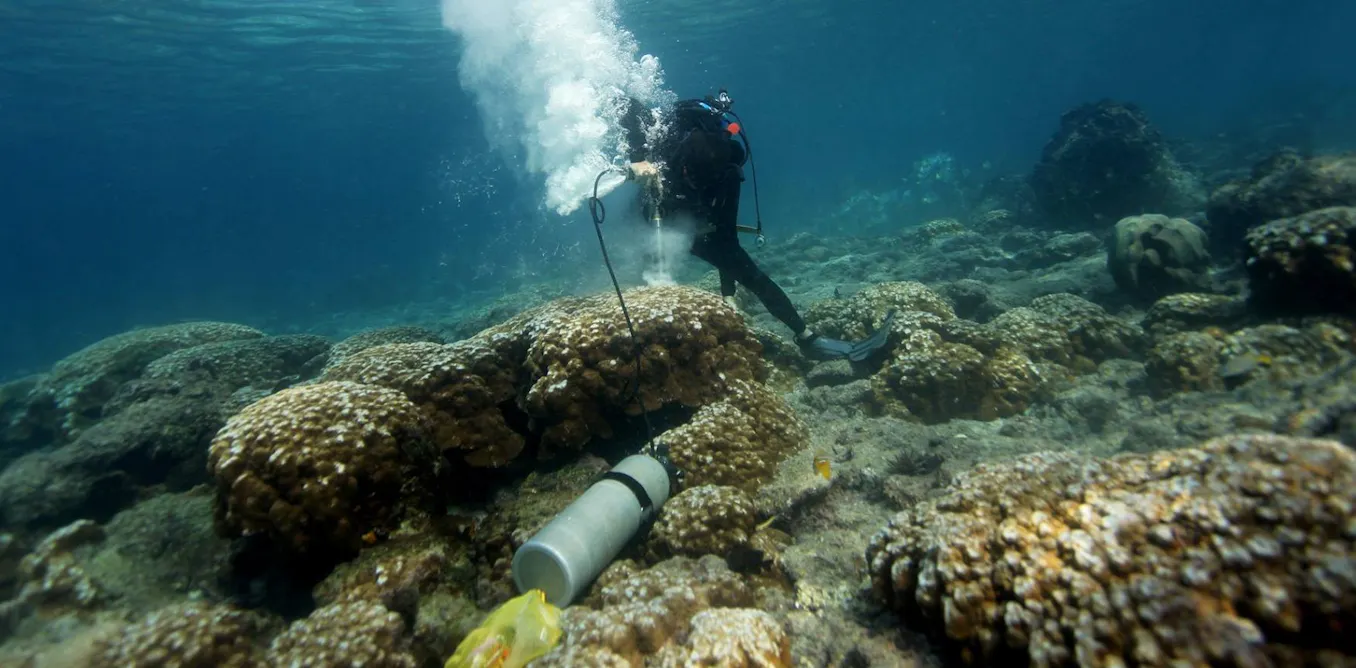
The largest living corals in the Galápagos grow in the northern islands of Wolf and Darwin, in water 20 to 50 feet deep. To study their history, we dived down and took core samples from long-lived corals, some 8 to 10 feet tall.
Every core we drilled from a living coral showed evidence in its calcified skeleton that the coral had suffered during the 1982-83 El Niño event. We saw obvious “death horizons” – dense layers of calcified material produced by other reef organisms such as algae, gastropods and barnacles interrupting the lattice of the skeleton.

We also took samples of fossil corals around the archipelago – mostly dead coral boulders found along the islands’ shorelines. Radiometric dating told us that these fossil corals were up to 4,500 years old. Those samples provide an even deeper view of El Niño’s history.
Back in the lab, we sliced the coral cores lengthwise into slabs and used a drill to extract powdered samples, each representing about one month’s growth, along a path from youngest to oldest. We analyzed the geochemistry of each sample. In the chemical ratios from thousands of samples, we found seasonal cycles spanning many decades and exceptional warm and cold years that revealed a unique history of El Niño and La Niña events.

Gerald and Buff Corsi © California Academy of Sciences

Julia Cole
A history of ENSO through time emerges
Our data show clearly that the strength of the El Niño-Southern Oscillation has intensified as global temperatures have warmed.
The chemistry of the corals revealed that El Niño events from the past 40 years were stronger than at any other time sampled in the past millennium.
The coral data aligns with ocean temperatures measured from thermometers over the past century. But the coral records extend much further back in time, providing long-term context to show that modern El Niño events are more extreme than before the industrial era began.

Julia Cole
The El Niño intensification we observed, starting in the mid- to late 20th century, is also greater than what nearly all climate models suggest would result from natural causes. It appears to be closely connected to human-caused global warming – a conclusion in line with expectations from most climate models.
Not all models anticipate El Niños strengthening as the climate warms, but our data shows that unusual strengthening has accompanied recent warming – an association that may allow scientists to identify models that most closely track observations.
Looking ahead
A stronger El Niño-Southern Oscillation means more intense and damaging climate extremes across the globe. If humanity can anticipate those hazards, we can prepare and perhaps avoid the worst damage.
Fortunately, scientists understand enough about El Niño and La Niña events today to be able to forecast them up to a year in advance. But such predictions depend on continuous, careful climate measurements from satellites and buoys across the remote tropical Pacific, coupled with continuous improvements in climate modeling and forecasting capabilities.
Those capabilities are now more important than ever as global warming accelerates.
The post “Galápagos corals show El Niño events are more extreme now than in past 1,000 years – here’s how my team made the discovery” by Julia Cole, Professor of Earth and Environmental Science, University of Michigan was published on 08/27/2026 by theconversation.com