

Australia’s Macquarie Island lies deep in the Southern Ocean, about 1,500 kilometres southeast of Tasmania. This World Heritage-listed sanctuary is a haven for species such as elephant and fur seals, penguins, albatrosses and petrels, and a key site for wildlife researchers.
But it is not safe from H5N1 bird flu. This lethal virus is rapidly spreading across the Australian mainland and Southern Ocean, already hitting other sub-Antarctic islands including Heard Island.
However, the Australian government has decided to withdraw all 24 expeditioners – including scientists, tradespeople and support staff – from the site. It says this is mainly to protect them from the psychosocial risks – the psychological harms of working in stressful or traumatic conditions – associated with living through a potential H5N1 outbreak and the wildlife casualties it may cause.
Those risks are real. Witnessing mass wildlife deaths could be deeply distressing for any person. But taking everyone off the island means the scientists who work there cannot document an outbreak as it unfolds, or understand what is happening to wildlife populations we have studied for decades.
Paul Carter/AAP
At Macquarie, monitoring is vital
Scientists have worked at Macquarie Island for more than 70 years, and withdrawing all personnel will disrupt long-term wildlife, climate, atmospheric and geological monitoring, well beyond the bird flu response.
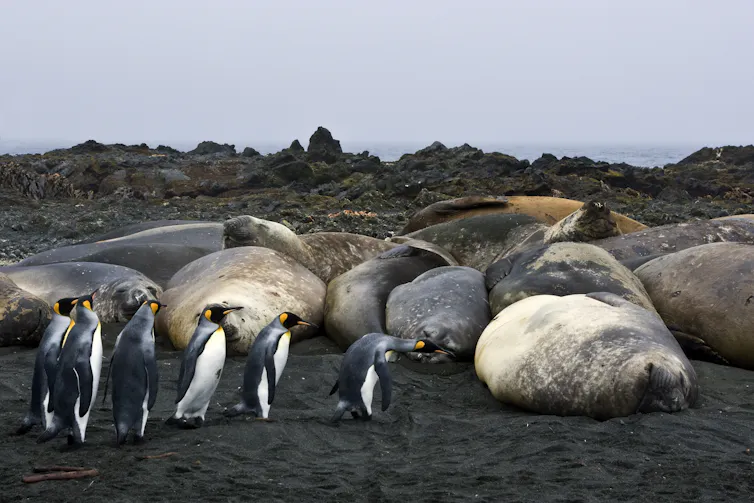
For southern elephant seals, the stakes are particularly high. The species is considered “vulnerable” on the IUCN Red List and under Australia’s Environment Protection and Biodiversity Conservation Act. Decades of monitoring show numbers of breeding females at Macquarie’s major colony have fallen sharply, dropping from 9,400 in 1949 to 2,550 in 2023. The federal recovery plan for this species identifies disease outbreaks as a threat and calls for regular, scientifically robust monitoring.
Bird flu is precisely this type of threat.
At Australia’s Heard Island, more than 13,000 elephant seal pups died during a recent H5N1 outbreak, while the number of breeding females fell by almost half at monitored sites on Britain’s South Georgia. The Australian Antarctic Division itself identified the need for 2026-27 population data to assess the impact of bird flu on Macquarie Island. But the government has now reversed course in withdrawing the island’s staff.
© Bruce Mitchell 2010/Getty
Psychosocial risk is real
Psychosocial or ecological grief – distress associated with the loss of species and places people care about – is well documented among conservation professionals.
But avoiding exposure to loss isn’t the only answer. Guidance from the World Health Organisation emphasises preparation, training and dedicated mental health and psychosocial support for personnel working in difficult emergency environments.
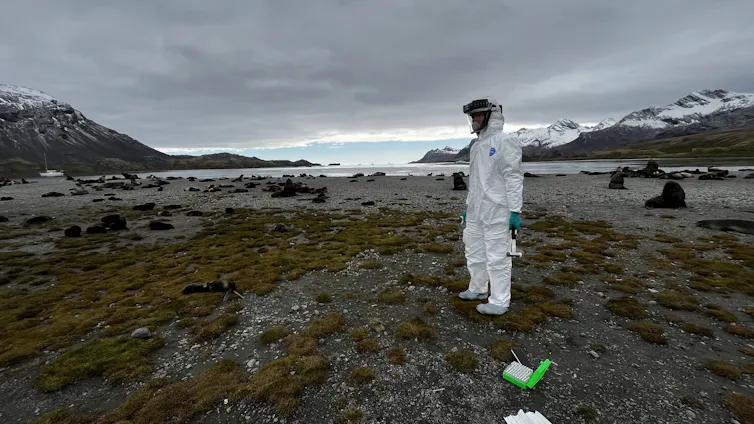
Other nations have already faced this problem. At other sub-Antarctic islands such as South Georgia, Crozet and Kerguelen and the Falklands, authorities boosted biosecurity measures – including providing personal protective equipment and guidance on wildlife sampling – to maintain essential science and disease surveillance. Similarly, the international Scientific Committee for Antarctic Research Action Group on Wildlife Health recommends assessing which activities should continue during outbreaks and outlines appropriate protective measures.
This raises important questions about how Australia reached its decision. Did the government seek advice from other programs that have successfully monitored outbreaks? Could a smaller specialist team remain with additional training, shorter deployments and dedicated psychological support?
The government hasn’t indicated what the long-term plan will be. Bird flu may not arrive this summer. Elsewhere in the Southern Ocean, outbreaks have recurred across multiple years. If the virus arrives next year or stretches over several years, will expeditioners be withdrawn indefinitely?
Jane Younger
Can cameras replace scientists?
After Australia’s personnel leave, the government may rely on live cameras, drones and satellites to monitor Macquarie Island. These tools will be useful. At Heard Island, drones were invaluable for measuring the enormous scale of mortality.
But remote monitoring cannot replace biological sampling. A camera cannot swab a freshly dead pup, collect blood from a surviving animal or conduct a postmortem.
Across Crozet, Kerguelen, Heard, South Georgia and the Falkland Islands, scientists sampled dead and apparently healthy wildlife during major outbreaks. These samples confirmed infections, detected antibodies in survivors and enabled viral sequencing. In our recent research, 104 new virus genomes collected across six sub-Antarctic and Antarctic locations allowed us to map transmission over thousands of kilometres and show how the virus continues to evolve, including adapting to mammals.
Without field samples, we lose crucial information about how the virus is evolving and spreading, limiting our ability to anticipate what happens next.
Richard McManus/Getty
Remote should not mean out of sight and out of mind
Surveillance, testing and reporting have been a top priority in our bird flu response on the Australian mainland. It should be no different on Macquarie Island, even though it is a remote location.
We cannot stop animals from dying if the lethal virus strain arrives. But we can understand which species are affected, which animals survive and where the virus may travel next.
We have monitored Macquarie’s declining elephant seal population for decades. We should not avert our eyes now.
We say this as scientists who have studied bird flu outbreaks and witnessed devastating wildlife losses firsthand. We are prepared for the difficult reality of studying wildlife disease. But what is much harder to accept is being forced to look away when science could still make a difference.
Read more:
What happens next with bird flu? An expert explains why monitoring matters
The post “Bird flu could devastate Macquarie Island. Why are we removing the scientists we need to understand it?” by Jane Younger, Senior Lecturer in Southern Ocean Vertebrate Ecology, Institute for Marine and Antarctic Studies, University of Tasmania was published on 09/01/2026 by theconversation.com