

You might be among the 46 million people who’ve seen a video showing how wolves changed Yellowstone, or you may have heard some other version of this story. Yellowstone, which covers nearly 3,500 square miles of the western United States, was the world’s first national park. Its pioneering reintroduction of wolves, which began in 1995, set a worldwide precedent for conservation.
The first half of the story is well established. Wolves were eradicated from Yellowstone in the 1920s. With the wolves gone, populations of elk (a large species of deer) overgrew. Elk overgrazed the park’s riverbanks, turning groves of willow and aspen and beaver ponds into bare grasslands.
This process was swiftly reversed, or so the story goes, when wolves were reintroduced. Not only did wolves kill elk, keeping their numbers in check, but they also scared them away from the valleys, giving trees a chance to regrow.
A range of beneficial effects followed: beavers moved back and rebuilt their dams, and the regrown shrubs attracted more bears, who further helped keep elk in check.
It’s a neat and captivating story, widely cited as evidence that wolves can restore ecosystems and reforest the land. Unfortunately, reality is much more complicated.
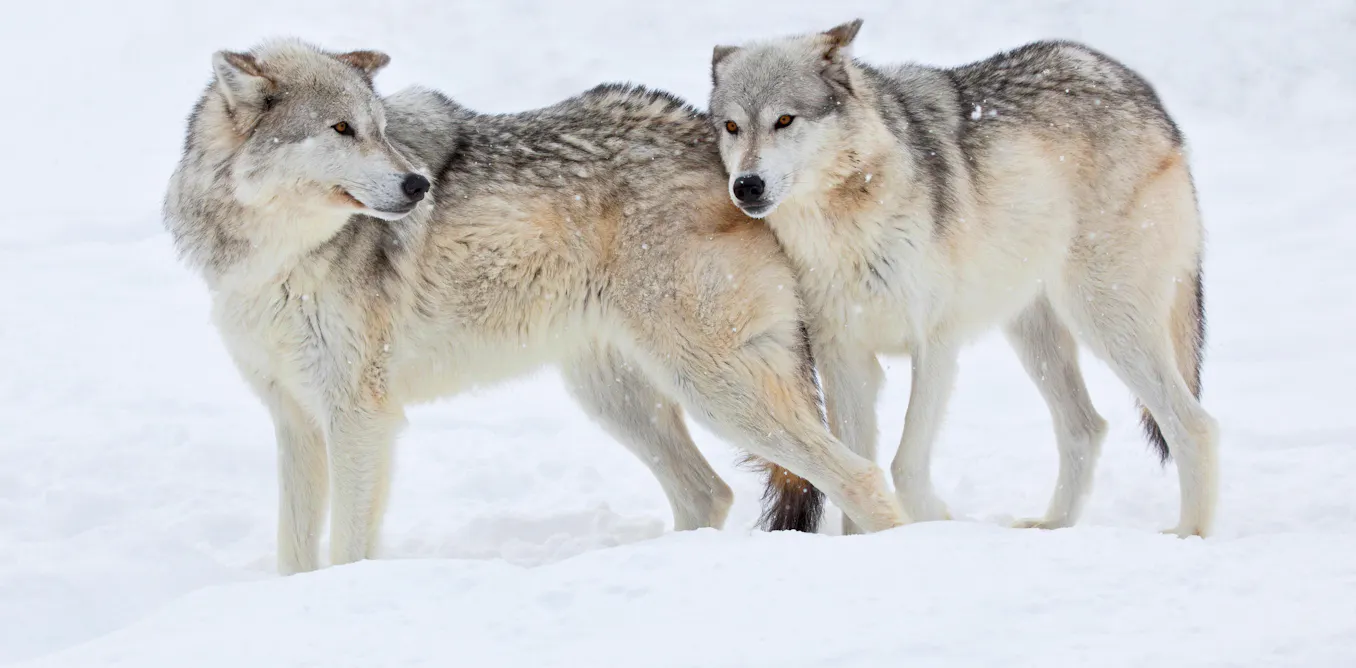
Wisanu Boonrawd / Alamy
Wolves did not, by and large, restore Yellowstone. Understanding the science behind this fact can teach us a lot about how ecosystems work. Even more interestingly, reflecting on why so many people are keen to believe this story can tell us a lot about ourselves, and our relationship with nature.
Why wolves did not save Yellowstone
The story originated with scientific studies in the early 2000s, built on a theory known as “trophic cascades”: the idea that changes at the top of the food chain can waterfall down to its very bottom. For example, wolf eats elk eats willow: so, more wolves equals fewer elk equals more and taller willows.
This idea was later popularised far beyond the scientific literature, notably by British rewilding advocate George Monbiot, whose 2013 Ted Talk was used to voice-over the viral Yellowstone wolves video.
But with a further two decades of data to draw on, scientists have found that this linear chain of causes and effects is an oversimplification of ecology. Wolves eat elk, yes, but so do humans and bears and mountain lions.

Seth Royal Kroft / Media Drum World / Alamy
Reductions in elk populations, caused by this varied suite of carnivores, did allow some degree of tree recovery in some parts of the national park. But that recovery has been exaggerated and falls far short of the landscape-wide reversal (from elk-dominated grasslands to willows and beaver ponds) that is often portrayed in popular accounts.
The park’s lead wolf biologist, quoted in the New York Times, described the reality as more of a “trophic trickle” than a cascade.
Another reason why wolves did not radically transform Yellowstone is that elk aren’t so scared of wolves after all. This might sound odd – who’s ever heard of prey that’s not scared of its predators? Actually, it’s feeding that takes priority in elk behaviour: hungry animals will seek good grazing, predators or no predators.
Why we wanted to believe
For all its scientific shortcomings, the story satisfies some of our deepest beliefs and cravings.
First of all, the idea that nature is a balanced machine where the pieces fit precisely and interact like clockwork. Take a single cog away, and the machine falls apart: elk run rampant and the ecosystem collapses. Put the cog back and in the blink of an eye, things run smoothly as they used to.
But ecosystems aren’t machines: they are dynamic, ever-changing, and often unpredictable.
Second, and more perversely, the story satisfies the common belief that only humans can disrupt nature’s harmony, and that it’s only by leaving nature alone that the balance is restored.
For instance, in the viral video about wolves in Yellowstone, there is not a single image of a human being. The narration describes the wolves as having “turned up” and says “the number of beavers started to increase”. In fact, the wolves were flown in from Canada, and beavers had been deliberately released into the park’s surroundings. These human interventions are absent from the story the video tells.
In a way, this is a continuation of a much older view of wilderness as something untouched and unpeopled. This view of nature inspired the founding of many national parks, Yellowstone included – eventually displacing millions of people from landscapes that were later presented as pristine.
Third, the Yellowstone story satisfies the craving to conceive of nature as a healing power. It’s the ecological equivalent of “nature cure” stories in popular culture, in which damaged people recover by going on an outdoor journey. What the Yellowstone story portrays, if you like, is a nature-nature cure: in this case, it is not a person but a wilderness that is healed by nature.
Wolves can be worth saving regardless of whether they save Yellowstone. Personally, I think ecologists should learn to say, simply, that they love wolves – and that these objects of their love need serve no purpose beyond themselves.
Before turning to the humanities, I was trained as a conservation biologist. Many biologists, like my earlier self, tend to think of emotions as too soft to include in their publications by contrast with data (especially numerical data), which is seen as hard and indisputable.
Now, though, this seems upside down to me. We don’t need a theory of trophic cascades to justify loving wolves. It is love and sorrow that are solid and beyond dispute, not fickle arguments about the balance of nature.
The post “Wolves did not save Yellowstone – why were we so desperate to believe they did?” by Rogelio Luque-Lora, Leverhulme Early Career Fellow, Centre for Sustainable Forests and Landscapes, University of Edinburgh was published on 09/29/2026 by theconversation.com