

This piece contains spoilers.
“I’ve always thought that sincerity was overrated,” says Canadian actor and comedian Nathan Fielder in an episode of his TV series The Rehearsal. “It just ends up punishing those of us who can’t perform it very well.”
Fielder’s absurdist comedy/documentary, involving elaborately staged scenarios and ethically questionable social experiments, exposes how little we can know about where participants’ performances begin or end. His own performative awkwardness becomes a foil in these experiments, too.
In his feature-length “documentary” You Can See Everything, co-directed with Lance Oppenheim, Fielder stages a similar experiment with Theranos founder and convicted felon Elizabeth Holmes.
Holmes, a Stanford dropout and self-made billionaire, was just 19 when she founded Theranos. The company aimed to “democratise health care” by creating a portable machine that could perform hundreds of tests from a single finger-prick blood sample.
Theranos never delivered on its promises, and in 2022 Holmes was convicted of three counts of wire fraud and one count of conspiracy, and sentenced to 11 years in prison. She maintains her innocence.
The story has proved irresistibly fascinating, generating countless articles, a hit podcast, a bestselling book, a TV series starring Amanda Seyfried, and two documentaries.
An anthropological experiment
You Can See Everything is less a documentary than an anthropological investigation.
The three-hour film has two parts. In the first, we join Holmes and her partner, Silicon Valley tech bro Billy Evans, inside their rented Southern California beach house during her final 34 days before entering prison.
The camera set-up – one each in the bedroom, bathroom and kitchen – gives the sense that we’re “seeing everything” (including watching Evans shower, nude).
The film also quickly pulls back the curtain on the public image of the charismatic CEO.
The signature, unblinking, blue-eyed gaze and quiet confidence of Holmes are there. But we also encounter her as a new mother, including strikingly maternal and loving scenes of her rocking her newborn, Ivy, and teary, postpartum episodes.
A24
Throughout, Holmes remains steadfast – and convincingly guileless – about her innocence and her honesty. “I’m always being real,” she tells Fielder. “I was just trying to communicate the best I could,” she says when grilled on her claims about Theranos.
Confronted with multiple and conflicting versions of Holmes, we watch as Fielder, with increasing desperation, attempts to close the gap between what he sees, what she says and her various public images.
The persistent questions, for the viewer, are: is Holmes sincere, or merely performing sincerity? Are we witnessing the tactics that fuelled Theranos’ initial success?
The second act
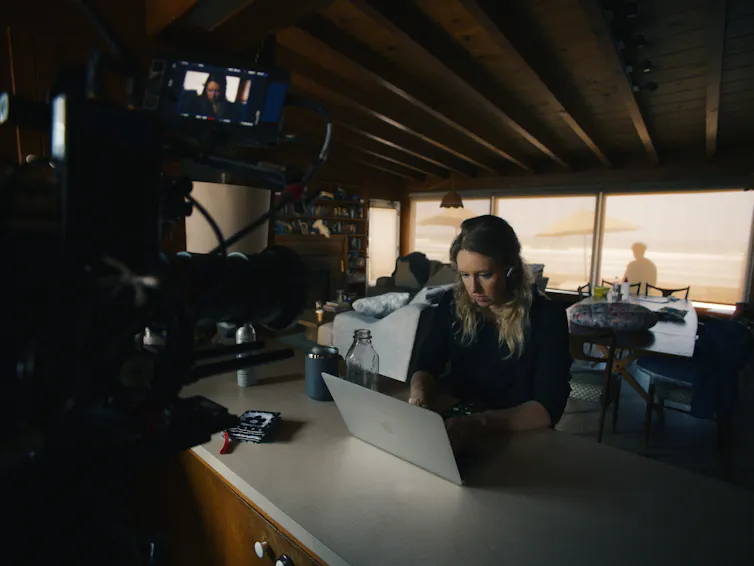
The second part of the film is set in 2025. Holmes is serving her sentence in a minimum-security federal prison in Texas, and largely unavailable to the filmmakers. In her absence, Fielder hires an actor to stand in for her in re-enactments of their conversations.
These scenes play out like an extended therapy session or debrief with a trusted friend, as the two try to parse Holmes’ behaviour and deduce her motivations.
The layers of performance at play in this second act dissolve any clear boundaries between actuality and fiction.
Fielder, an avid student of human behaviour, performance and perception within the documentary format, may have met his foil: a master of deception.
A24
An odd couple
You Can See Everything marks Holmes’ first time talking to the press since 2016. We learn in the film that it was her and Evans’ idea to pitch the documentary to the production company A24. Fielder only became attached to the project later.
Fielder has questioned Holmes’ decision to allow someone like him into her private milieu for her final 34 days of freedom: “I’m not the most, like, comforting.”
A case in point: the final afternoon before Holmes enters prison. Sitting with her and Evans in the backyard of their new Texas rental, Fielder, in his trademark deadpan manner, asks the couple if they want some privacy so they can have sex for the last time. The camera cuts to Fielder in his car, music blasting, sunnies on and the windows up.
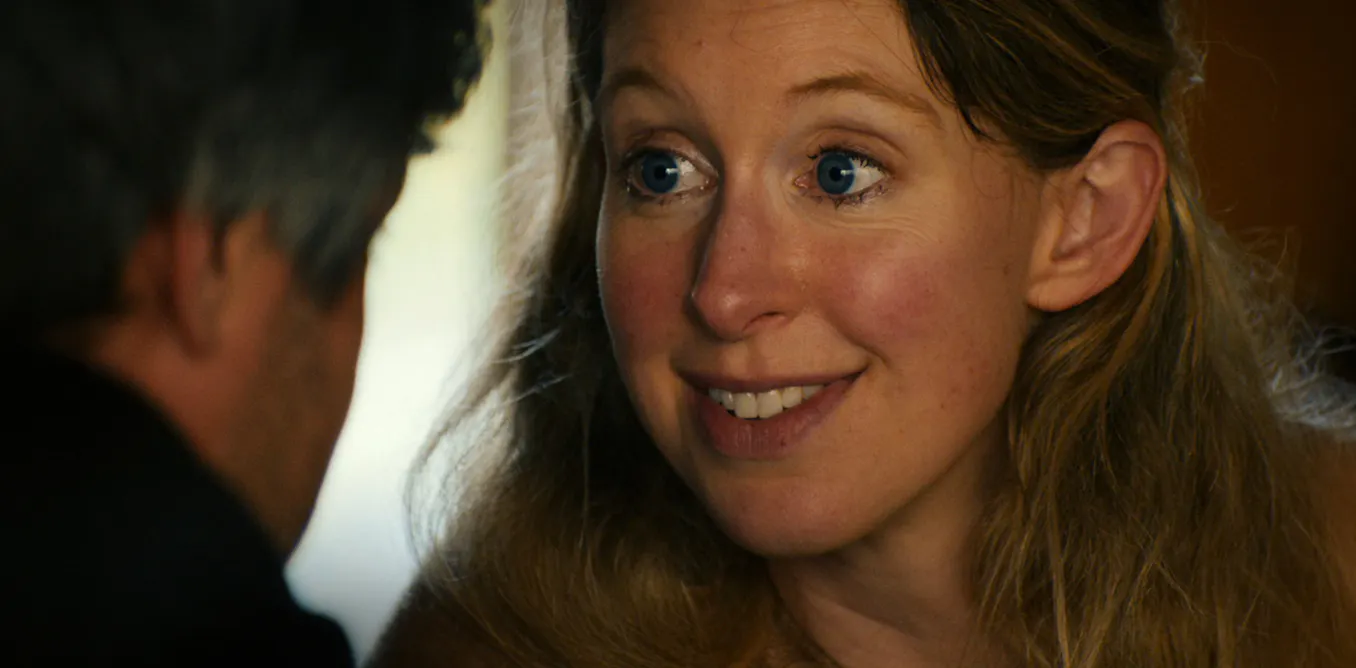
Stylistically, the film leans heavily on close-up zooms on the subjects’ faces, generating an uncomfortable intimacy for the viewer.
No matter how close we get to Holmes’ face, however, it remains inscrutable.
This is only exacerbated by Fielder’s incessant questioning of her motives and words, highlighting the real limits of knowing another’s interior world.
A house of mirrors
Evans emerges as a main character in the film’s second half, as his controlling and domineering behaviour takes centre stage. We learn that he has power of attorney for Holmes and posts on her X account without her knowledge.
These revelations unfold when Holmes is behind bars and out of contact. Whether she has consented to Evans’ behaviour is up for grabs.
At a certain point in the narrative, it feels like being trapped in funfair maze of distorting mirrors. You start to wonder if this film, and its audience, are just pawns in a masterful game of manipulation being played by Holmes and Evans.
As in a house of mirrors, seeing more doesn’t necessarily bring greater understanding. You probably won’t leave the cinema with a clearer picture of Holmes, but rather, dazed and confused.
You Can See Everything is in cinemas from November 12.
The post “Can you see everything? Nathan Fielder and Elizabeth Holmes face off in You Can See Everything” by Audrey Mitchell, PhD Candidate and Sessional Tutor/Lecturer in Film Studies, University of Sydney was published on 11/10/2026 by theconversation.com