

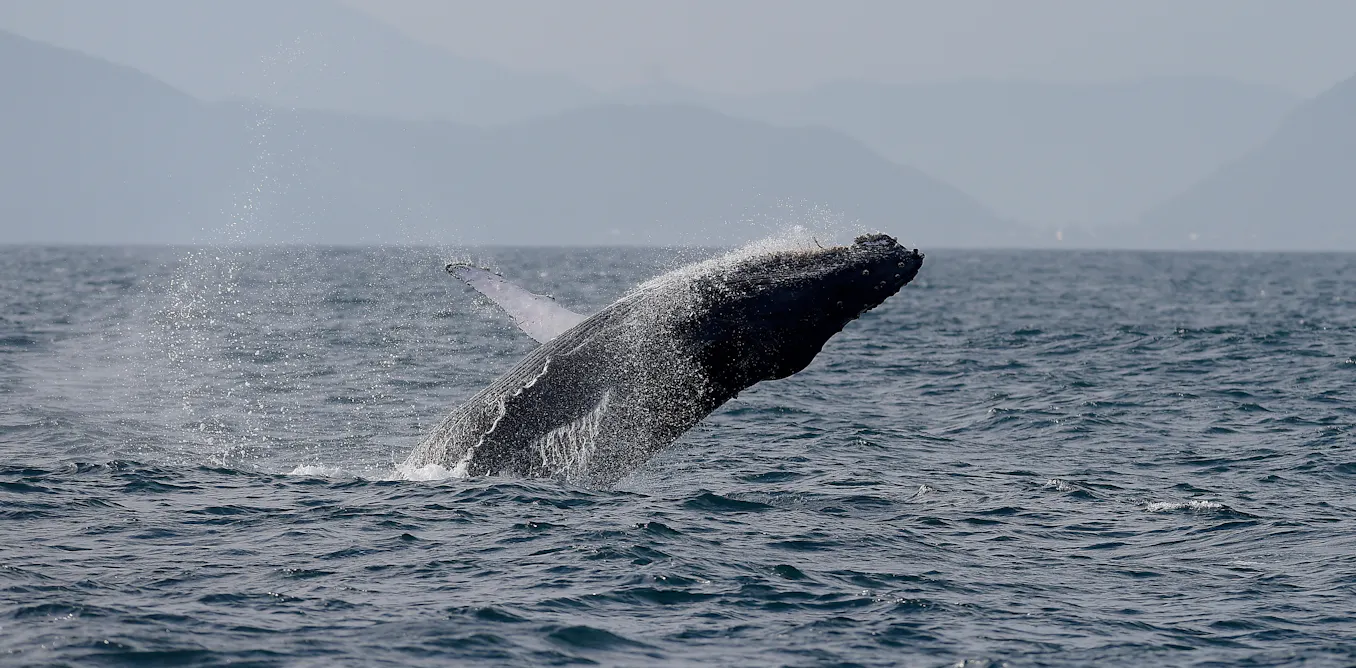
Sighting a humpback whale from a boat can be awe-inspiring. For some BC Ferries passengers, that experience became disturbing when their ferry struck and fatally injured a humpback whale on Oct. 18.
The whale was later identified as BCX1700, nicknamed Notcho. Notcho’s death, and the ceremony Sḵwx̱wú7mesh Úxwumixw (Squamish Nation) held to honour him, made national news.
Coverage of Notcho’s death may illicit feelings of anger, sadness or despair. These are forms of what is called ecological grief: the emotional response caused by experiencing or learning about environmental destruction, species extinction, biodiversity loss and climate change.
Effective ways to cope with ecological grief depend on the situation and the person. A common suggestion for people feeling ecological grief is to take action.
In Notcho’s case, the Marine Education and Research Society provided practical solutions for preventing future ship strikes based on the details of his death.
Online responses from members of the public to the Sḵwx̱wú7mesh Úxwumixw ceremony show that mourning practices can also be helpful for coping.
Notcho’s story
North Pacific humpback whales are a conservation success story in many ways. Their populations have been recovering since they were legally protected from commercial whaling in 1966.
Unfortunately, as their numbers in the Salish Sea increase, so does the risk of ship strikes. The same behaviour that allows people to enjoy them — spending time at the surface feeding or resting — also puts them at risk of collisions with boats.
Fatal ship strikes of whales are not unusual, and there are specific reasons Notcho’s death became a national news story: his fatal injury was preventable, traumatic and witnessed up close by several people. He had a name and had been known in the area for almost 10 years. Sḵwx̱wú7mesh Úxwumixw recognized Notcho as a relative and honoured him accordingly.
THE CANADIAN PRESS/Darryl Dyck
Ecological grief is normal and healthy
Ecological grief can be experienced in relation to many types of ecological losses, such as individual animals like Notcho, cherished trees like the Golden Spruce or entire species and ecosystems, to name just a few.
It can also be felt in response to the impacts of climate change. Researchers, and the public more broadly, increasingly understand ecological grief as a healthy and valid emotional response.
As with any form of grief, mourning is a beneficial, and even necessary, process for coping with emotions. Ecological grief itself has been well-studied and described, but effective ways of coping with it, and of mourning ecological losses, are not as well understood.
Coping with ecological losses
I have spent my career working in conservation biology, and this is not my first brush with ecological grief. It’s an unfortunate occupational hazard. I recently returned to academia to investigate strategies for coping with it.
Through my preliminary research, I have been exploring three forms of coping: action-focused (or problem-solving), emotion-focused and meaning-focused.
When I heard the news about Notcho and went online for more information, I noticed evidence of all three in public reactions to a post made by Sḵwx̱wú7mesh Úxwumixw on their Facebook page about an honouring ceremony for Notcho.
On Facebook, members of the public expressed action-focused reactions when they conveyed frustration about ferry speed limits in the area and called for changes. Some people wanted to know if his body would be returned to the ocean to provide nourishment to the marine ecosystem as a form of ecological restoration action.
People also used words and emojis to express sorrow, heartbreak and love, which can be a form of emotion-focused coping.
Meaning-focused coping may take the form of developing mourning practices. For Sḵwx̱wú7mesh Úxwumixw, mourning Notcho meant bringing him to their territory so “(we) could care for his remains in accordance with our laws,” and honouring him with a sacred ceremony. Many online responses expressed gratitude for the ceremony.

THE CANADIAN PRESS/Darryl Dyck
Making meaning through mourning
The need for specific mourning practices, like ceremonies or rituals, to mourn ecological losses was identified more than 30 years ago by Phyllis Windle, an ecologist and hospital chaplain. When it comes to ecological grief, some people may lack spiritual traditions to support them.
Meaningful rituals can be difficult to create in a secularized society, and without precedent or cultural guidance, people may not know how to make meaning from these losses.
Facebook users responding to the honouring ceremony of Sḵwx̱wú7mesh Úxwumixw demonstrated their desire for meaning-making through mourning practices in a variety of ways, from thanking everyone caring for Notcho’s journey, to expressing gratitude for learning about the honouring ceremony, to creating their own mourning practices.
While some people find Indigenous beliefs and ceremonial practices inspiring, non-Indigenous people need to create practices rooted in their own beliefs and values.
As a non-Indigenous person from Ontario, I do not claim any connection to Notcho or the waters he lived in, apart from a brief, magical encounter with a pod of breaching humpbacks in northern British Columbia a decade ago. Nonetheless, I cried when I heard how Notcho died and as I read people’s responses.
I wondered whether the ferry passengers who witnessed his fatal injury experienced a form of secondary trauma and how they will cope. I also think about the conservation organizations and volunteers who love these whales and give their time to advocate for them. Do they have the practices and supports they need to mourn when they lose a whale they know?
As an outsider, it may not be my place to create my own ritual for Notcho. What I have found is that telling a part of his story, with gratitude to those who knew him, has become my small way of making meaning from his death.
Perhaps that is where many of us can begin when we experience ecological grief: we can let ourselves feel both love and sorrow for whales and other non-human parts of nature. And we can respectfully create ways of marking these losses that reflect our own values. Ecological grief is a sign of how much we care.
The post “Mourning Notcho: What one whale’s death teaches us about ecological grief” by Corina Brdar, PhD Student, Interdisciplinary Social Research, Trent University was published on 11/15/2026 by theconversation.com