

After centuries of whaling, humpback whales of the southern hemisphere were close to extinction. As few as 5,000 animals were left in the oceans. But after efforts to end whaling culminated in a 1985 moratorium, the whales began one of the biggest comebacks in conservation. Around 50,000 humpback whales now migrate along the eastern Australian coastline.
For decades, scientists associated with the Humpback Whale Sentinel Programme have monitored southern hemisphere humpback whales during the winter as they migrate from Antarctica to their tropical breeding grounds. This programme uses humpback whales as a sentinel species to track broader changes in the Antarctic sea-ice ecosystem. Humpback whales rely heavily on krill, and krill in turn rely on sea ice. If there’s a change in whale behaviour, health or reproduction, it signals a change in the supporting ecosystem.
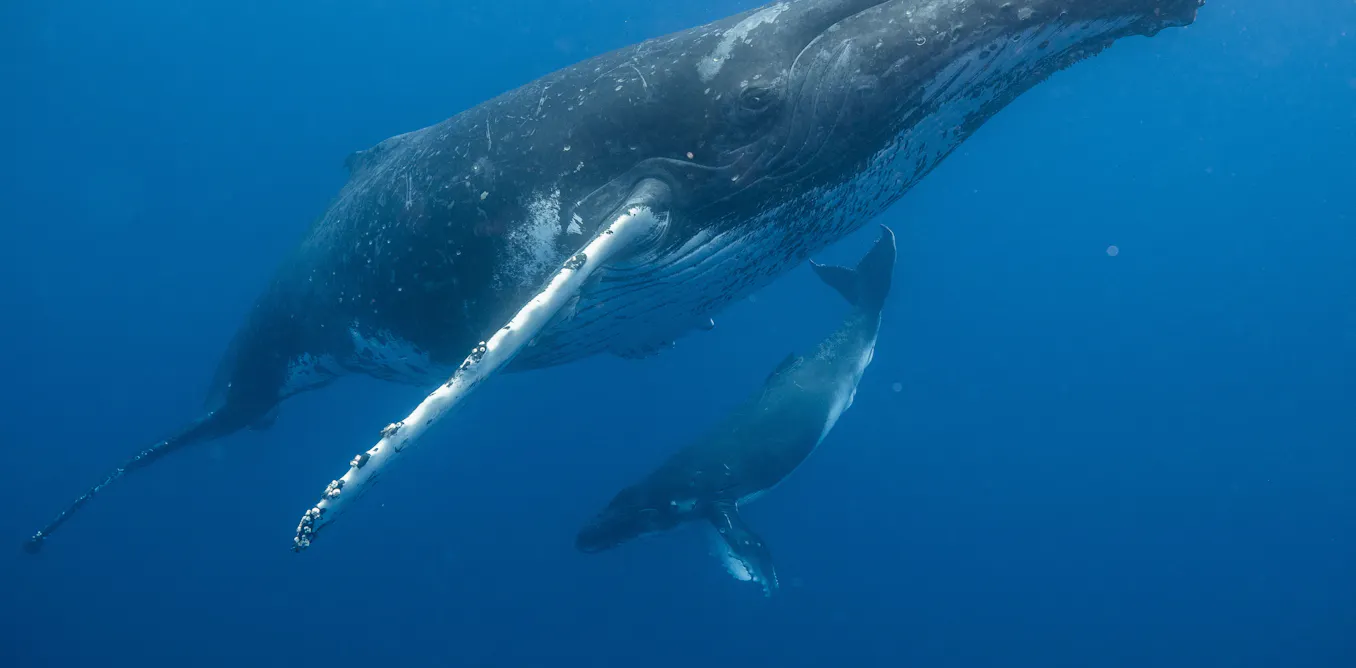
This winter, the migration was missing something vital – its calves. Data from the Cetacean Research Centre reports a massive drop in calving during the northern migration off Western Australia’s Ningaloo coast. The number of calves sighted each day fell from a 12-year average of ten calves to less than two during the recent 2026 winter season.
As the season progressed, reports came in from Ecuador, where low calf numbers coincided with unusually warm ocean conditions, while Brazil reported low calf numbers and an increase in strandings of young whales. In Reunion Island, only one calf was sighted. New Caledonia reported both low calf numbers and known returning whales. In Queensland’s Moreton Bay, calf numbers were down 90% from 2025.
These reports come almost a decade after Antarctica’s sea ice suddenly shifted to a low ice regime, suggesting climate-driven ecosystem impacts.
Read more:
Unlike anything I’ve seen: why this whale season has marine scientists puzzled
Humpback whales as sentinels
Humpback whales in the southern hemisphere usually don’t eat during their months-long migration to warmer waters to breed. They rely on their fat supplies accumulated over the Antarctic summer, when they feed on large swarms of krill. These tiny crustaceans depend heavily on sea-ice. Larval krill hide under sea ice during the harsh winters, eating algae associated microbes under the ice and avoiding predators. As the oceans warm and more sea ice melts, concerns have been raised for the species and their many consumers.
Satellites let scientists track sea-ice extent. But it’s much harder to get data on what sea-ice loss means for the ecosystem. This is why krill are so important, as these make up a large part of the diet of many Antarctic creatures, including humpback whales.
The Humpback Whale Sentinel Programme uses the whales to understand changes taking place in the Antarctic sea-ice ecosystem. Every year, we survey and take biopsies from healthy free-swimming whales from five distinct humpback populations, each of whom feeds in a different sector of Antarctica.
Tissue samples are analysed at Griffith University’s Antarctic Sentinel Laboratory where where we determine the population’s health based on individual fat stores (healthy whales have lots of fat stored), diet (are they eating krill or changing their diet?) and reproductive potential (who is pregnant, migrating and surviving?).
Results from the program have uncovered hidden changes happening in Antarctica, such as the beginning of a long-term shift to low sea ice levels around Antarctica following record-breaking sea ice lows in 2017.
So where are the calves?
Reproduction in female humpback whales depends on the success of the summer feeding season. If females accumulate enough energy reserves, they can sustain a new pregnancy. Adult males are thought to migrate for breeding opportunities regardless of their body condition. But the energy cost of reproduction is borne primarily by females, and pregnancy and lactation use lots of energy.
Pregnant females migrate to warmer waters to give their calves a better chance of surviving and growing to adulthood. Females without enough energy reserves to sustain a new pregnancy may shorten or even forgo migration.
In a typical year, the number of whales migrating past Reunion Island in the Indian Ocean and along southeast Queensland coastlines peaks during the northbound (heading to the breeding grounds) and southbound (returning to Antarctica) legs. This year, these peaks were missing. This could suggest the whales turned back earlier.
While we don’t know whether female humpback whales shortened their migration or avoided it altogether, we do know their presence is an important indicator of a successful summer foraging season. This is why scientists monitor the sex ratio of migrating humpback whales as an indicator of fecundity. Female participation in the migration is a good indicator of breeding opportunity and therefore calf numbers the following year.
While males are known to outnumber females during the peak migration, 2025 indications from Queensland were concerning with males outnumbering females by more than ten to one. That’s compared to the preceding 17-year average of 2.7 to one. The far fewer females that had accumulated enough energy reserves to migrate and breed in 2025 correspond with the low Queensland calf numbers observed in 2026.
When noise becomes a signal
The 2026 downturn in breeding success of southern hemisphere humpback whales coincides with reports that hundreds of southern right whale calves have stranded and died this year in Argentina, suggesting wider impacts. South African researchers have also found this species is having fewer calves.
The Commission for the Conservation of Antarctic Marine Living Resources has just held its annual meetings in Hobart, which included discussions on extending existing Southern Ocean protections.
Our findings of a downturn in successful humpback breeding is a warning. While this species has had a sustained recovery from whaling, they may be facing a bigger threat in the form of irreversible, climate-driven ecosystem change.
The Humpback Whale Sentinel Program is a consortium of scientists. We acknowledge the equal contribution and authorship of Dr Milton Marcondes, Dr Cristina Castro, Dr Solenne Deville, Dr Violaine Dulau, Dr Raphael Mayaud, Dr Alexandre Bernier-Graveline, Stephanie Stack, Isabella Reeves, Dr Jenny Allen, Carla Patulny and Cathrine Atkin.
The post “This year’s humpback whale migration was missing something vital – the calves and their mothers” by Susan Bengtson Nash, Professor, Planetary Health, Griffith University was published on 11/18/2026 by theconversation.com