

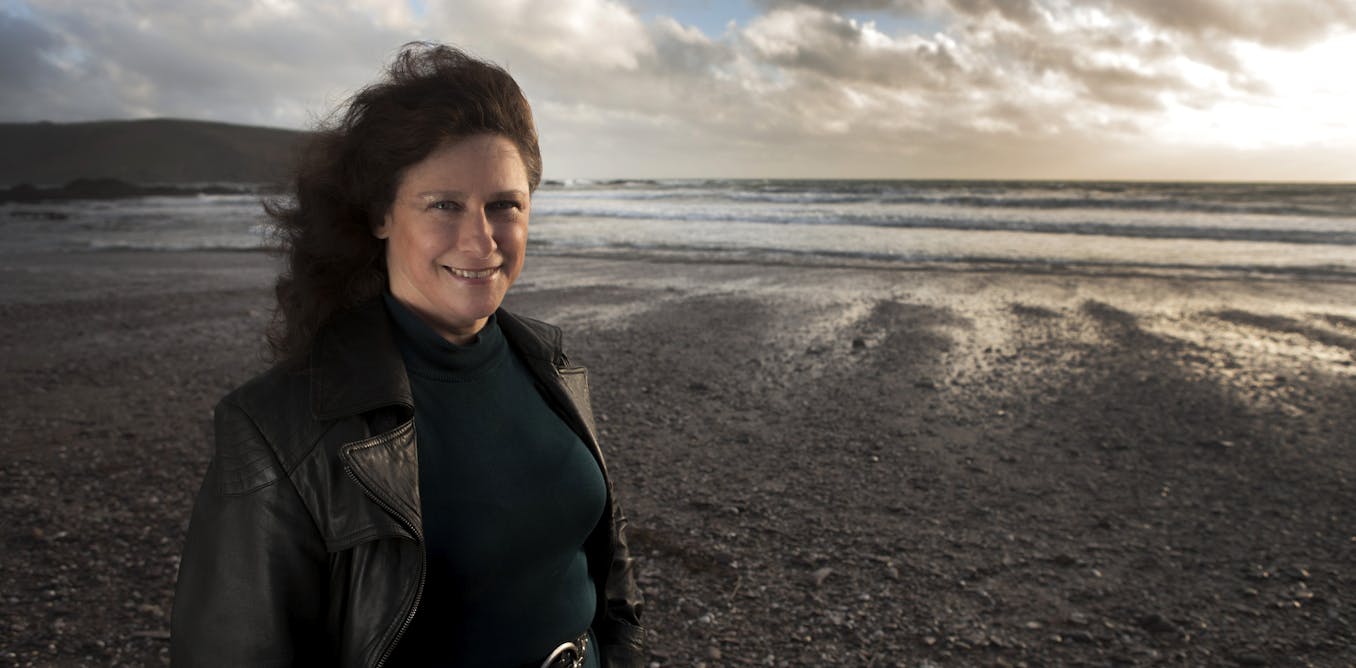
She is an ecologist recognized worldwide for being the first to unequivocally demonstrate the impact of climate change on a wild species: the Edith’s checkerspot butterfly. In recent years, however, Camille Parmesan has been interviewed not only for her expertise on the future of biodiversity in a warming world or for her share in the Nobel Prize awarded to the IPCC, but for her status as a refugee scientist.
Twice in her life, she has chosen to move to another country in order to continue working under political conditions that support research on climate change. She left Trump’s America in 2016, and later post-Brexit Britain. She now lives in Moulis in the Ariège region of southwestern France, where she heads the CNRS’s Theoretical and Experimental Ecology Station.
Speaking with her offers deeper insight into how to protect biodiversity – whose responses to climate change continue to surprise scientists – what to do about species that are increasingly hybridizing, and how to pursue research on a planet that is becoming ever more climate-skeptical.
The Conversation: Your early work on the habitats of the Edith’s checkerspot butterfly quickly brought you international recognition. In practical terms, how did you demonstrate that a butterfly can be affected by climate change? What tools did you use?
Camille Parmesan: A pickup truck, a tent, and a butterfly net, good strong reading glasses to search for very tiny eggs and caterpillar damage to leaves, a notebook and a pencil to write notes in! In the field, you don’t need more than that. But before doing my fieldwork, I had spent a year going around museums all across the USA, a couple in Canada, and even in London and Paris collecting all the records for Edith’s checkerspot. I was looking for really precise location information like ‘it was at this spot, one mile down Parsons Road, on June the 19th, 1952’, because this species lives in tiny populations and is sedentary. That process alone took about a year, since at the time there were no digitized records and I had to look at pinned specimens and write their collecting information down by hand.
Singer & Parmesan, Fourni par l’auteur

Singer & Parmesan, Fourni par l’auteur
Once in the field, my work consisted of visiting each of these sites during the butterfly’s flight season. Since the season lasts only about a month, you have to estimate when they will be flying in each location in order to run a proper census. For this, you start by looking for adults. If you do not see adults, you do not stop there. You look for eggs, evidence of web, like bits of silks, damage from the overwintering larvae starting to feed…
You also look at the habitat: does it have a good quantity of healthy host plants? A good quantity of healthy nectar plants for adult food? If the habitat was not good, that location did not go into my study. Because I wanted to isolate the impact of climate change, from other factors like habitat degradation, pollution… At the larger sites, I often searched more than 900 plants before I felt like I had censused enough.
Today, when you go back to the fields you started monitoring decades ago, do you see things you were not able to see at the beginning of your work?
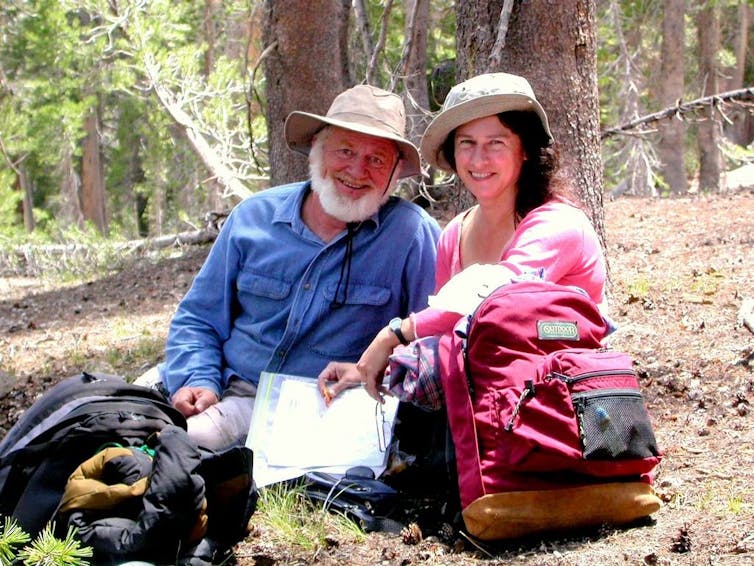
C. P.: I know to look for things I didn’t really look for when I started 40 years ago, or that my husband Michael [the biologist Michael Singer] didn’t look for when he started 50 years ago. For instance, we discovered that the height at which the eggs are laid is a bit higher now, and that turns out to be a really significant adaptation to climate change.
Author provided (no reuse)
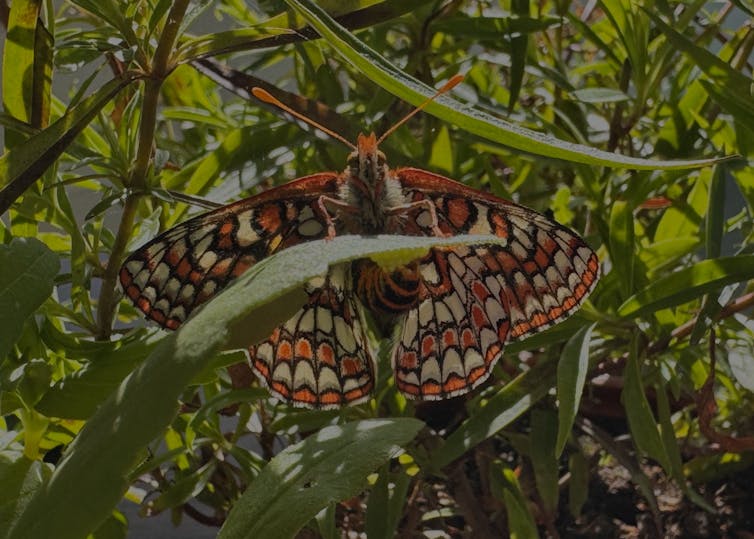
The eggs are being laid higher because the ground is getting far too hot. Last summer, we measured temperatures of 78°C (172.4°F) on the ground. So if a caterpillar falls, it dies. You can also see butterflies landing and immediately flying up, as it is way too hot for their feet and they’ll then fly onto vegetation or land on you.
In my early days, it wouldn’t have occurred to me that the height of where the eggs are laid could be important. That is why it is so important for biologists to simply watch their study organism, their habitat, to really pay attention. I see a lot of young biologists today who want to run in, grab a bunch of whatever their organism is, take it back to the lab, grind it up and do genetics or look at it in the lab. That’s fine, but if you don’t spend time watching your organism and its habitat, you can’t relate all your lab results back to what is actually happening in the wild.
Singer & Parmesan, Fourni par l’auteur
Thanks to your work and that of your colleagues, we now know that living organisms are greatly affected by climate change and that many species must shift their range in order to survive. But we also know that it can be difficult to predict where they will be able to persist in the future. So what can be done to protect them? Where should we be protecting lands for them?
C. P.: That is the big question plaguing conservation biologists. If you go to the conservation biology meetings, a lot of people are getting depression because they don’t know what to do. We actually need to change the way we think of conservation, away from strict protection toward something more like a good insurance portfolio. We don’t know the future, therefore we need to develop a very flexible plan, one that we can adjust as we observe what’s happening on the ground. In other words, don’t lock yourself into one plan, Start instead with an array of approaches, because you don’t know which one will work.
We just published a paper on adapting, for land conservation, some decision-making approaches that have been around since the 1960s in fields known to be unpredictable, like economics, for instance, or urban water policy, where you don’t know in advance if it is going to be a wet year or a dry year. So urban planners came up with these approaches for dealing with uncertainty.
With modern computers, you can simulate 1000 futures and ask: if we take this action, what is happening? And you see it is good in these futures, but bad in those, and not too bad in others. What you’re looking for is a set of actions that is what they call robust – that performs well across the largest number of futures. For conservation, we did so by starting with standard bioclimatic models. We had about 700 futures for 22 species. It turns out that if we just protect where these species occur today, most organisms don’t survive. Only 1 or 2% of the futures actually contain those species in the same place. But what if you protect where it is now, but also where it’s expected to be 30% of the time, 50% of the time, 70% and so on? You have these different thresholds. And from these different future possibilities, we can determine, for instance, that if we protect this location and that one, we can cover 50% of areas where the models predict the organism persists in the future. By doing that, you can see that some actions are actually pretty robust, and they include combinations of traditional conservation, plus protecting new areas outside of where the species are now. Protecting where it is now is usually a good thing, but it is often not enough.
Another thing to bear in mind is that bigger is better. We do still need to protect lands for sure, and the bigger the better, especially in high biodiversity areas. You still want to protect those places, because species will be moving out, but also moving in. The area might end up with a completely different set of species than it has today, yet still remain a biodiversity hotspot, perhaps because it has a lot of mountains and valleys, and a diversity of microclimates.
On a global scale, we need to have 30 to 50 percent of land and ocean as relatively natural habitat, without necessarily requiring strict protection.
Between these areas we also need corridors to allow organisms to move without being killed immediately. If you have a bunch of crop land, wheat fields for example, anything trying to move through them is likely to die. So you need to develop seminatural habitats winding through these areas. If you have a river going through, a really good way to do this is just have a big buffer zone on either side of the river so that organisms can move though. It doesn’t have to be a perfect habitat for any particular organism, it just has to not kill them. Another point to highlight is that the public often doesn’t realize their own backyards can serve as corridors. If you have a reasonably sized garden, leave part of it unmown, with weeds. The nettles and the bramble are actually important corridors for a lot of animals. This can be done also on the side of roads.
Some incentives could encourage this. For example, giving people tax breaks for leaving certain private areas undeveloped. There are just all kinds of ways of thinking about it once you shift your mindset. But for scientists, the important shift is to not put all your eggs in one basket. You cannot just protect where it is now, or just pick one spot where you think an organism is going because your favorite model says so, or the guy down the corridor from you uses this model. At the same time, you cannot save everywhere a species might be in the future, it would be too expensive and impractical. Instead, you need to develop a portfolio of sites that is as robust as possible, given financial constraints and available partnerships, to make sure we won’t completely lose this organism. Then, when we stabilize the climate and eventually bring it back down, it’s got the habitat to recolonize and become happy and healthy and whole again.
Another issue that is very much on the minds of those involved in biodiversity protection today is hybridization. How do you view this phenomenon, which is becoming increasingly common?
C. P.: Species are moving around in ways they haven’t done in many thousands of years. As they are moving around, they keep bumping into each other. For example, polar bears are forced out of their habitat because the sea ice is melting. It forces them to be in contact with brown bears, grizzly bears, and so they mate. Once in a while, it’s a fertile mating, and you get a hybrid.
Historically, conservation biologists did not want hybridization, they wanted to protect the differences between species, the distinct behavior, look, diet, genetics… They wanted to preserve that diversity. Also, hybrids usually don’t do as well as the original two species, you get this depression of their fitness. So people tried to keep species separate, and were sometimes motivated to kill the hybrids to do so.
But climate change is challenging all of that. The species are running into each other all the time, so it is a losing battle. Also, we need to rethink how we approach biodiversity. Historically, conserving biodiversity meant protecting every species, and variety. But I believe we need to think more broadly: the goal should be to conserve a wide variety of genes.
Because when a population has strong genetic variation, it can evolve and adapt to an incredibly rapidly changing environment. If we fight hybridization, we may actually reduce the ability of species to evolve with climate change. To maintain high diversity after climate change – if that day ever comes – we need to retain as many genes as possible, in whatever form they exist. That may mean losing what we perceive as being a unique species, but if those genes are still there, it can revolve fairly rapidly, and that’s what we’ve seen with polar bears and grizzly bears.
In past warm periods, these species came into contact and hybridized. In the fossil record, polar bears disappear during certain periods, which suggests there were very few of them at the time. But then, when it got cold again, polar bears reappeared much faster than you’d expect if they were evolving from nothing. They likely evolved from genes that persisted in grizzly bears. We have evidence that this works and it is incredibly important.
Something that can be hard for non-scientists to understand is that, on the one hand we see remarkable examples of adaptation and evolution in nature (for instance trees changing the chemistry of their leaves in response to herbivores, or butterflies changing colors with altitude… ) while, on the other hand, we are experiencing massive biodiversity loss worldwide. Biodiversity seems incredibly adaptable, but is still collapsing. These two realities are sometimes hard to connect. How would you explain this to a non-specialist?
C. P.: Part of the reason is that ongoing climate change is happening very quickly. Another reason is that species have a pretty fixed physiological niche that they can live in. It is what we call a climate space, a particular mix of rainfall, humidity and dryness. There is some variation, but when you get to the edge of that space, the organism dies. We don’t really know why that is such a hard boundary.
Singer & Parmesan, Fourni par l’auteur
When species face other types of changes like copper pollution, light and noise pollution, many of them have some genetic variation to adapt. That doesn’t mean these changes won’t harm them, but some species are able to adjust. For example, in urban environments today, we see house sparrows and pigeons that have managed to adapt.
So there are some things that humans are doing that species can adapt to, but not all. Facing climate change, most organisms don’t have existing genetic variation that would allow them to survive. The only thing that can bring in new variation to adapt to a new climate is either hybridizing – which will bring in new genes – or mutations, which is a very slow process. In 1-2 million years, today’s species would eventually evolve to deal with whatever climate we’re going into.
If you look back hundreds of thousands of years when you had the Pleistocene glaciations, when global temperatures changed by 10 to 12°C, what we saw is species moving. You didn’t see them staying in place and evolving.
Going back even further to the Eocene, the shifts were even bigger, with enormously higher CO2 and enormously warmer temperatures, species went extinct. As they can’t shift far enough, they die off. So that tells you that evolution to climate change is not something you expect on the time scale of a few 100 years. It’s on the time scale of hundreds of thousands to a couple of million years.
In one of your publications, you write: “Populations that appear to be at high risk from climate change may nonetheless resist extinction, making it worthwhile to continue to protect them, reduce other stressors and monitor for adaptive responses.” Can you give an example of this?
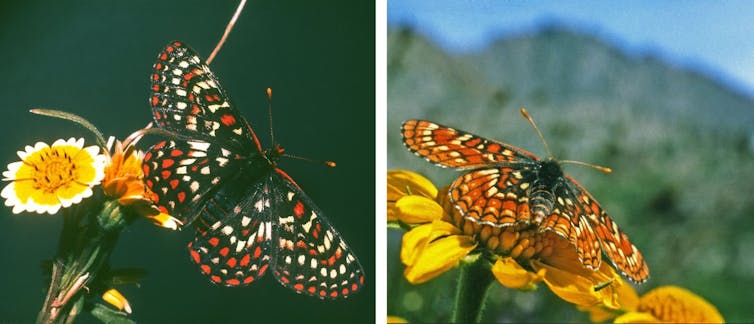
C. P.: Sure, let me talk about the Edith’s checkerspot, as that’s what I know the best. Edith’s checkerspot has several really distinctive subspecies that are genetically quite different from each other, with distinct behaviors, and host plants. One subspecies in southern California has been isolated long enough from the others that it is quite a genetic outlier. It’s called the Quino checkerspot.

Larry Gibert & Michael C Singer, Fourni par l’auteur
It is a subspecies at the southern part of the range, and it’s being really slammed by climate change. It already has lost a lot of populations due to warming and drying. Its tiny host plant just dries up too fast. It’s lost a lot due to urbanization too: San Diego and Los Angeles have just wiped out most of its habitat. So you might say, well, give up on it, right?
My husband and I were on the conservation habitat planning for the Quino Checkerspot in the early 2000s. By that time, about 70% of its population had gone extinct.
My husband and I argued that climate change is going to slam them if we only protected the areas where they currently existed, because they were low elevation sites. But we thought, what about protecting sites, such as at higher elevations, where they don’t exist now?
There were potential host plants at higher elevation. They were different species that looked completely different, but in other areas Edith’s checkerspot used similar species. We brought some low elevation butterflies to this new host plant, and the butterflies liked it. That showed us that no evolution was needed. It just needed the Quino checkerspot to get up that high, and it would eat this, it could survive.
Therefore, we needed to protect the area where they were at the time, for them to be able to migrate, as well as this novel, higher habitat.
That’s what was done. Luckily, the higher area was owned by US Forest Service and Native American tribal lands. These tribes were really happy to be part of a conservation plan.
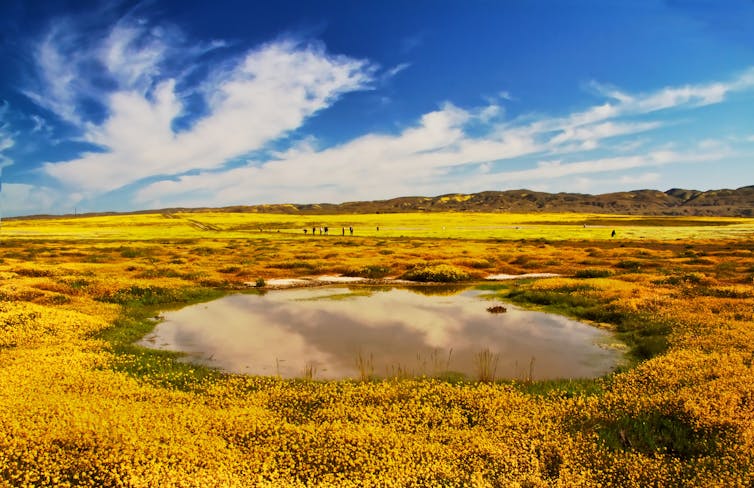
In the original area, a vernal pool was also restored. Vernal pools are little depressions in the grounds that are clay at the bottom. They fill up with water in the winter and entire ecosystems develop. Plants come up from seeds that were in the dry, baked dirt. You also get fairy shrimp and all kinds of little aquatic animals. The host plant of the Quino checkerspot pops out at the edge of the vernal pool. It is a very special habitat that dries up around April. By that time, the Quino checkerspot has gone through its whole life cycle, and it’s now asleep. All the seeds have dropped and are also dormant. The cycle then starts again the next November.
Mikaku/Flickr, CC BY
Sadly, San Diego’s been bulldozing all the vernal pools to create houses and condos. So in order to protect the Quino checkerspot, the Endangered fish and wildlife service restored a vernal pool on a small piece of land that had been full of trash and all-terrain vehicles. They carefully dug out a shallow depression, lined it with clay and planted vegetation to get it going. Among other things, they planted Plantago erecta, which Quino checkerspot lives off.
Within three years, this restored land had almost all of the endangered species it was designed for. Most of them had not been brought in. They just colonized this new pool, including Quino checkerspot.
After that, some Quino checkerspot were also found in the higher-environment habitat. I was blown away to be honest. We didn’t know this butterfly would be able to get up the mountain. I thought we’d have to pick up eggs and move them. The distances aren’t large (a few kilometers over, or 200 m upward), but remember that this butterfly doesn’t normally move much – it mostly stays where it was born.
Was there a wildlife corridor between these two areas?
C. P.: There were some houses, but they were very sparse, with lots of natural scrubby stuff in between. There weren’t really host plants for the Quino checkerspots. But it would allow them to fly through, have wild nectar plants on the way and not be killed. That’s the big point. A corridor doesn’t have to support a population. It just has to not kill it.
You too have had to relocate during your career in order to continue your research in ecology without being affected by the political climate. Over the past year in France, you have been asked to speak about this on numerous occasions and have been the subject of many articles describing you as a scientific refugee. In the United States, does this background also generate curiosity and media interest?
C. P.: A lot of colleagues, but also just people I know and have not necessarily collaborated with have asked me: How did you do that? How hard is it to get a visa? Do people speak English in France? But what’s interesting is the media in the USA has taken no interest. The media attention has been entirely outside of the USA, in Canada and Europe.
I don’t think Americans understand how much damage is being done to academia, education and research. I mean, even my own family doesn’t understand how much harm is being done. It’s difficult to explain to them because several of them are Trump supporters, but you would think the media would talk about that.
Most of the media have articles about damage to the university structure and damage to education, banning of books for instance, or the attempt to have an education system that only teaches what JD Vance wants people to learn. But you don’t really have a lot in those articles about people leaving. I think Americans can sometimes be very arrogant. They just presume America is the best and that no one would leave America to work somewhere else.
And it’s true that the USA traditionally has had such amazing opportunities, with so much funding from all kinds: many governmental agencies, funding many different projects, but also private donors, NGOs… All of this really literally stopped just cold.
In order to get people interested in biodiversity conservation and move them out of denial, it can be tempting to highlight certain topics, such as the impact on human health. This is a topic you have already worked on. Does it resonate more?
C. P.: I’ve always been interested in human health. I was going to be a medical researcher early on and I switched. But as soon as I started publishing the results that we were getting on the extent of species movements, the first thing I thought of was, ‘well diseases are going to be moving too’. So my lab’s work on human health focuses on how climate change is affecting where diseases, their vectors, and their reservoirs are spreading. One of my grad students documented the movement of leishmaniasis into Texas, going northward into Texas related to climate change.
In the IPCC we documented malaria, dengue and three other tropical diseases that have moved into Nepal, where they’ve never been before, at least in historical record, and that’s related to climate change, not to agricultural changes.
We also have new diseases emerging in the high Arctic. But not many people live in the high Arctic. It’s the Inuit communities that are being affected, so it gets downplayed by politicians. In Europe,the tiger mosquito is spreading into France, carrying its diseases with it.
Leishmaniasis is also already present in France, one species so far, but predictions suggest that four or five more species could arrive very soon. Tick-borne diseases are also increasing and moving north across Europe. So we are seeing the effect of climate change on human disease risk in Europe right now. People just aren’t aware of it.
You mentioned your family, some of whom are Trump supporters. Are you able to talk about your work with them?
C. P.: In my family, the only option is to not talk about it, and it’s agreed upon by everyone. It’s been that way for a long time about politics, even religion. We all love each other. We want to get along. We don’t want any divisions. So we kind of grow up knowing there are just certain topics you don’t talk about. Occasionally, climate change does come up and it gets difficult and it’s like, that’s why we don’t talk about it. So it’s not been possible to have an open conversation about it. I’m sorry about that, but I’m not going to lose my family. Nor, obviously, just push to convince them. I mean, if they want to know about it, they know where to come.
But I’ve also experienced working with people who have very different beliefs from mine. When I was still in Texas I worked with the National Evangelical Association. We both wanted to preserve biodiversity. They see it as God’s creation, I just think it’s just none of man’s business to destroy the Earth and I am an atheist, but that is fine. We did a series of videos together where I explained the effect of global warming. The result was wonderful.
This article is published as part of the 20th anniversary celebrations of the French Agence Nationale de la Recherche (ANR). Camille Parmesan is a winner of the “Make Our Planet Great Again” (MOPGA) program managed by the ANR on behalf of the French government. The ANR’s mission is to support and promote the development of fundamental and applied research in all disciplines, and to strengthen the dialogue between science and society.
The post “an interview with IPCC ecologist and ‘refugee scientist’ Camille Parmesan” by Camille Parmesan, Director, Theoretical and Experimental Ecology Station (SETE), Centre national de la recherche scientifique (CNRS); University of Plymouth; The University of Texas at Austin was published on 12/09/2025 by theconversation.com