

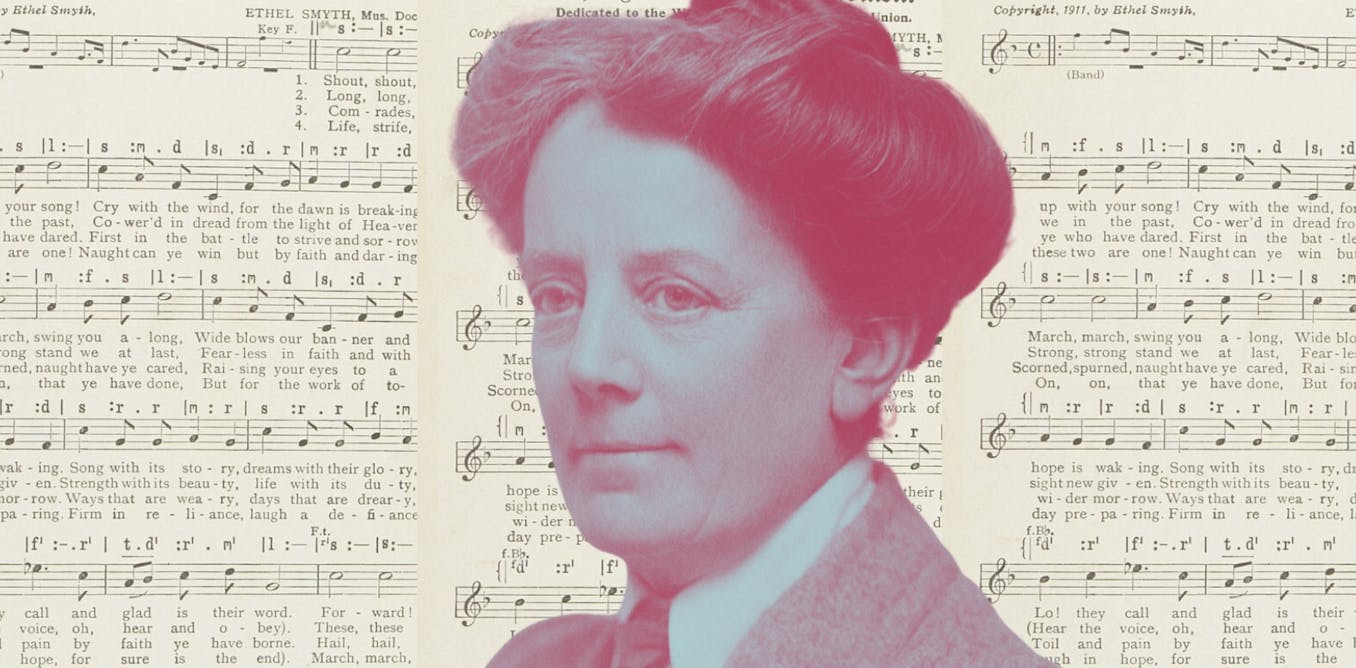
Like a voice from the grave, an important part of Surrey’s cultural heritage has sounded again. It is a short ceremonial brass fanfare by Dame Ethel Smyth (1858–1944).
Fanfares are short, rousing pieces for brass instruments. Late last year I was asked to find one to open the installation ceremony for the University of Surrey’s new vice chancellor, Professor Stephen Jarvis. As this was going to be a high-profile public event attended by hundreds of people in Guildford Cathedral, I knew I needed a unique piece of music.
Rather than commission a new work, I revived a forgotten piece instead: Smyth’s Hot Potatoes fanfare. I chose this composer because she had strong local ties and links to university research.
In 1930, eight of the most prominent British composers of the day were commissioned to write short fanfares for the Musicians’ Benevolent Fund. Each lasted about a minute.
The last of the set was written by Smyth. She based it on a military bugle call, formally titled the Men’s Meal (2nd call). The call signalled that the troops could collect their rations. It is colloquially known as Hot Potatoes. Soldiers added comic words to help remember its meaning: “Oh, pick ’em up, pick ’em up, hot potatoes …”
Three months ago, the university’s department of music and media presented a major orchestral concert for the annual nationwide Being Human Festival. Several of Smyth’s works received their modern UK premiere.
One year prior, the university installed a maquette of Smyth outside its main music performance space on campus. It is a smaller replica of the lifesize-plus statue unveiled in 2022 a few miles away in the centre of her home town, Woking. My research revealed it to be one of few statues to women composers in the world.
At the pinnacle of Smyth’s impressive musical output lies her six operas, several of which are available in modern recordings. Her other compositions include a Mass (a musical setting of the Christian liturgy), a concerto for violin and horn and a symphony-cum-oratorio. Smyth is widely known in Britain and internationally as one of the greatest women composers in classical music history. She was also an influential suffragette and a much-published author of autobiographical and other prose writings.
Yet little is known of her Hot Potatoes fanfare, possibly the last piece she ever wrote, other than its original instrumentation: four trumpets, four trombones and percussion. It is rarely even mentioned in literature on Smyth.
Composed when she was in her 70s, experiencing profound hearing difficulties and with the greatest achievements of her career behind her, its manuscript has long been lost and for many years it seems to have been generally assumed that it could never be performed again.
The piece would have held particular significance for Smyth. She was familiar with military fanfares from childhood, since her father had attained the rank of Major-General in the British Army. She quoted such bugle calls in her own music, Hot Potatoes having previously appeared in the overture to her final opera, Entente Cordiale, the centenary of the first performance of which fell last year.
While the use of Hot Potatoes is not explicitly identified in the opera’s published vocal score, an archival copy now held in the Beecham Collection at the University of Sheffield is annotated in Smyth’s own hand to indicate its origin.
Smyth’s fanfare from past to present
Smyth’s Hot Potatoes and the other fanfares in the set were first performed by students from the Royal Military School of Music (Kneller Hall Musicians) under Captain H.E. Adkins. The occasion was the Musicians’ Benevolent Fund Annual Dinner held in London’s Savoy Hotel on May 8 1930 (coincidentally the same date on which Smyth died 14 years later), from where the performance was relayed for broadcast on the BBC National Programme.
The fanfares were reprised at this annual event a couple more times, including on St Cecilia’s Day, November 22 1932. The previous June, it had also been recorded by the same ensemble for release by His Master’s Voice (HMV) toward the end of that year. But thereafter the trail runs cold.
However, the HMV recording of the fanfares yielded sufficient information for me to transcribe and arrange Smyth’s piece for students of the University of Surrey Brass Ensemble. I based this work on my wider knowledge of the composer’s output, which proved invaluable in identifying and replicating her musical idiosyncracies.
The idea came to me during research undertaken for my most recent journal article, which takes one of Smyth’s early piano pieces as a case study for exploring questions of performance and interpretation in the rediscovery of “lost” music by historically marginalised composers.
Author provided (no reuse)
Instead of a faithful transcription, I changed the scoring (though in a nod to the original, I retained four separate trumpet parts) as well as the key of the piece. I even recomposed one bar in its entirety.
Certain details were simply too difficult to make out on the recording, while others naturally lent themselves to being enhanced (and I was convinced that there was at least one wrong note). Nonetheless, this project demonstrates the creative possibilities for bringing back music assumed to be lost to history, and for celebrating diversity by resurrecting works by neglected artists.
Fittingly, since Professor Jarvis’s installation ceremony was an official university event, I conducted the Brass Ensemble from the Cathedral’s South Balcony while wearing my doctoral robes, as had been Smyth’s own practice when wielding the baton. I hope this recovery of Smyth’s Hot Potatoes fanfare will now lead to repeat performances.

Looking for something good? Cut through the noise with a carefully curated selection of the latest releases, live events and exhibitions, straight to your inbox every fortnight, on Fridays. Sign up here.
The post “How I brought a lost fanfare by Ethel Smyth back to life” by Christopher Wiley, Head of Music and Media; School of Arts, Humanities and Creative Industries, University of Surrey was published on 02/26/2026 by theconversation.com