

Teenagers’ bodies change fast. Bones grow, muscles develop, and balance is altered. Adolescence can be a time of high energy, but it is also a delicate period for movement control.
Many teenagers lose coordination as they grow. They trip easily or lose accuracy in tasks they once mastered, but this is a question of biology rather than clumsiness. Their bodies change faster than their brains can adapt.
Training the brain
This is where neuromuscular training comes into play. This type of exercise helps coordinate muscles efficiently, quickly and safely, as it refines the precision with which the brain tells them when and how much to activate.
In simple terms, it improves the way the brain interprets information from the environment, and how it reacts to it. When a person loses their balance, for instance, the nervous system detects a change and activates the correct muscles within milliseconds. A trained brain reacts sooner and avoids dangerous or unsteady movements.
Research has shown that, when performed properly and under supervision, neuromuscular exercises improve agility, balance, reaction speed and muscle coordination. They also increase joint stability and movement efficiency, which are both vital in preventing injuries and making the body perform well.
Read more:
Is weightlifting safe for kids and teens? Here’s what parents need to know
What does it consist of?
A neuromuscular programme combines strength, balance, coordination and agility exercises. Unlike other methods, its goal is not to lift more weight or do more reps, but to move better.
Here is a simple, example programme consisting of five exercises that do not require any equipment. With a total duration of 10-12 minutes, the idea is to devote 40 seconds of work and 20 seconds of rest to each exercise, 2 or 3 times a week:
1. Dynamic movement
The aim here is to activate the body and improve alignment before further exercise.
2. Stability and balance
- Balancing on one leg while touching points on the floor in front, behind, and to the sides. As a variation, touch points closer to the feet or turn the head to one side.
The aim here is to improve posture control, which tends to get worse during puberty.
3. Core and hip strength
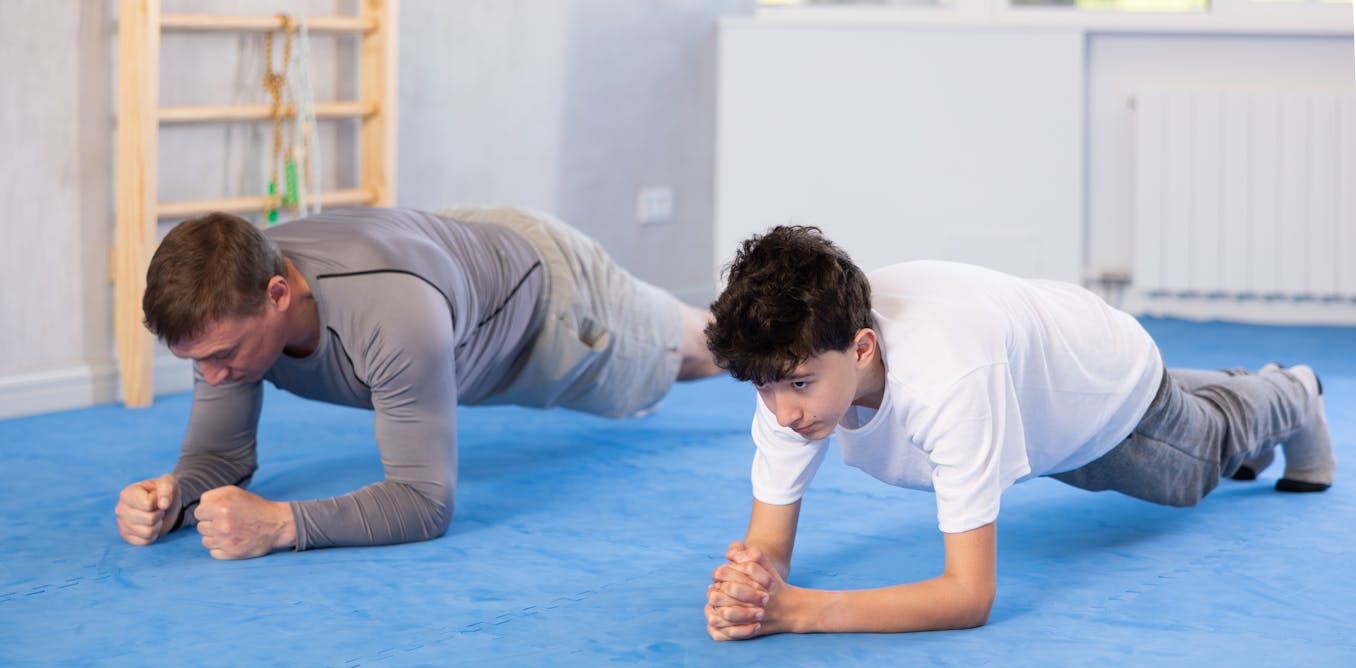
- Plank with alternating leg or arm lifts. It is important to keep the hips as still as possible while lifting arms and legs.
These exercises strengthen the muscles that stabilise the spine and legs.
4. Knee alignment and landing
- Gentle standing jumps with a focus on “soft landing”: knees forward, hips back and feet shoulder-width apart. The focus is on how you land, not the height of the jump.
This improves landing technique and reduces the risk of injury.
5. Agility
- Zigzag movements between cones (or another object if training indoors). Make a controlled stop before changing direction.
The aim here is to help the brain learn to stop, balance and reorient movement without losing control.
Motor-skill vulnerability
This type of exercise is especially important during adolescence, as puberty causes the body to grow irregularly: bones come first, followed by muscles and then nerve connections. This lack of synchronisation can affect balance, coordination and posture control, causing many adolescents to go through what is known as a period of “motor-skill vulnerability”.
Neuromuscular training can help to re-educate control of the body. In addition to teaching the brain to adapt to a body that is changing every few months, it also stimulates the maturation of the nervous system and improves response to external stimuli. It is not just vital for sport, but also for everyday life – walking, climbing stairs, reacting to a fall, and so on.
The value of neuromuscular training therefore goes beyond sport, and can influence teenagers’ physical and mental health. It improves posture, body awareness and confidence in movement, reduces the risk of knee, ankle or back injuries, and improves concentration and attention.
In an increasingly sedentary world, teaching young people to move with control and balance is effectively a form of physical literacy. Including this type of work in schools, youth programmes, or physical activity routines should not be a luxury reserved for athletes, but an essential part of healthy development.
A weekly e-mail in English featuring expertise from scholars and researchers. It provides an introduction to the diversity of research coming out of the continent and considers some of the key issues facing European countries. Get the newsletter!
The post “How neuromuscular training helps growing teens to retain their motor skills” by Elena Mainer Pardos, Profesora e Investigadora Universidad San Jorge. Ciencias de la Actividad Física y del Deporte., Universidad San Jorge was published on 12/10/2025 by theconversation.com