

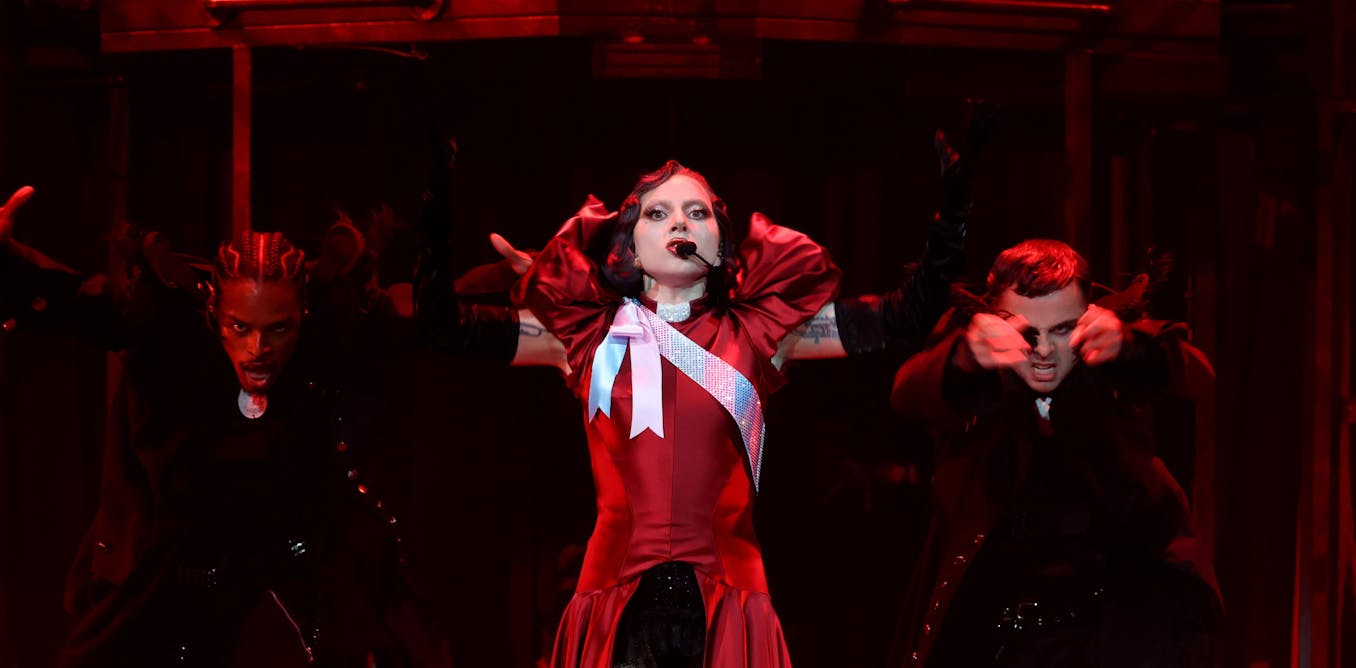
Lady Gaga has arrived in Australia for her long-awaited Mayhem Ball Tour – her first time performing here in more than ten years. Gaga is playing five shows across Melbourne, Brisbane and Sydney. Fans are beyond excited, with tens of thousands waiting in queues to buy tickets.
For a pop star whose legacy spans almost two decades, many are wondering how Gaga has remained so influential – and why Mayhem (2025), her seventh studio album, is so special to fans.
As someone who has written a book about Lady Gaga, my short answer is that Mayhem brings Gaga’s past into the present by reviving the gothic synth-pop aesthetic of her earlier albums.
More importantly, this reconnection with the past is a powerful rekindling of Gaga’s “born this way” message of self-love, pride, and the importance of community.
A return to darkness
The gothic synth-pop style is recognised for its catchy melodies coupled with heavy electronic beats, bass lines and synthesisers, as well as dark subject matter (lyrics and iconography that reference love, death and/or the occult, such as zombies, vampires, monsters and so on).
This style of music characterised Gaga’s early albums, The Fame Monster (2009), Born This Way (2011) and ARTPOP (2013). After almost a decade of exploring genres such as jazz (2014 album Cheek to Cheek) and soft-country rock (2016 album Joanne), Gaga returns to her synth-pop roots in Mayhem.
The album is littered with intertextual references to her early work. In Abracadabra, she emphasises the song’s title through her unique Gagarian style of gibberish, referencing themes of love (“amor”) and death (“morta”):
Abracadabra amor oo na-na, Abra coo-da-bra, morta oo Gaga.
The line takes us back to the iconic earworm opening of Bad Romance, a song that similarly comments on the dark sides of love: “rah rah ah-ah-ah, ro mah ro-mah-mah, ma-ma, Gaga oh la la, want your Bad Romance”.
Visually, Abracadabra revives a gothic colour palette of red, black and white – hues that are characteristic of the Born This Way era.
The song’s music video also showcases three key gothic-style fashion pieces emphasising these colours: a red, wide-brimmed latex hat covered in spikes; a white catsuit with a black cross across the front; and a trailing white lace cape with a dramatically high collar.
The outfits reflect Gaga’s roots in avant-garde fashion, and her ARTPOP era in particular.
The video is also notable for its high-angle, wide-camera shots used to capture the angular and sharp dance choreography performed by Gaga and her dancers. These scenes hark back to the dance scenes in the Born This Way music video.
Mayhem is also thematically and lyrically similar to Gaga’s early career-defining albums. In Don’t Call Tonight, the chorus includes lyric and melodic revivals of her hit track Alejandro from The Fame Monster.
Similarly, the Mayhem track Perfect Celebrity is a clear critique of fame and its dark sides – a topic explored extensively in both The Fame Monster and its predecessor The Fame (2008).
These are just some examples of the intertextuality underpinning Mayhem. These references are powerful because they bring Gaga’s past into the present, providing fans with a deeper connection to the new album and accompanying tour.
More importantly, they signal a creative homecoming – a full circle moment that solidifies Gaga as a star with a signature style and legacy. In a press conference conducted exclusively with fans, Gaga commented on the through line between Mayhem and her earlier work:
When I’m writing songs I have total visions […] And when I made this album, I had all [of] these gothic dreams but while I was awake […] Abracadabra is its own gothic dream, and it came to life in the video […] it comes out on tour, and it comes out in personal style […] That’s a through line to my earlier work […] gothic dreams, that was how I found Mayhem.
Facing your demons
In interviews with media, Gaga explains how Mayhem is about her own personal chaos and the challenges and self-doubt she’s experienced as a star. But it’s also a commentary on how she “feel[s] about the world”, and that “the world is a chaotic place”.
For Gaga, Mayhem is a way to memorialise the parts of her – and the parts of life – that are not easy to accept. She processes this chaos through the album, while also finding a way “to celebrate and dance through it”.
In 2016, Gaga published an open letter online explaining her personal struggles with post traumatic stress disorder (PTSD) and fibromyalgia, a debilitating chronic pain condition.
This openness from her is significant for fans, many of whom experience their own mental health challenges, or feel (or have felt) displaced from, or misunderstood, by mainstream society. Through Gaga, and each other, fans find connection and a sense of belonging.
Mayhem also reminds us of Gaga’s core message: love and accept yourself for who you are, and carry that identity with pride. These messages also resonate for me. As a proud Gamilaraay woman, I know how the loss of identity through violence results in feelings of displacement.
I also understand identity is not isolated and individual, but is deeply embedded in culture and relationships to community and Country. As Gaga herself said back in 2016:
returning to your family and where you came from, and your history – this is what makes you strong.
The post “Lady Gaga’s Mayhem tour marks a powerful return to the darkness that defined her” by Kat Nelligan, Lecturer in Music Industry, RMIT University was published on 12/09/2025 by theconversation.com