

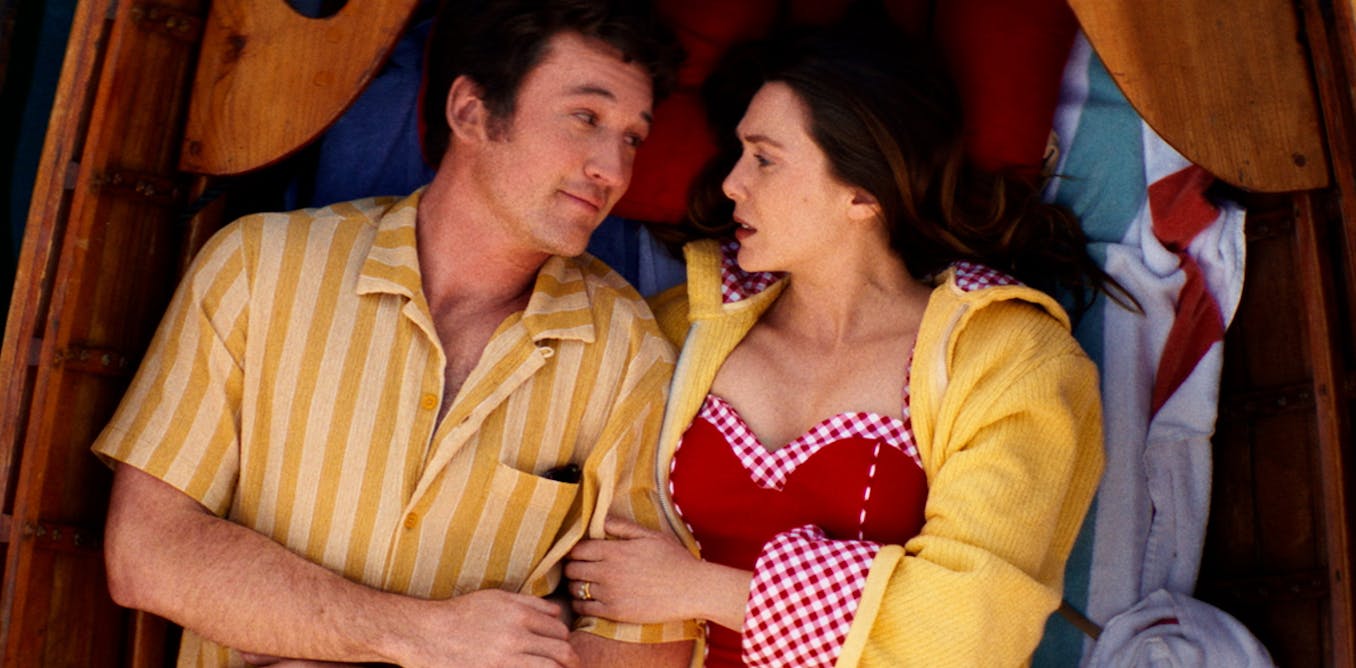
In the new rom-com Eternity, Joan (Elizabeth Olsen) faces an impossible choice: spend forever with the steady husband she’s loved for years, or reunite with the dreamy first husband she married back in her carefree youth.
In this afterlife, everyone gets one shot at choosing where – and with whom – they’ll spend eternity, guided (and occasionally harassed) by an overworked Afterlife Coordinator on a strict deadline. Once the decision is made, it’s final. A few souls try to wriggle out of their choice, but escapees are hunted down and flung into the void. Not a place where anyone wants to be.
Joan can pick the dependable but unglamorous Larry (Miles Teller) or her youthful love, Luke (Callum Turner) who died a war hero. Everyone in this post-life holding area is restored to the physical age when they were happiest. Troublingly for Larry, Joan is the age she was when she married Luke, and when she kissed him goodbye before his fateful posting overseas.
Read more:
Valentine’s Day: a brief history of the soulmate – and why it’s a limited concept
On the face of it, this choice of eternities doesn’t make much sense. So much of our human love is about mortal longings, rather than immortal longings. An eternity of me would be more than I would inflict upon anyone, let alone my wife Suzanne, a woman who really deserves better. Human love only makes sense in a transitory context, just as the beauty of cherry blossom would be lessened if we could freeze dry it and secure it permanently to the tree with Gorilla glue.
But Eternity is not truly about a love that could last forever. It is about the way that love, real ordinary love, involves more than happiness, and how love shapes our decisions in ways that seem to be involve recognition rather than choice. These are familiar philosophical themes which could become quite heavy, but Eternity handles them deftly, with an upbeat humour.
In the film, the afterlife is just as confusing as the regular world. God isn’t around to offer judgement. The decision about futures must be made quickly so that the system can cope without becoming overloaded. Trains are continually moving, bringing new arrivals to a massive hotel, before they depart permanently to their forever destination.
The trains do not travel on roads to freedom. Destinations offer only a themed existence. They include Paris World, with a fake rive gauche where a fake Jean-Paul Sartre and a fake Albert Camus argue passionately in a café about the finer points of existentialism before getting into a fist fight. Sure, it’s something that many philosophers would like to see – but not endlessly.
The story first appears to focus on an existentialist idea: in life, we are forced to make impossible choices without any final moral guidance. Even love, it seems, must give way to the harsh fact that our choices have no solid foundation.
And, like any good student of Sartre, Joan discovers that this is not a pleasant situation. The philosopher and political economist John Stuart Mill believed that the greatest happiness and the greatest freedom to choose must go together. Freedom to choose does not make us happy. It makes us anxious.
The turning point of the film comes when Joan starts to see that neither happiness nor choice really decides anything. Threatened with the prospect of her wandering off to Paris World, one of her husbands tries to decide for her by sacrificing his own happiness.
A husband trying to decide for his wife is, no doubt, a rare and dangerous sort of thing and it does not stick. What’s interesting about Eternity is that it doesn’t settle for this obvious “Judgment of Solomon” solution, where the man willing to sacrifice his own happiness is the one she should choose in the end.
A24
Yes, that does turn out to be part of the story. And yes, it does help her to recognise that maximising happiness is not the same as living a good and meaningful life – a life in which happiness has its place but only alongside other things. But the film also makes a deeper move. Joan risks being cast into the void when she realises that the whole business of choice has been shadow play. While she has the body of her younger self, she has the history of her older self. And that matters.
It matters because love is not a response to the unique characteristics of others: their physique, laughter or what philosophical discussions of love jokingly refer to as “the way they wear their hat and sip their tea”. Rather, love is the recognition of a shared history of caring for one another. A recognition of who, and what, counts as home.
Joan’s struggle is not a struggle to overcome a paralysing anxiety, to make her impossible choice and then march resolutely into the future. It is simply a struggle to go home.

Looking for something good? Cut through the noise with a carefully curated selection of the latest releases, live events and exhibitions, straight to your inbox every fortnight, on Fridays. Sign up here.
The post “this clever film proves romance isn’t about choosing ‘the one’ – a philosopher of love explains” by Tony Milligan, Teaching Associate in Philosophy, University of Sheffield was published on 12/10/2025 by theconversation.com