

Puerto Rican singer Bad Bunny (Benito Antonio Martínez Ocasio) made history this weekend as the first Superbowl halftime headliner to sing only in Spanish – that too at a moment when the United States is facing a hostile anti-immigration climate.
The show’s message of love and togetherness has reverberated across countries and cultures. It is also chock-full of symbolism and messaging that represents an alternative America to the one taking shape under Donald Trump.
Chris Torres/EPA
A fiesta celebrating Puerto Rican culture
The performance took place in a noticeably Puerto Rican setting. Fresh coconuts and piragua (snow cone) carts led the way to domino players and boxers (Puerto Rico is the world’s largest contributor of boxing champions per capita).
Bad Bunny opens with the viral hit Tití me preguntó (Tití asked me). He walks through a crew wearing costumes typical of Puerto Rican peasants, with traditional straw pava hats and string ropes for belts.
This sugarcane field set is a nod to an important aspect of Caribbean history, wherein sugarcane plantations represent a shared history of slavery. At the same time, they signify an immediate link to land, hard work, national identity, and Puerto Rico’s agricultural roots.
The nation’s sugarcane industry was aggressively changed under Operation Bootstrap, a series of economic projects pushed by the US federal government from around 1947. This encouraged the establishment of factories, and private and foreign investment, to the detriment of the island’s economy and infrastructure. It provoked mass unemployment and migration to the US and, by the 1950s, had forever changed Puerto Ricans’ way of life.
While some audiences criticised the choice to sing the songs Tití me preguntó and Yo perreo sola (I twerk alone), due to their sexual lyrics, others lauded their inclusion as a form of LGBTQIA+ inclusivity. These were followed by the party-pleasers Safaera, Eoo, Party and Voy a llevarte pa PR.
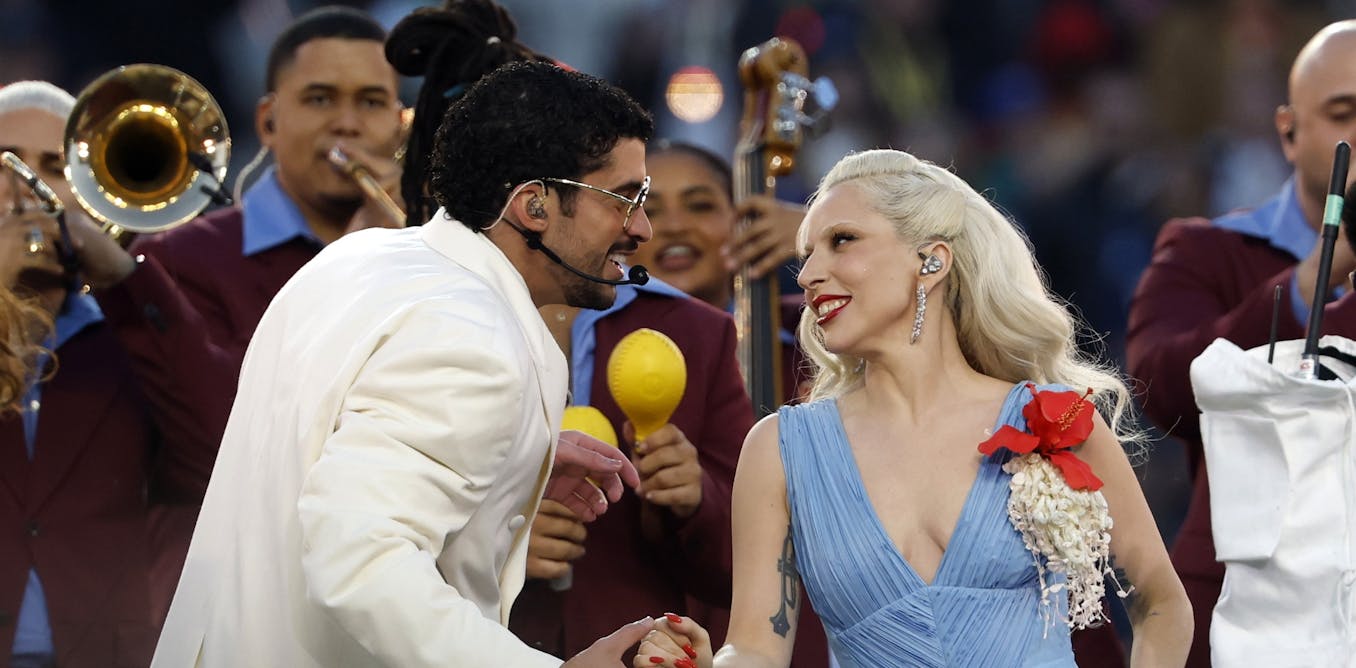
Lady Gaga made a surprise appearance, singing a salsa-style version of her hit song Die with a Smile, atop a stage replica of the famous El Morro fortress in San Juan.
Gaga wore a light blue dress of the same shade that once featured in Puerto Rico’s original flag. This flag, however, was banned in 1948 under an American gag law (which ended in 1957) that tried to stifle the island’s independence movement.
During Gaga’s song, the scene of a live wedding (yes, the couple actually got married) cements Benito’s message of togetherness.

AP/Frank Franklin II
A show loaded with symbolism
Apart from matching the wedding theme, the prominence of white clothing in the show reflects a reality of Caribbean daily life, wherein white was often worn to combat the harsh heat.
It also recalls various attire customarily worn in local music genres such as bomba and plena, as well as in Afro-Cuban religious traditions such as santería.
Benito’s own white shirt is emblazoned with the name “Ocasio” and the number 64. This is an homage to his late-uncle, who was born in 1964. The tribute offers a tender lesson on Spanish naming customs, as well as the cultural importance of family.
At one point, we see Benito hand his recently-won Grammy trophy (his album Debí Tirar Más Fotos was the first-ever Spanish-language album to win Album of The Year) to kid actor Lincoln Fox. Viewers were quick to point out Fox’s resemblance to Liam Conejos, the five-year-old boy whose detention by ICE agents last month caused national outrage.
Ricky Martin sang the heavily political track Lo que le pasó a Hawaii (What happened to Hawaii). This song pleads for Puerto Rico to not share a similar fate to Hawaii – the last state to join the union, at the cost of significant cultural loss, land, language and tradition.
Martin is framed by sparks coming from electrical poles in the background. They symbolise Puerto Rico’s poor electrical infrastructure, which was worsened in the aftermath of hurricanes María and Irma in 2017, and the electrical grid’s privatisation in 2021.
The show closes on a lighter note, with songs that highlight Puerto Ricanness. The track Café con Ron (Coffee with rum) takes the audience back to island customs, and the opening cañaveral (sugarcane fields).
Meanwhile, DtMF/Debí tirar más fotos (I should have taken more photos) evokes nostalgia for the past, and serves as a reminder of intercontinental unity.
Behind the crowd of pleneros (Puerto Rican drum players), a background screen reads: “The only thing more powerful than hate is love” – a direct challenge to the the anti-immigration policies currently permeating the US.
Benito also pays tribute to iconic reggaeton predecessors with the inclusion of tracks by Tego Calderón, and Daddy Yankee’s 2004 hit Gasolina, among others.
Freedom in the face of oppression
President Donald Trump described the event as “one of the worst, EVER!” and a “slap in the face” to the US. I never thought I would agree with Trump, but a slap in the face it was – one that reminded us all of the fabric of American culture.
Bad Bunny’s performance not only provided visibility to the significant Latinx/Latine population that holds the US together, it also served as evidence that accommodating to Anglo culture is no longer a requirement to fit in – especially for younger generations.

John G. Mabanglo/EPA
As Bad Bunny pronounced the famous line “God Bless America” – going on to list multiple countries and territories, including Puerto Rico – he imparted a lesson all Spanish-speakers have been given at least once in our lives. For us, “America” is not limited to the land that lies between Canada and Mexico, but rather extends across continents.
Benito’s geography lesson ends with the parting words “seguimos aquí” (we are still here) which, due to the Spanish language’s use of the present tense as future, can also be translated into “we will continue to be here”. A powerful message indeed.
The post “Unpacking Bad Bunny’s Superbowl show – an alternative joyful vision for America” by Consuelo Martinez Reyes, Senior Lecturer in Spanish and Latin American Studies, Macquarie University was published on 02/10/2026 by theconversation.com