

I sometimes think that my teenage fascination with the Beatles is what drew me to becoming a professional historian. Piecing together what I could find out about them in the years before the internet was a sort of gateway to the history of Britain and the world in the decade in which I was born – Carnaby Street, the Vietnam War, Richard Nixon and counter-cultural figures like Timothy Leary.
The original Beatles Anthology released in 1995 in the form of three albums and a documentary series was undoubtedly a treat for Beatles fans. Recently an updated version of the Anthology arrived in the shops. The new release includes a fourth CD of unreleased tracks.
It is always thrilling to hear iconic tracks at an earlier stage of their gestation. And this is essentially what the recently released additional material offers. However, the true obsessives among us have heard much of the Anthology material from bootleg collections. What does remain as hard to come by as ever are some of the films.
At a time when a fan had to be grateful for what they were given, I can still remember the excitement of learning that the BBC was planning to show all the band’s films over the Christmas of 1979. If we are, indeed, in the “barrel-scraping” phase, as one critic dubbed the new Anthology, of Beatles commemoration, it is surprising how difficult it now is to access some of those films.
In the last ten years some work has done to make some of the films more accessible. The band’s first movie, A Hard Day’s Night (1964), directed by Richard Lester, was re-released in cinemas in 2014 to mark its 50th anniversary. It is currently available on the BFI’s streaming service.
Their swan-song film, Let it Be (1970) was remastered for Disney+ in 2024 by Peter Jackson. Jackson had previously spliced together hours of unused footage from director Michael Lindsay-Hogg’s original recording sessions to create the 2021 documentary Get Back.
Although some are yet to be remastered. The band’s 1968 well-regarded animated movie Yellow Submarine, is still awaiting an authorised re-release, although no doubt this will come. Their dismal 1967 BBC Christmas special Magical Mystery Tour was notoriously dead-on-arrival and if there are commercial reasons for resuscitating it, there certainly aren’t any artistic ones.
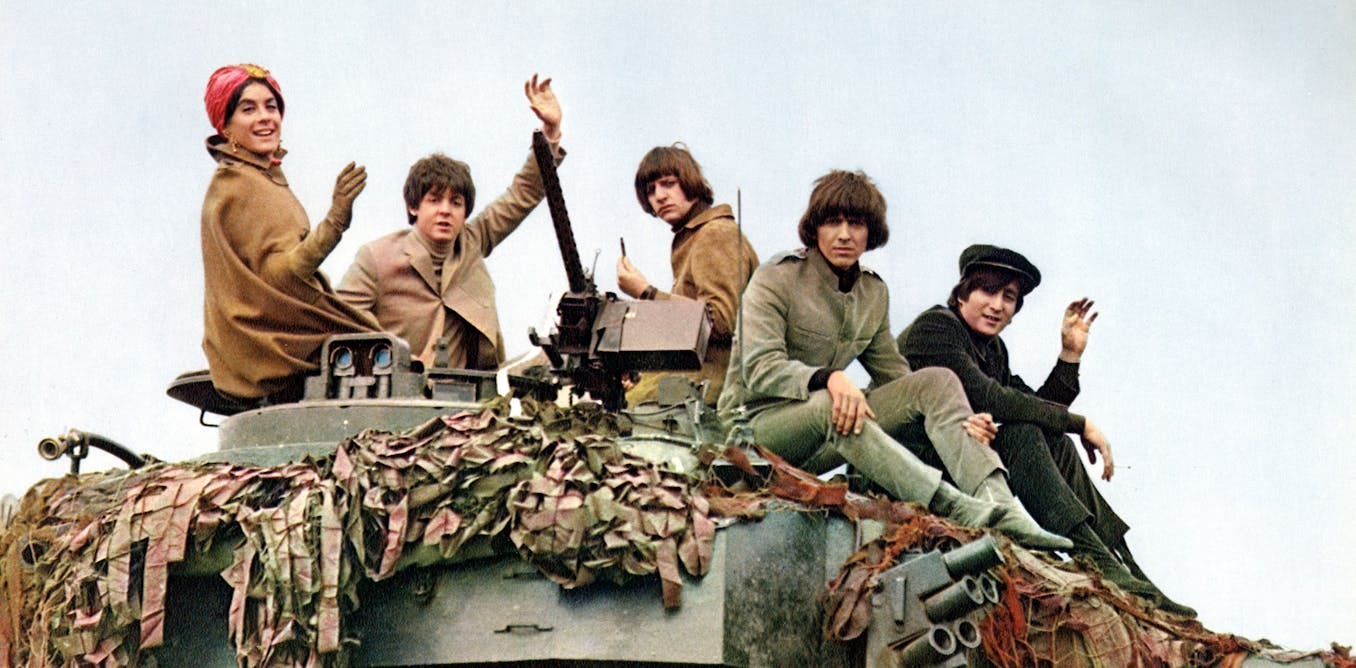
But what about Help! (1965), the band’s second outing with Richard Lester? The film’s madcap plot involves the group being chased around the globe by the comically inept members of a religious cult keen to recover a sacred ring from the finger of the band’s drummer, Ringo Starr.
It is a far more accomplished piece of filmmaking than Magical Mystery Tour. Indeed, it was in many ways ground-breaking for pioneering the music video format and rock musicals. But the last DVD release of the movie was a 2007 two-disc set.
Read more:
Anthology 4 shows there’s still more to discover about the Beatles
The reason why the film has missed out on more recent celebratory repackaging isn’t difficult to surmise: it features three familiar European character actors – Leo McKern, Eleanor Bron and John Bluthal – adopting “brown-face” to portray Indian cult members. And their quest for the ring is in order to enable them to carry out a human sacrifice. No mention is made of any of this in the documentary series that accompanied the Anthology recordings, and which has also been re-released.
As the 1960s progressed, these sorts of crude orientalist stereotypes faced parody and criticism. But apologists for the movie would struggle to demonstrate that Help! is doing anything other than reinforcing those attitudes. Some contemporary critics have simply labelled it as racist.
I wonder if an attempt could be made to salvage Help! by re-releasing it with its own documentary package exploring the historical context of the film. If the choice is probably between either contextualisation or simply allowing the movie to languish in the far-corners of eBay to avoid offending global consumers, then I think we should go for the former.
While it would be difficult to make Help! genuinely palatable to contemporary viewers, it could be used as the starting point for a fascinating exploration of the ways in which Britain in the Swinging Sixties viewed its colonial past.
Some of the era’s more radical writers and filmmakers like Edward Bond and Tony Richardson were keen to question the values of their parents’ generation. But as Help! demonstrates, imperial assumptions of white racial superiority continued to permeate popular culture, not least in the area of comedy.
If the Beatles of 1965 had passively accepted the plot of Help!, the Beatles of the late 60s would almost certainly have baulked at it. George Harrison famously embraced Indian music, culture and religion. John Lennon would subsequently feature in another Richard Lester film, How I Won the War (1967), which mocked British jingoism and its rigid class system.
A year later, Lennon had to face racist abuse from the British press and fans when he left his wife for the Japanese artist, Yoko Ono. Also, the track Commonwealth, which surfaced in the 2021 documentary Get Back, is an improvisation satirising Enoch Powell’s Rivers of Blood speech, which was held responsible for inspiring a spate of racist attacks.
The Beatles were on a journey, and Help! deserves to be seen and discussed as part of that journey, rather than being hidden away.
Looking for something good? Cut through the noise with a carefully curated selection of the latest releases, live events and exhibitions, straight to your inbox every fortnight, on Fridays. Sign up here.
The post “The Beatles’ movie Help! featured crude racial stereotypes – but it shouldn’t be hidden away” by Philip Murphy, Director of History & Policy at the Institute of Historical Research and Professor of British and Commonwealth History, School of Advanced Study, University of London was published on 12/02/2025 by theconversation.com