

Kent Jones’s carefully wrought film Late Fame offers a wry eulogy for vanished bohemia and a deft meditation on F. Scott Fitzgerald’s famous dictum that “there are no second acts in American lives”.
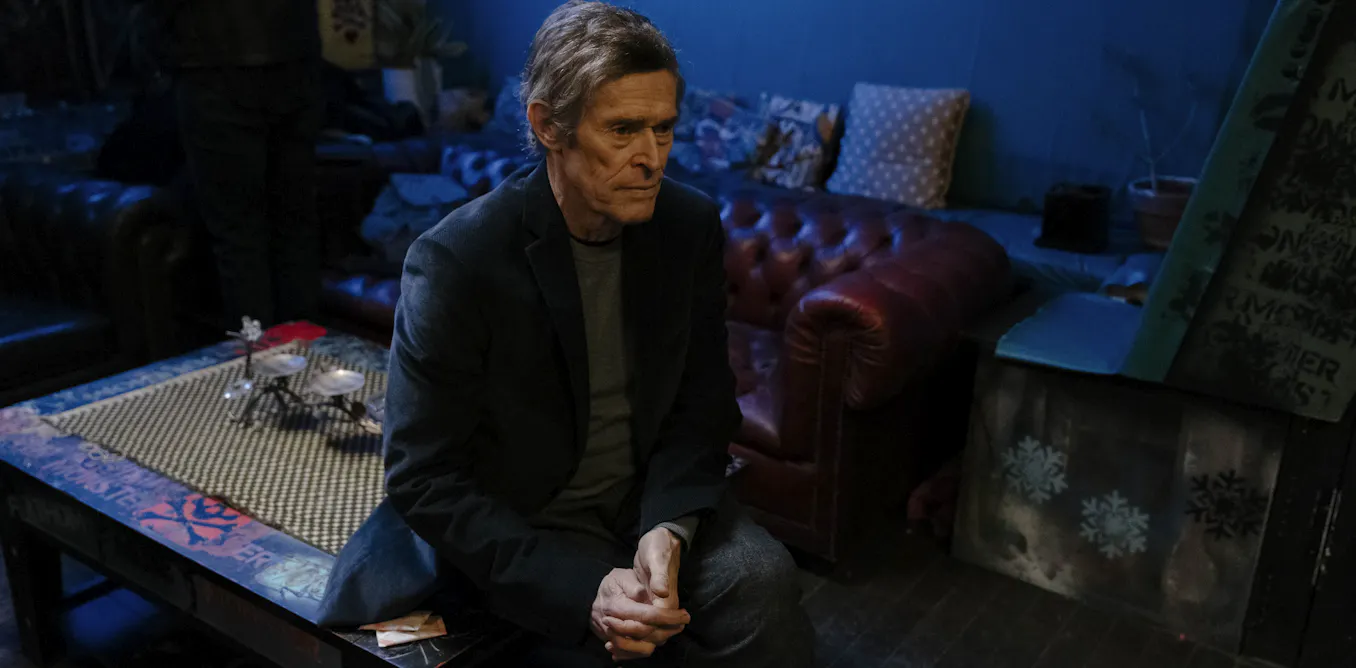
Almost half a century ago, Ed Saxberger (Willem Dafoe) was a minor figure on the New York poetry scene. But as Ed himself acknowledges: “I had my moment. It passed.”
The decades since the publication of his solitary volume of verse, Way Past Go, have passed in utter obscurity. So returning home one wintry evening, Ed is surprised to be met by Myers (Edmund Donovan, enjoyably vampiric), a twentysomething stranger who hails him as a forgotten literary genius and an avatar of “Old Downtown” New York.
Myers introduces himself as the leader of a small group of nostalgic aesthetes who have rediscovered and taken inspiration from Ed’s slender, long out-of-print volume of Beat-ish verses. Sceptical yet flattered, Ed lets Myers prevail upon him to meet his band of self-styled analogue contrarians (snottily deprecating the digital influencers huddled over their smartphones at the next table).
His new pals press Ed to compose a new poem – his first in decades – as the star turn in an absurd faux-New Wave “happening” whose planning gives the film its light narrative framework. With his library of taped poets – T.S. Eliot, Wallace Stevens, Gary Snyder – for company, Ed doggedly pursues inspiration through the chilly Manhattan streets (atmospherically filmed by Wyatt Garfield).
Vertigo Releasing UK
Passing the designer boutiques and high-end restaurants of 21st-century SoHo, he seems a man out of time – a distant cousin perhaps of the night crawler Dafoe played in Paul Schrader’s Light Sleeper (1992). Even his booklined one-bedroom Lower East Side walkup feels like a holdover from a bygone era of affordable rents in cold-water apartments.
But that Patti Smith past is a distant country, and so it seems is Ed’s creative spark. The suggestive phrase “seasons collide” offers the germ of an idea, but his yellow legal pad remains obstinately blank. Come the big night, Ed can only offer to read a 45-year-old poem from Way Past Go – though as he points out to the disappointed Myers, as far as the audience is concerned it could just as well be brand new.
Long-vanished counterculture
Ed is in every scene of the film, so inevitably much depends on Willem Dafoe’s performance – which happily is ideally cast and perfectly judged. Initially it feels a stretch that Dafoe’s edgy, charismatic screen persona could be submerged in the unremarkable routines of Ed’s life – his daily grind as a postal worker, toasted tuna sandwiches, rounds of pool at the local bar with his small coterie of blue-collar male friends.
But it’s precisely by playing off these expectations – and perhaps our awareness of his own long career as a fixture on the real downtown scene (a founder member of the avant garde Wooster Group theatre company) – that Dafoe comes to embody Ed’s distant boho past, his workaday present, and his unsuspected hunger for something more, all so credibly.
Another actor might also have had us worrying for Ed’s wellbeing or that this vulnerable older man might be exploited, knowingly or otherwise, by his callow new pals. But Dafoe’s feral mien, however subdued here, reassures us he’s no patsy. Ed sees as clearly as we do that these self-styled artistes are quintessential poseurs, rich kids lightly slumming on daddy’s dime in retro coffeehouses and loft apartments accessorised with $1,200 first editions of Naked Lunch.
None of them gives the slightest indication of any talent, or for that matter the application to pursue their chosen craft. (If they were for real, they’d be in Bushwick or Hoboken, not rubbing shoulders with the hedge fund managers in SoHo.)
They’re simply tripping on secondhand memories of a long-vanished counterculture to which Ed gives them vicarious access – even as he freely admits his acquaintance with legends like Allen Ginsberg and Gregory Corso was fleeting at best. For Ed, being part of an artistic coterie – however ersatz – after all this time is like whistling a half-forgotten tune, the pleasurable twitch of a phantom limb.
If anyone threatens to unmoor Ed it’s Grace (Greta Lee), the only woman in Myers’s band. Older than the others – though still many years Ed’s junior – she’s the group’s self-styled muse, channelling Louise Brooks, Marlene Dietrich and Audrey Hepburn in equal measure.
Ed gladly lets Grace – who’s motivated perhaps by an awareness that her own persona is precariously fabricated – seduce him into embracing his improbable shot at late-in-life celebrity, lubricated if needs be by the occasional fib. Ed even takes a meeting with a vapid literary agent to discuss the publication of his (non-existent) memoir. It’s in these passages of the film, as Ed testily rejects his decidedly unliterary working-class buddies, that we fear he may really be losing his compass. But will he fall for this chance of late-blooming fame?
Ultimately, Late Fame might be seen as a reflection on the profound unknowability of people. Myers’s real motivations and ambitions remain strangely opaque. Grace’s siren persona belies a much sadder reality.
Ed himself is estranged from his siblings, for reasons we never learn, and when he finally reads his (excellent) old poem publicly, it hints at a lost romance that may – or may not – have shaped the rest of his life. We can’t know, but Kent Jones has fashioned a film that invites us, engagingly and tenderly, to wonder.
The post “Late Fame: this tale of literary redemption is sad, tender and opaque” by Barry Langford, Professor of Film Studies, Royal Holloway, University of London was published on 08/27/2026 by theconversation.com