

On Pakistan’s Indus delta coast, a 350,000-hectare mangrove project is turning a growing forest into something that can be sold to companies thousands of miles away: carbon credits.
Carbon credits allow companies to pay for projects that store carbon or prevent further emissions, with each credit equalling a certain amount of carbon. Restoring mangroves can generate credits as a healthy, growing forest absorbs and stores carbon. It’s part of a thriving billion dollar industry.
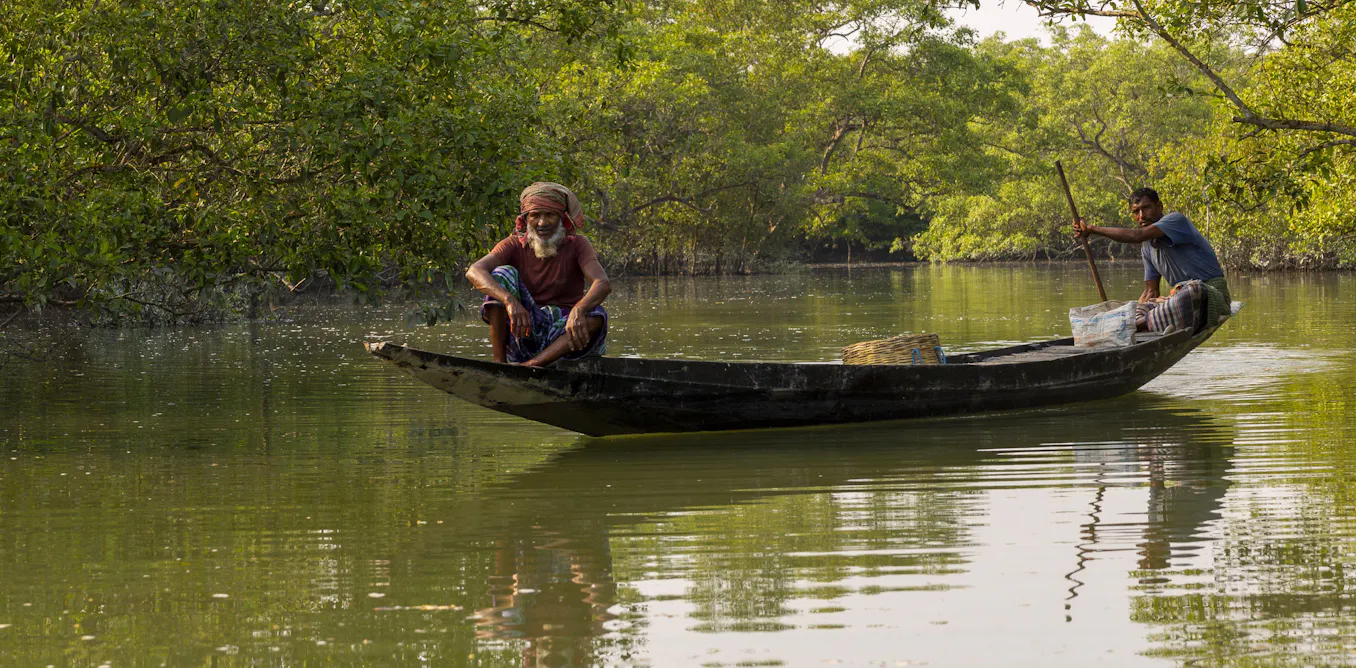
But that forest was already worth something to the thousands of people living there. It protects 60 villages from storms, provides nursery habitat for fish and is a source of wood, honey and thatch.
The difference points to a bigger problem. A mangrove has at least two kinds of value: the value that can be packaged and sold to a (wealthy) distant buyer, and the value that is experienced locally but is much harder to monetise. Only the first has a market built around it.
Amazing aerial / Alamy
This gap will be under the spotlight at the upcoming UN climate summit Cop31 in Antalya, Turkey, this November. At last year’s Cop30, governments called for the money provided by wealthy countries to help communities cope with the consequences of climate change to at least triple by 2035. For those living in mangrove forests, this so-called adaptation finance could help them survive stronger cyclones and rising seas.
But a decade of climate finance has built pipes that tend to run in one direction, towards whatever can be measured, traded and exported. Pour adaptation money into that plumbing and it comes out where the pipes already exist.
Restoration has become a new kind of market, and like any market it creates jobs, contracts, training and monitoring. But it also distributes what it generates along a chain of intermediaries: verifiers, brokers, aggregators, certifiers, each taking a share before anything reaches a village.
How large a share is unknowable: only a tenth of intermediaries disclose what profits they make. And the agreements meant to pass value back are scarce: of 47 carbon credit project documents the not-for-profit Carbon Market Watch reviewed, only 15 mentioned benefit sharing, and just four showed evidence of sharing benefits with local or Indigenous communities.
Most arguments about fairness ask what percentage local people get at the end. But that leaves out the bigger question of what they have to give up along the way.

Made Nagi / EPA
Beyond money sits something more complex: every restoration project involves trade-offs, and somebody carries them. Protecting carbon stored in mangrove forests can mean closing a fishing ground. Planting for biodiversity can mean growing species that yield no firewood or fruit. Dredging channels and replanting in tidy single-species blocks can produce a forest that scores well on a monitoring form, but no longer resembles the one people knew how to live in.
These are choices, not accidents. The pattern is often familiar: costs are immediate, local and certain, while benefits are deferred, distant and uncertain. A global analysis of 88 mangrove restoration studies in 2021 found that restored forests often recover fewer ecological functions than comparable natural forests, and the waiting period can impose real short-term costs on communities living alongside them.
When restoration becomes a trade-off
Communities who live in mangroves are so often cast as part of this problem. A family cutting wood or fishing inside a protected zone becomes an encroacher, their extraction the thing restoration must stop. Yet communities have regulated their own use of these forests for generations.
The Sundarbans, the world’s largest mangrove forest, spans India and Bangladesh. There, people of all religions invoke Bonbibi, guardian of the forest, who protects those entering out of need and punishes those who come out of greed. Her story is one part of a broader body of local knowledge about how people should use and care for the forest.
That knowledge can inform restoration, helping decide which species are planted where, and turning planting into stewardship that people sustain after the funding ends. Where it is sidelined, researchers have described the result as green colonialism. What changed is not local people’s greed, but the terms: who may take, who may sell, and who gets to call it exploitation.
Those terms keep moving, because success itself keeps being redefined. The Matang mangroves on Malaysia’s west coast have been managed and documented since 1902, the longest such record anywhere. The forest has remained productive, but what counts as success has changed: first charcoal for a colonial economy, then timber for a newly independent nation, then biodiversity, now carbon, with biodiversity credits close behind.

Fazry Ismail / EPA
Each time, new priorities emerged, and the definition of a healthy forest rearranged itself to match. Communities often appear in that story when their labour is useful, and recede when it is not.
What counts as success?
Seen this way, restoration projects can have three broad outcomes. In the first, the ecosystem recovers and local people hold a fair share of the value. In the second, it recovers but the value drains to intermediaries and distant buyers. In the third, the scheme collapses because the rush to sell was never governed.
The uncomfortable part is that the second outcome can still count as success. A 2026 review of 77 ocean or coastal carbon storage projects found it is rarely possible to tell which outcome you are looking at, because community involvement is so seldom documented.
The second outcome is the one worth fixing: the most common and the most deceptive. That means putting the people who live in and around restoration projects at the centre of deciding what worked.
This is the question our Revive project is exploring. Working across three Malaysian sites, we start with what residents themselves count as a good outcome, then trace how those outcomes trade off against the value chains built around the forest.
Trade-offs cannot be designed away. What can change is who decides. At present, decision-making often follows whoever is paying, which is how success can be met while the people doing the restoring are worse off. Communities who have managed these forests for generations should be setting the terms, not receiving them.
We can measure a mangrove’s carbon to the tonne. We still cannot say who paid for it, in fish, in access or in time. Until those who pay are the ones defining success, tripling the money risks tripling the imbalance.
The post “Mangrove restoration is becoming big business, but benefits don’t always reach local people” by Aarti Krishnan, Senior Lecturer in Sustainability and Innovation, University of Manchester was published on 10/02/2026 by theconversation.com