

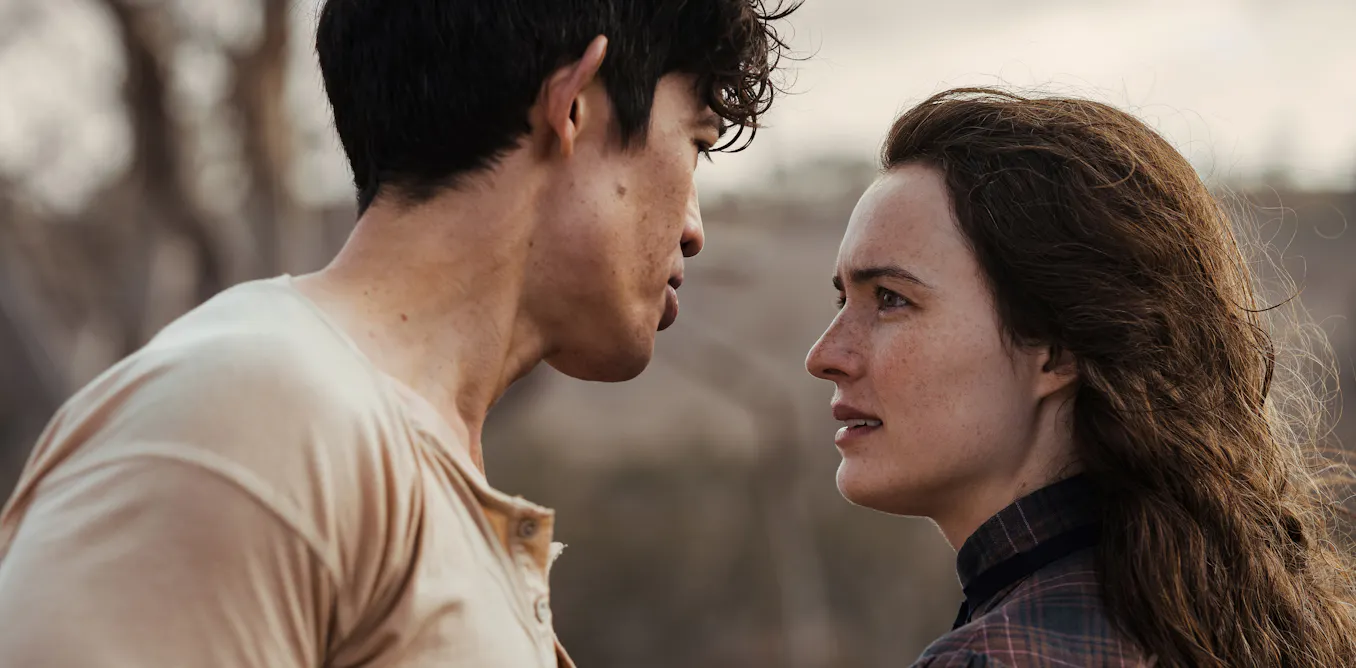
Chinese Australian actor Christopher Chung takes on a lead romantic role in the new Netflix adaptation of Miles Franklin’s classic 1901 Australian novel, My Brilliant Career.
Chung plays Harry Beecham, the handsome and wealthy suitor of the novel’s protagonist and narrator, Sybylla Melvyn.
Teenage Sybylla – who Franklin modelled on herself – is the headstrong daughter of a once-prosperous British Australian farming family who have fallen on hard times.
In a dramatic change from the original novel, Chung’s Harry is Chinese – or, more accurately, he is of mixed Chinese and European heritage, as is the actor himself.
To some viewers, this might seem anachronistic. But it could very well have happened in Australia at the turn of the last century.
Read more:
Guide to the classics: My Brilliant Career and its uncompromising message for girls today
Chinese Australians in the past
At the time My Brilliant Career is set, official statistics tell us there were around 33,000 Chinese people in Australia.
While they made up less than 1% of the total population, Chinese people – both immigrant and Australian-born – were part of many rural and urban communities, particularly in the eastern states of New South Wales, Queensland and Victoria.
The large majority of Australia’s Chinese population were men, as had been the case since the gold-rush decades of the mid-19th century. Social, cultural, legal and economic factors restricted the emigration of Chinese women at that time.
The Powe Family Collection, courtesy Brad Powe, Author provided (no reuse)
Among those counted as “Chinese” in official statistics were Australians of mixed Chinese-European heritage. Known in the racist language of the time as “half-caste Chinese”, they numbered about 3,000 in 1901, mostly the children of white mothers and Chinese fathers.
One such family was the Ah Poo (later Harper) family.
China-born George Gwok Ah Poo married Emma Ann Lowe at Terara, south of Sydney, in 1875.
He was a goldminer turned market gardener and orchardist. The couple had nine children born between 1877 and 1894.
Their eldest surviving daughter, Lily May, was born in 1880. She married another Chinese immigrant, Henry Fine Chong, at Parramatta in 1896.
White women and Chinese men
Intimate relationships between white women and Chinese men were part of the story of Chinese migration to Australia from its beginnings.
The earliest known Chinese settler, John Shying, arrived in Sydney in 1818 and married twice in NSW.
First he married English-born Sarah Jane Thompson at Parramatta in 1823. After Sarah’s death, he married Irish-born Bridget Gillorley in 1842, also at Parramatta.
John and Sarah Shying had four sons, and their descendants celebrated the bicentennial of John Shying’s arrival in Sydney in 2018.
The exact number of Chinese-European relationships in colonial Australia is difficult to know, but estimates by historians put the number of legal marriages between white women and Chinese men in NSW and Victoria during the 19th century at more than 1,000.
Many more relationships were never sanctioned by marriage, including long-term de facto partnerships, short-term cohabitation, casual liaisons and prostitution.

Society of Australian Genealogists, Tart McEvoy Papers, 5/199 no. 3, Author provided (no reuse)
The best known Chinese-European couple from that time is probably tea merchant and philanthropist Quong Tart and his English-born wife, Margaret née Scarlett.
They married in Sydney in 1886 (against her father’s wishes), had four girls and two boys, and lived in a lavishly decorated mansion, “Gallop House”, in the Sydney suburb of Ashfield.
In 1911, Margaret Tart published a biography of her remarkable husband.
Stereotypes and racial anxieties
For three decades I have been working alongside descendants and family historians to uncover the stories of these Chinese-European couples and their families, hoping to better understand their place in Australian history.
When I first began my doctoral research in the late 1990s, I encountered persistent stereotypes about these families, both in my historical sources and in published histories.
In the mid-19th century, Chinese-European relationships in the Australian colonies were initially viewed as a curiosity by journalists and politicians, who were mostly white, male and middle class.

National Library of Australia
As the (albeit small) numbers of interracial relationships grew, white colonists who opposed Chinese immigration accused Chinese men of “seducing” and “corrupting” white girls.
In parliaments and in the press – for example, the notoriously racist Bulletin – opponents to Chinese immigration discussed interracial relationships as an example of Chinese “immorality”, an unwelcome “vice” alongside gambling and opium use.
The same journalists and politicians characterised white women who partnered with Chinese men as being illiterate, degraded and desperate. Why else would they choose a Chinese lover or husband?
Ideas of Australia as a white man’s country solidified at the end of the 19th century. Contemporary literature, the press and parliamentarians voiced fears of the creation of a “piebald race” – a derogatory term for those of mixed racial heritage.
But Australia never prohibited relationships between white women and Chinese men by law, as happened in the United States, where 15 states made it illegal for Chinese and white people to marry between 1850 and 1950.
Telling different stories
Today, many can trace their heritage back to a Chinese ancestor, or two or three, who arrived in Australia in the 19th century.
The revelation of Chinese heritage can be a surprise. Some mixed-race families chose to hide their non-European ancestry during the difficult White Australia decades of the early 20th century.

Braidwood Historical Society, Ng Nomchong Family P97/28/341a, Author provided (no reuse)
The reimagining of My Brilliant Career with a Chinese Australian romantic lead and a love story that crosses racial boundaries reflects a previously hidden reality of colonial Australia.
The post “Love across racial boundaries: the true history behind Netflix’s My Brilliant Career” by Kate Bagnall, Senior Lecturer in Humanities, University of Tasmania was published on 08/11/2026 by theconversation.com