

Oversexed teenagers, invincible killers and a deserted cabin – what could possibly go wrong?
Slasher movies that focus on teenagers being picked off by a killer are a horror staple. The victims were typically white and heterosexual, with villains that seemed to punish sexually active women while allowing the chaste girls to live. This survivor is often called the final girl.
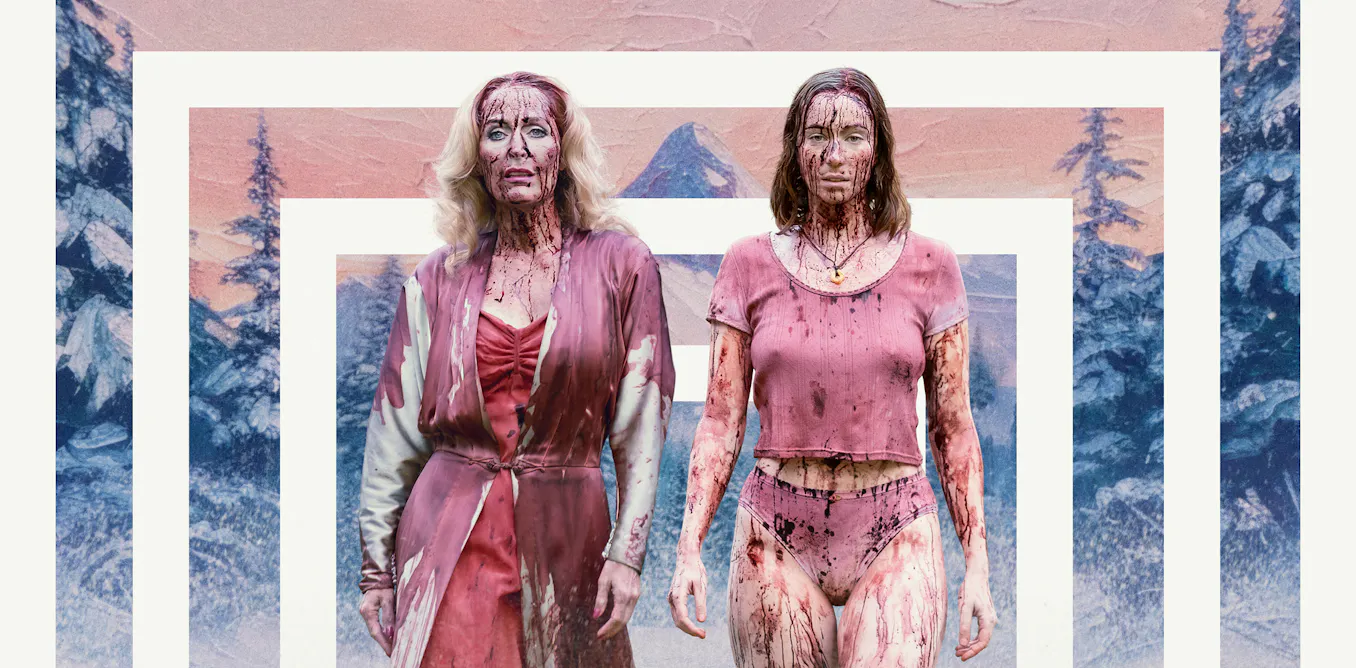
Jane Schoenbrun’s “Teenage Sex and Death at Camp Miasma” (2026) has earned significant critical praise for its queer and postmodern take on slasher films. Its heroine, Kris, who’s played by Hannah Einbinder, is a budding filmmaker with an encyclopedic knowledge of the slasher subgenre. It gives audiences more than one final girl and directly challenges puritanical rules about sex.
The film focuses on Kris’ decision to reboot a fictional slasher franchise, “Camp Miasma,” that has seen extremely diminishing returns with each new film. To do this, she seeks out the film’s original final girl, Billy Presley – played by Gillian Anderson – who lives on the same camp where the first film was shot. It’s quickly apparent that Kris is attracted to Billy, which changes her vision for the film she wants to make, much to the studio and her agent’s dismay. When the franchise’s villain, Little Death, begins to appear, it isn’t clear if the monster is real or fantasy.
Schoenbrun’s film riffs on 1980s slasher films like “Friday the 13th.” But it also reveals, subverts and sometimes celebrates queer tropes from past horror films, particularly queer villains.
Are lesbian vampires aging well?
For most of the history of film, queer or queer-coded characters have been frequently portrayed in a negative light.
In horror films, this negative coding was achieved by making the queer character the monster. One of the earliest of these villain narratives is the lesbian vampire trope.
In “Dracula’s Daughter” (1936), the title character has a bloodthirsty obsession with female characters. Age differences are common in these tropes, often with a moralizing undertone that pits youthful innocence against queer monstrosity. This predatory nature is crystallized in a key scene in which Dracula’s daughter, Countess Zaleska, invites a young woman to pose for an art study before attacking her.
Yet Countess Zelska hates her vampirism and seeks out a male psychiatrist to “cure” her. Ultimately unable to change, the Countess repeatedly victimizes women, including the psychiatrist’s girlfriend. The story’s parallels to conversion therapy and internalized homophobia are foundational to the film.
In “Camp Miasma,” audiences get both an inversion and a subversion of the queer villain trope. The younger Kris pursues the older Billy, initiating their sexual and romantic connections. Billy is incredibly mindful of consent and Kris’ struggles with sex. And while Countess Zaleska is a clear threat to the younger women in the 1936 film, Billy is framed as an eccentric rather than as a monster; at several points, Billy pretends to be scary or insane, only to reveal that she’s joking.
Slashing boundaries and binaries
As their relationship develops, Billy and Kris are triangulated by the killer Little Death. As in earlier horror films, Little Death – a not-so-subtle nod to the French expression for orgasm, “la petite mort” – is coded as transgender, nonbinary or both. Their backstory involves being taunted for dressing as both male and female.
Trans and cross-dressing killers are another long-standing horror trope in films such as “Psycho” (1960), “Dressed to Kill” (1980) and “The Silence of the Lambs” (1991). The trope frames the killer as sick or deviant, with their sexuality or gender causing them to act out violently.
MUBI
The trope reached its peak – or nadir, depending on how you see it – in the 1983 low-budget slasher “Sleepaway Camp.” The film presents the villain as female for most of the movie only to reveal them as having been assigned male at birth as part of a confusing and transphobic plot twist. Their confusion is also tied to a memory of watching their father make love with another man. That their first victim is an adult who is a pedophile and a rapist complicates how audiences might view the killer.
Little Death occupies a similar space in “Camp Miasma”; however, rather than aligning the character’s gender nonconformity with being a killer, the film presents Little Death as helping Kris realize her desires: to be both killer and victim, active and passive, male and female, without privileging one over the other.
What’s your favorite meta scary movie?
To present seemingly opposing ideas in the film – and in the character of Kris – Schoenbrun reimagines the meta horror of the past few decades.
The “Scream” franchise made slasher films self-aware. They feature teenagers who are well-versed in the conventions of slasher films. Much of this is played up for comedic effect, despite featuring classic tropes like a masked killer and final girl.
But films like cult favorite “Jennifer’s Body” (2009) complicate that self-awareness by pairing it with genuine feelings and social commentary. The film explores the complicated dynamic between Needy, who’s played by Amanda Seyfried, and her sexy and more popular best friend, Jennifer – who’s played by Megan Fox – a monster who eats boys. Even as it plays with cliches or tropes, “Jennifer’s Body” reveals that postmodern cynicism can often be a way to hide vulnerability.
In “Jennifer’s Body,” pop culture references are part of how characters talk to each other. While trying to stop Jennifer’s murderous rampage, Needy points out that Jennifer is a bad friend: “You’re a jerk!” The blood-covered Jennifer responds “Nice insult, Hannah Montana. Got any more harsh digs?”
“Camp Miasma”‘s nods to the horror genre are largely isolated to recreating or riffing on a famous shot from another film. During one of Little Death’s killing sprees, they bash a victim against a tree, mirroring an over-the-top killing in “Friday the 13th Part VII: The New Blood.” The only dialogue referencing movies comes from Kris’ endless film talk. As the film progresses, it becomes clear that Kris’ intellect – particularly her vast knowledge of films – is a way to avoid her own sexual desires.
Queer contradictions
In “Camp Miasma,” reality becomes less stable as the film progresses. This surrealism reflects Kris’ evolving identity and desires as she grapples with binaries and contradictions within herself and others.
One of the key lines of “Camp Miasma” is “If it gets too real, you can always turn it off.” In the strange world of the film, this statement may or may not be true of movies, but it definitely isn’t true of desire and gender. “Camp Miasma” features two characters who are cut off from the world and their families; the camp itself becomes a new home for them, much like how queer people have often had to create their own families and spaces.

MUBI
Filmmaker Schoenbrun identifies as trans and nonbinary, and their film is suffused with the contradictions of being a queer person, let alone a queer horror fan and creator.
Queer fans of “Dracula’s Daughter,” “Sleepaway Camp” and “Jennifer’s Body” have reclaimed the films, creating cult followings despite initial poor critical or commercial reception. They also have generated significant critical debate, as queer audiences have to wrestle with films that sometimes pair representation with homophobia, transphobia or both.
“Teenage Sex and Death at Camp Miasma” revolutionizes queer horror, not by solving what makes it problematic, but by highlighting how the very idea of good or bad queer representation is yet another binary that should be resisted.
This article was updated to clarify the plot of “Sleepaway Camp.”
The post “‘Teenage Sex and Death at Camp Miasma’ winks and blows a blood-soaked kiss at horror films of queer past” by Scott Malia, Associate Professor of Theatre, College of the Holy Cross was published on 09/29/2026 by theconversation.com