

KEY TAKEAWAYS
-
In May 2026, the American ultrarunner Rachel Entrekin became the first woman to win the Cocodona 250-miler in Arizona, a flagship event in the sport.
-
While women excel at very long distances, they remain under-represented. Why is this?
-
At the 2026 Ultra-Trail du Mont-Blanc (UTMB), France’s Blandine L’Hirondel won the women’s race in 21 hours 54 minutes, the first woman to finish in under 22 hours. Rachel Entrekin came second.
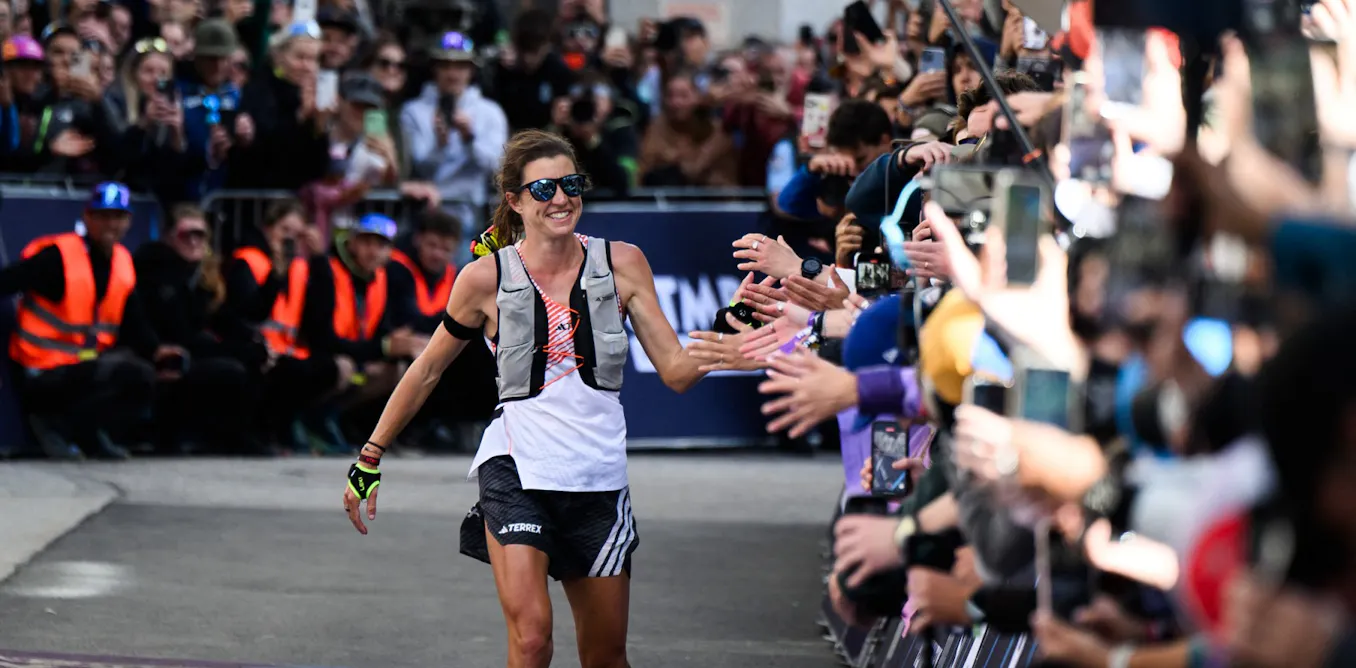
For 56 hours and 9 minutes, with hardly any sleep, American professional runner Rachel Entrekin ran across Arizona. On May 9 2026, the 34-year-old physiotherapist became the first woman to win the Cocodona 250, taking the overall lead in one of the toughest ultra-trails in North America. She smashed the event’s all-time record and finished more than an hour ahead of the first man (iRunFar).
As with every female sporting achievement over the past thirty years, the press hailed it as a “historic moment”. But behind the performance, one fact is never quantified: these victories are not flukes – they demonstrate a pattern of consistency.
Two contrasting trends
Ultra-trail running – any off-road race longer than a marathon (26.2 miles), usually in mountainous terrain – harbours a paradox. The longer the distance, the fewer women enter; yet the longer the distance, the closer their performances come to those of the top male runners.
Two open databases that I have compiled – TRAILGENDER (in French) (95 countries, 15,848 events) and ITRA Phase 0 (126 countries, 21,177 events) – based on the rankings of the International Trail Running Association (ITRA) – document this on an unprecedented scale.
Over 10 kilometres (6.2 miles), women account for 40% of participants, and the fastest woman’s time is 19% slower than that of the fastest man. Over 100 miles: 16% of participants are women, but the gap is just 4.5%. Over 200 kilometres – Entrekin’s speciality – fewer than 10% of participants are women, and the gap is 3%.
Mathilde Plard, Fourni par l’auteur
It’s not all about the body
Physiology confirms this relative advantage in extreme conditions. A leading review published in Sports Medicine in 2021 notes that the gap between top performances – around 10% in the marathon – falls “as low as 4%” in ultra-endurance events – thanks to greater resistance to fatigue and more economical management of energy levels – but that these advantages only count “in extreme endurance events”, precisely those in which women compete the least.
Endurance also carries a long-overlooked risk: female ultra-trail runners are among those most at risk of relative energy deficit in sport – a sustained imbalance between calories burned during training and those actually consumed, which disrupts hormone levels, weakens bones, compromises the immune system and can disrupt menstrual cycles. The International Olympic Committee first described the syndrome in 2014 and updated its definition in 2023.
Endurance isn’t just about watts. A 2026 Canadian study followed seven female runners during a six-day ultrarace. In the early days, each competitor treated her pain as an individual problem to be dealt with – which many of them concealed, so as not to “look weak”. By the third day, exhaustion had broken down this façade: they began running together, acknowledging what they were going through, and helping one another at the refreshment stations. At the finish line, they no longer measured their success by the number of kilometres, but by the fact that they stuck it out together. This is a way of running ultras that the dominant sporting culture – entirely focused on individual feats – had not anticipated.
So why are there so few women at the starting line? The answer is social, and geography illustrates this. Over the same distance, my World Atlas of Women’s Participation in Trail Running records 34% of female finishers in Canada, 31% in the United States… and 17% in France, despite it being the world’s largest market for the discipline.
The bodies are the same, yet participation doubles from one country to the next. The obstacle lies in the conditions of access, as the French sociologist Catherine Louveau and the researchers Holly Thorpe and Adele Pavlidis, among other scholars of gender and sport, have shown for the past thirty years.
Surveys of female runners and comparisons between female and male runners confirm this: training time cut short by domestic chores, the cost of equipment and race numbers, a lack of role models, and insecurity about training alone at night. Those who line up for 100 miles or 250 miles form a cohort that has been selected twice: first by society, and only then by the race itself. What is the product of a social filter is thus mistaken for a biological exception.
History might have been erased, but the debate is on
Entrekin didn’t inaugurate anything. For nearly a century and a half, every generation has seen a woman beat the men, and then forgotten her.
As early as 1878, in Brooklyn, the British pedestrianism champion Ada Anderson covered a quarter-mile every fifteen minutes, day and night, for nearly 28 days, in front of thousands of spectators. A century later, between 1989 and 2003, the American ultramarathon runner Ann Trason won the Western States 100 race fourteen times, became queen of the 100-mile race, and finished twice second overall. In 2017, Courtney Dauwalter won the Moab 240 ten hours ahead of the second finisher; in 2019, the British woman Jasmin Paris won the Spine Race while expressing her breast milk at refreshment stations, before becoming the first woman to finish the Barkley Marathons in 2024, less than two minutes before the cut-off. Without media coverage to immortalise each win, each achievement is hailed, time and again, as a “first”.
The debate is now open. The ITRA has launched a Women’s Trail Day. Associations are pushing organisers towards fairer standards: Trail Sisters in the United States and SheRACES in the United Kingdom. SheRACES was founded by Sophie Power, who was photographed breastfeeding her baby at an aid station during the 2018 UTMB; her campaign helped bring about the race’s pregnancy deferral policy, in force since 2023. Women-led media, such as the Culotte & Trail and Femme de trail podcasts in France and the magazines Grand Trail and RunHer, give female trail runners a voice. These strides count.
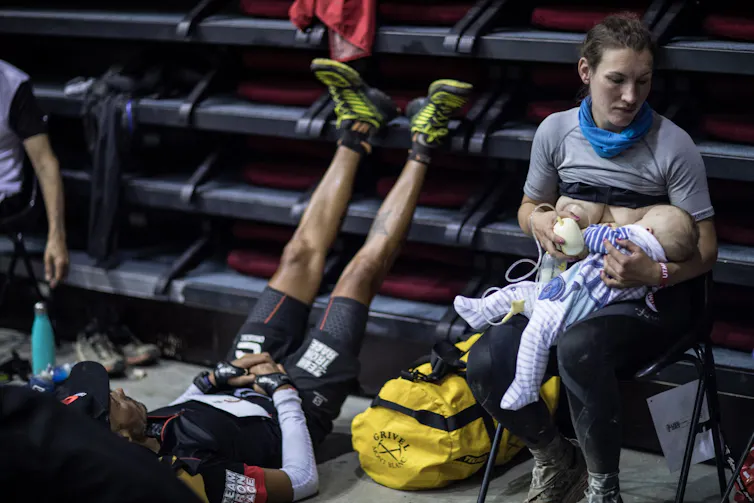
Alexis Berg/Mons Prod Pour Strava/AFP
Beyond the ‘exception’ narrative
One last figure calls for caution. Taking part in the UTMB is not simply a matter of signing up: entrants go through a lottery. Tickets come as “Running Stones”, earned by finishing other races in the brand’s circuit, one to four per race depending on the distance. The more stones runners hold, the better their odds in the draw: those selected for 2026 held 11 on average. In other words, a place is earned first by racing again and again, which presupposes the time, money and availability this requires.
Women accounted for only 18% of applications for this year’s UTMB, even as the organisation highlights the sport’s gradual feminisation. That figure only shows how many women got through this first gate. It does not tell us how many wanted to run. The number of women who actually started is not officially published either, race by race and by sex, although it can be reconstructed from the results: in 2026, women made up about 17% of starters on the UTMB. Applications and starters are almost the same share, which suggests that the filter operates before the application, among those who never had the stones, the time or the money to apply. As long as official figures are not published, the effects of a selection system will keep being mistaken for a lack of motivation. Without the real figures, reading a lower female ‘appetite’ into the data would mean mistaking a filter for a preference.
The paradox will not be resolved by a single feat, nor by a slowly rising average. It will take open, sex-disaggregated data, audits, and a work of memory that places Ann Trason, Courtney Dauwalter, Jasmin Paris and Rachel Entrekin in a continuous history, alongside Kilian Jornet and Eliud Kipchoge.
This is also what we will explore in a PhD project (in French) that I am co-supervising from autumn 2026 with two colleagues, Thibault Deschamps and Quentin Hallez, and the team at La Clinique du Coureur: what, beyond the body, enables these women to keep going. Researchers call it “psychological flexibility”: the capacity to accept discomfort instead of fighting it, to revise one’s goal mid-race rather than clinging to it until breaking point, and to let a wave of discouragement pass without reading it as a verdict. Over 30 hours of effort, this skill may count for as much as maximal oxygen uptake.
Rachel Entrekin won a race. Her victory does not prove that equality has been achieved. It shows what a woman can do once she reaches the start line. The real question concerns all the others, those who never get there.
A weekly e-mail in English featuring expertise from scholars and researchers. It provides an introduction to the diversity of research coming out of the continent and considers some of the key issues facing European countries. Get the newsletter!
The post “Ultra-trail running: why women excel yet remain under-represented” by Mathilde Plard, Géographe et sociologue, chargée de recherche au CNRS (UMR 6590 ESO), Université d’Angers was published on 10/18/2026 by theconversation.com