

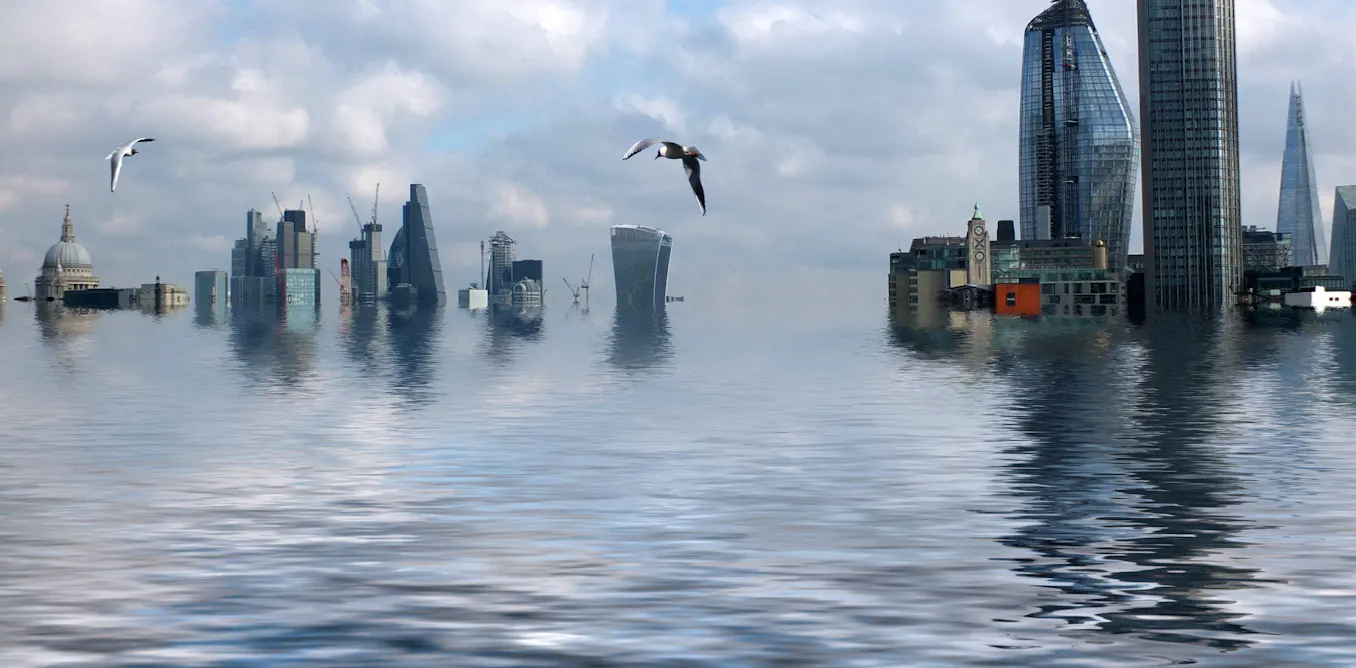
London is under water. The Houses of Parliament, Buckingham Palace, St Paul’s Cathedral and the Bank of England are all submerged. Far away, the West Antarctic and Greenland ice sheets have collapsed, triggering accelerated sea level rise which, combined with a storm surge in the North Sea and a high spring tide, has led to water flooding over the Thames Barrier. Thousands of shops, offices, schools and houses are several feet deep in effluent-rich water.
Economists struggle to calculate the ongoing economic damage, but everyone knows it is epochal. The realisation dawns that the UK’s capital city is no longer defendable. The government has no choice but to abandon it permanently to the waves.
This dystopian vision of the next century is not the most likely outcome. But nor do current scientific projections rule it out.
As scientists learn more about how climate change could trigger catastrophic flooding, wholesale collapse of food supplies and millions of heat-related deaths, there is a growing realisation that such risks need to be more widely understood and acted on. Too many people remain unaware about what could actually happen. Disasters like these are possible. Crucially, they are not yet inevitable.
This lack of awareness is concerning, as I outlined with colleagues in an article published in February 2026 in the journal Nature. It fuels both climate denial and climate doomism. We have the evidence needed to help steer humanity towards greater safety, but scientists have not communicated that evidence effectively enough. We have tied ourselves too closely to a paradigm that focuses on best-known outcomes.
Read more:
East London is at high risk of extreme flooding – here’s how to limit the damage
No one wants to be the scientist who cried wolf. That aversion to predicting outcomes that may not happen has made us too ready to rule out those that could potentially take place.
We can do better. And so can everyone involved in communicating climate change information. Presenting the potential horrors of continued greenhouse gas emissions as though they are simply inevitable encourages people to give up on reducing those emissions at the very moment in history when we can least afford to do so. The catastrophic collapse of the West Antarctic and Greenland ice sheets that could cause the abandonment of London is not yet a foregone conclusion. But time is fast running out to avoid scenarios like this becoming a reality.
The case for stubborn hope
The writer and activist Rebecca Solnit points out that uncertainty in what lies ahead can be a trigger for climate action and an antidote for despair. Hope, she says, can come from a stubborn determination to enable positive change despite the challenges. This makes a lot of sense to me as a climate scientist who has worked for 30 years identifying the causes and consequences of human-induced greenhouse gas emissions.
Annie Spratt / unsplash, CC BY-SA
To help everyone navigate that uncertain future, we argued in Nature that the scientific community needs to produce a new kind of climate-risk assessment – one that paints a compelling picture of things that may happen but are still avoidable. Knowing the possible perils, in a nevertheless uncertain future, gives people a better chance to navigate the choices they and their politicians face.
The missing climate assessment
There has been a previous global assessment of climate change risks, published in 2015, led by former chief scientific advisor to the UK government Sir David King. Produced relatively quickly by a small group of authors, it nevertheless demonstrated the potential power of such a set of information.
But that report is more than ten years old. With growing evidence that the risk of irreversible changes to the climate are mounting, a new assessment could show a much clearer picture of what is at stake. By presenting the best that could happen and the worst, side by side and as the years tick by, it would provide a roadmap for stubborn hope, an antidote to despair despite the stark realities.
London could be submerged by 2200. But it need not be. And there are many other climate change risks, particularly those affecting the most vulnerable nations, that are both catastrophic and still avoidable. Everybody deserves to know how the future could pan out if humanity does, or doesn’t, reach net-zero emissions by the middle of this century. Whether it be a top-down directive from the UN secretary general or a bottom-up initiative from scientists, a global assessment of avoidable climate-change risks would fill a gaping hole in the world’s knowledge of its most existential threat.
The post “Why climate scientists need to talk more about the very worst-case scenarios” by Peter Stott, Science Fellow, Met Office, and Professor in Detection and Attribution, University of Exeter was published on 07/13/2026 by theconversation.com