

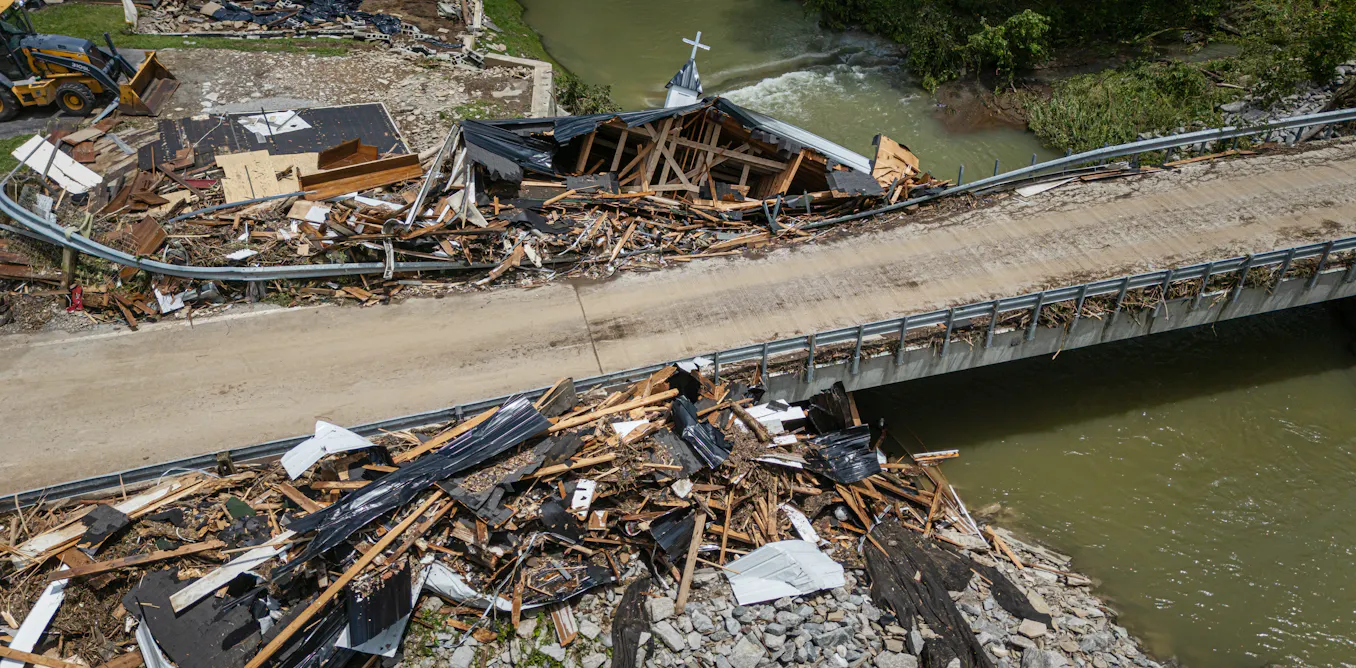
Flash flooding has been tearing up communities across the U.S., with heavy downpours sending creeks and rivers rushing over their banks from Texas to Kentucky, across the Midwest and into the Mid-Atlantic states and the Northeast. In Missouri, floodwater swept away a home, and National Guard helicopters had to rescue and evacuate dozens of people from a summer camp.
If this feels like déjà vu after two summers of flash flooding across America, imagine being a community that has had to live through flooding like this again and again.
Residents in Cocke County, Tennessee, were still recovering from the effects of Hurricane Helene’s deadly 2024 rush of mountain floodwater when a new storm turned creeks into raging rivers in June 2026. Officials in Tioga County, Pennsylvania, had been lobbying the state to dredge flood-prone streams when flash flooding in early July 2026 hit the same communities flooded by Hurricane Debby’s remnants two years earlier.
As storms intensify in our warming world, recovery no longer feels permanent in places at risk of disasters. Instead, it’s too often a temporary reprieve before the next disaster hits. Communities are also spending down their savings to rebuild, and they’re finding bank accounts thin when disaster strikes again.
Jon Cherry/Getty Images
This state of repeated disasters is known as disaster fatigue. As a researcher who works on disaster planning and recovery, I’ve seen how this problem has grown for residents and communities at risk of fires, floods, hurricanes or other natural disasters.
When recovery never really ends
The traditional disaster response model assumes a sequence of preparedness, response, recovery and, eventually, a return to stability.
However, a full recovery from major flooding or a hurricane takes years. Increasingly, communities might not have completed repairs before another damaging storm arrives. At the same time, families rebuilding after a hurricane may confront a housing shortage. Insurance and reconstruction costs rise. Businesses and their workers face economic uncertainty about how soon they can reopen. Farmers recovering from drought may face another season of extreme weather before their livelihoods are restored.
The same pattern can be seen beyond weather-related disasters. In Venezuela, powerful earthquakes in 2026, followed by aftershocks, occurred within a broader context of economic and humanitarian challenges, making recovery even more complex.
In many places, recovery is no longer a destination. It has become an ongoing and seemingly unending process.

Brandon Bell/Getty Images
Emergency management scholar Victoria Ingham and colleagues define community disaster fatigue as the deterioration of the community’s ability to function, its well-being and its capacity to recover when disasters repeatedly disrupt daily life and overwhelm the community’s resources. Research examining communities exposed to repeated disasters has found evidence of fraying social networks and growing strain on the government and community systems essential for recovery.
Related research on resilience fatigue among residents suggests that repeated exposure to hazards can produce physical and emotional exhaustion, anxiety about future disasters and frustration associated with the constant effort required to return to normal.
Compounding disasters
Part of the challenge is that disasters increasingly do not occur in isolation.
Researchers and emergency managers often talk about these risks as cascading and compounding disasters. A flood doesn’t just damage roads; it also disrupts healthcare access, interrupts supply chains and creates long-term economic hardship. At the same time, communities may be dealing with extreme heat and housing shortages.
Climate change is contributing to many of these patterns. Heavy precipitation, extreme heat, drought and other weather-related hazards are occurring more frequently in many regions.
For communities already trying to manage a recovery, each new event adds another layer of disruption and costs.
Hidden costs of repeated recovery
One of the most important consequences of repeated disasters is the strain on social cohesion – the relationships and networks that help communities share information, coordinate resources and support one another during difficult times. Volunteers who repeatedly respond to emergencies may experience burnout.
Research examining disaster fatigue among community leaders found that people reported feeling exhausted and overwhelmed by the many decisions, lack of resources and other challenges associated with managing repeated emergencies over time.
Residents, too, can become exhausted by repeated evacuations and rebuilding cycles. Research on mental health after disasters shows that prolonged recovery demands, housing instability and uncertainty about the future can contribute to anxiety, depression and trauma-related symptoms.
Disaster fatigue does not mean weakness or failure. Communities can retain their ability to bounce back while simultaneously experiencing exhaustion. In fact, some of the most resilient communities got that way because they have had to recover from damage repeatedly.
Rethinking recovery
Repeated disasters expose weaknesses in the systems that provide aid and help with recovery, which will still be needed long after the headlines fade.
Communities often receive an immediate outpouring of support, but it can be disconnected from residents’ actual needs. Following major disasters, donations of clothing and toiletries may arrive in large quantities, yet critical needs such as housing assistance, debris removal and long-term recovery support such as childcare services or healthcare and social service support may go unmet.
Effective recovery depends not only on the generosity of the donations, but also on strategic approaches that can get the type of aid needed to the people who need it. Long-term recovery planning and coordinated recovery efforts – combining the strengths of government agencies, nonprofits, faith-based organizations and community groups – can help tap into the funding and types of assistance most needed and help communities quickly determine where the need will be greatest.
Recognizing community disaster fatigue is an important step toward building recovery systems that are as enduring as the challenges communities increasingly face.
These systems require sustained investments in people, institutions and communities. As disasters become more frequent and recovery efforts increasingly overlap with new floods, storms, heat waves, droughts and other disruptions, strengthening these systems will be crucial for successful, resilient recoveries.
The post “When disaster recovery becomes a way of life: Community disaster fatigue is on the rise with more frequent floods” by Lee Ann Rawlins Williams, Clinical Assistant Professor of Education, Health and Behavior Studies, University of North Dakota was published on 07/13/2026 by theconversation.com