

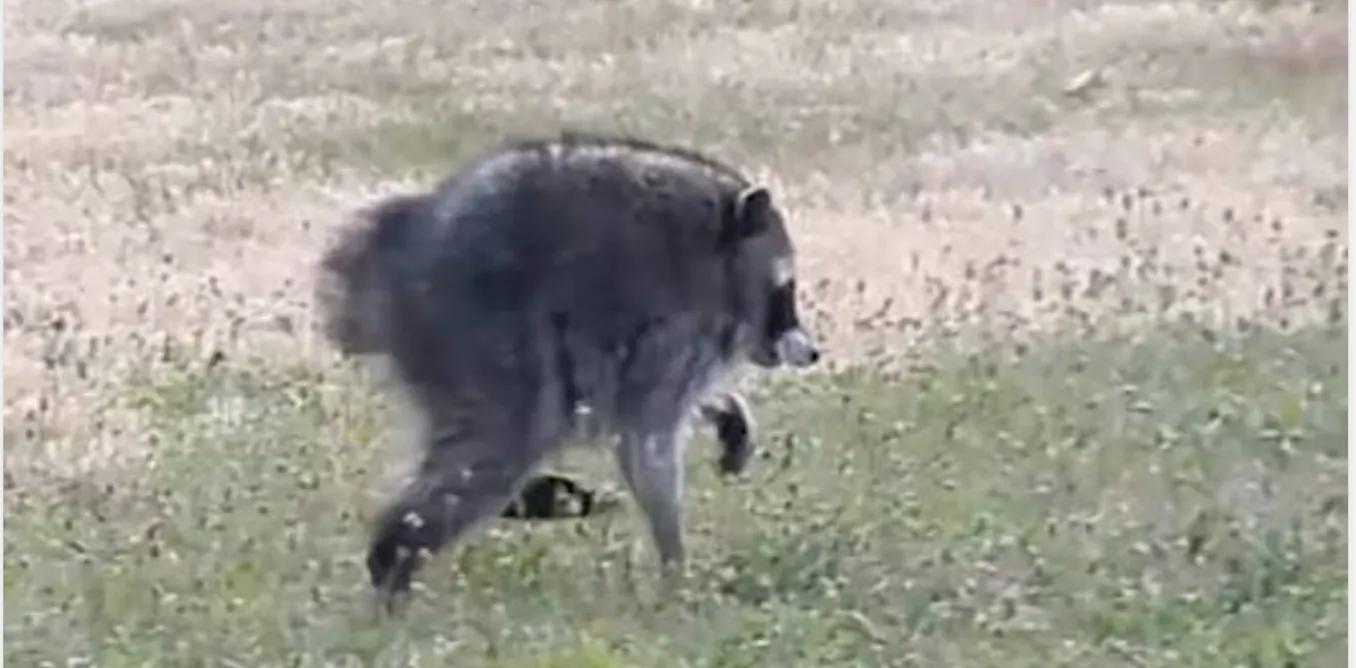
If you’ve been anywhere near the internet in recent days, you will likely have seen the viral footage of “Jimothy”: an unusually round raccoon in Seattle that hops and skips along in video filmed by local resident Kiana Hall.
This animal has a very rare congenital deformity called short spine syndrome, where the spine fails to develop properly in utero.
In fact, the condition can affect dogs, calves and other mammals – but is so vanishingly rare that in my entire career, having treated thousand and thousands of small animals, I have never seen a clinical case in real life.
What causes the condition, and can it be fixed?
Short spine syndrome is so exceedingly rare that it’s hard to say exactly why it happens.
When it is seen, it can be in wild or rescue animals – cases where the lineage is hard to map out and study.
What we can say is that the condition results in animals having normal limb length but significantly shorter spines. This gives them the appearance of having no neck and a short, round body. The normal length of spine is compressed and can they look almost spherical.
One notable example is an Instagram-famous dog named Tilly – sometimes known as “Tilly the Friendly Loaf”.
Tilly and Jimothy are clearly survivors.
It’s possible many animals that develop this condition in utero do not survive long; a lot depends on the degree of deformity and how it affects the spinal cord. Many might not live long in utero, or survive birth or the initial months of life.
It would be pretty unusual to have a puppy born with it but you never know; readers may have had dogs like this at home, but it would be just a handful of cases.
The deformity is so severe it would be extremely challenging to try and correct it surgically.
Short spine syndrome throughout history
It’s not a new condition, and has always sparked human attention. In fact, it has been documented in the past via paintings.
One 1968 paper focused on two dogs with the condition that were depicted in the 1600s by Swedish painter David Klocker Ehrenstrahl, who described the dogs as “monster of wolf and dog” and “monster of fox and dog”. One famous painting is titled “Deformed dog”:
David Klöcker Ehrenstrahl/Wikimedia
As the author of that paper puts it, these paintings constitute “early historical evidence of the existence of this malformation”.
There is also a Japanese case report from the 1960s that describes how
The external appearance of “short-spine dogs” was characteristic and very odd.
Resilience and survival
When I saw the footage of Jimothy, it made me think of the resilience of nature. Here is an animal that has had an unlucky start but is getting on with life as best he can, with the support of his amazing mother.
Jimothy’s story is, among other things, about how animals with this condition can adapt, survive and lead a happy life. It shows the resilience of animals in nature – and that’s something we can all draw inspiration from.
The post “‘Jimothy’ the raccoon has short spine syndrome – but this condition can affect dogs, too” by Chris Tan, Associate Professor in Veterinary Surgery, University of Sydney was published on 07/24/2026 by theconversation.com