

More than one quarter of young adults in Britain now say their gym memberships matter more to them than holidays or eating out.
Sport England data shows that Gen Z has begun to turn away from running, swimming and fitness classes towards gym and strength training. For them, weight training is seen as the best form of exercise because it can help build strength, improve appearance and boost overall health.
People have argued about the best forms of exercise for over two centuries. While today’s fitness trends tend to be more about improving the body and overall fitness, health has rarely been the sole reason why certain exercise trends gained popularity through the eras.
Napoleon and gymnastics
In 1806, Napoleon Bonaparte invaded Prussia and, inadvertently, created the modern fitness industry.
As Napoleon’s troops stormed their way eastward, one Prussian man, Friedrich Ludwig Jahn, began to seethe with anger. For Jahn, Prussian men had lost because they were physically weaker than the French.
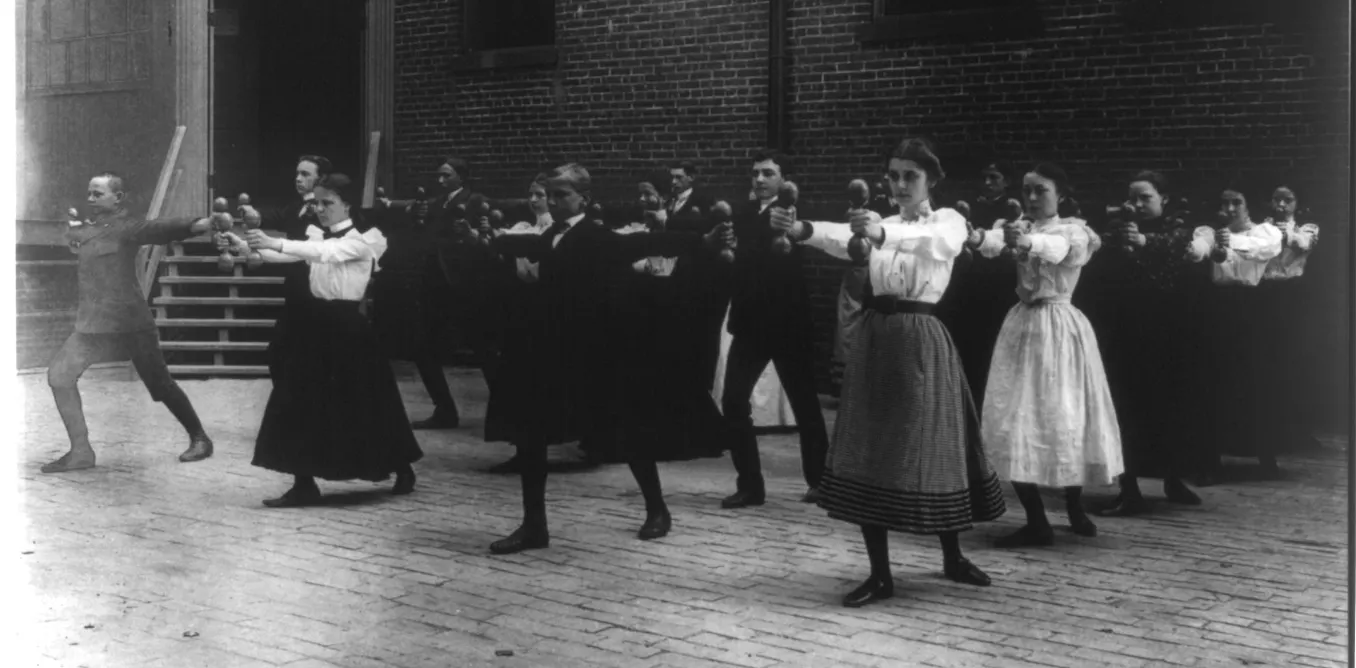
The nation’s solution, according to Jahn, lay not in muskets – but muscles. So in 1811 Jahn opened a Turnplatz – an open-air gymnasium. Young men ran, jumped, climbed ropes, wrestled and vaulted. They also swung on two pieces of equipment that Jahn is believed to have invented: the parallel bars and the horizontal bar. Soon the trend spread to other nations, with England’s first outdoor gymnastics school opening in 1825.
The underlying logic behind Jahn’s Turnplatz system – that strong nations demanded physically strong troops – became a rallying cry for a wave of gymnastic and calisthenic systems for men and women across the century.
The birth of bodybuilding
A popular form of entertainment in the Victorian era were strongmen shows, where muscular men would perform theatrical acts of strength. One of the most popular performers of the time was Charles “Samson” Sampson, whose act involved snapping chains with his chest.
The Strobridge Lith. Co., Cin’ti & New York/ Wikimedia Commons
But in 1889, a new kind of strongman arrived on the scene. During one of Sampson’s performances, a moustachioed strongman named Eugen Sandow stripped down to his pants in a London theatre, responding to a challenge from Sampson. But what made Sandow different from Sampson and other strongmen of the era was his physique. He was lean and sculpted.
From 1889 until his death in 1925, Sandow became synonymous with the ideal body. He was deemed the “best specimen of manhood” by Harvard University physical educationalist Dudley Sargent. Sandow hosted the first major bodybuilding contest in London in 1901 and ran a health enterprise which spread across the British Empire, the Americas and Australasia. Thousands followed his mail-order courses, read his magazine and drank his cocoa.
Those lifting dumbbells and barbells to build their bodies like Sandow classed themselves as “physical culturists” in the same way that modern trainees may define themselves by Pilates, Hyrox or weight training.
Following Sandow and others, people trained for health but they also trained to become better workers, better spouses, to be more attractive or dynamic.
Read more:
Fitness gurus and ‘muscular Christianity’: how Victorian Britain anticipated today’s keep fit craze
Although the state still mattered – Sandow even trained British troops for the second South African war – the emphasis slowly shifted to building the body for its own sake.
The post-war aerobics boom
The approach to exercise in the post-war era shifted due to an emerging new health concern: people were sitting down too much. This fear was fuelled by a 1953 work published by epidemiologist Jerry Morris which found that London bus drivers experienced higher instances of heart disease than conductors, who spent their day climbing stairs. The cause? Inactivity.
In the US, physicians began rallying against rising heart disease. Their radical solution was to advise people to run slowly for set periods of time – an activity we today call jogging. Pioneered in New Zealand and brought to the US in the 1960s, jogging soon kickstarted an “aerobics” boom.
New gym chains filled up with previously untrained enthusiasts running and doing aerobics classes. Aerobics classes were particularly popular with women. And in 1969, fitness instructor Jacki Sorenson originated the aerobics dance movement after she began setting routines to pop music, stitching together steps from jazz, folk, cha-cha and square dancing.
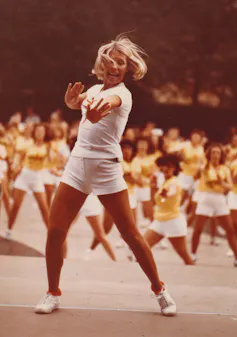
Employee of Aerobic Dancing, Inc./ Wikimedia Commons
The popularity of aerobics only continued to grow throughout the 80s, thanks to actor Jane Fonda’s best-selling 1982 workout video which brought aerobics into the living room.
The muscle builders
In 1977 the world was introduced to Austrian bodybuilder Arnold Schwarzenegger in the hit documentary Pumping Iron. Brash but charming, muscular but beautiful, Schwarzenegger and the entrepreneur pushing him, Joe Weider, popularised bodybuilding as we now understand it.
Pumping Iron hit cinemas at a time when aerobics had driven more people into gyms and new gym equipment made lifting weights far more accessible.
Schwarzenegger’s physique soon became a template for heroic figures in pop culture. Action stars, children’s toys and athletes all succumbed to the bodybuilding effect. Leading 80s megastar Sylvester Stallone even transformed his body with Schwarzenegger’s training partner Franco Columbu in preparation for Rambo and the Rocky movies.
Women were lifting, too. Lisa Lyon won the first women’s world bodybuilding championship in 1979. Two decades later women’s weightlifting reached the Olympics.
By the 2000s, lifting weights was no longer a fringe activity. Budget and 24-hour gyms were commonplace while sports such as CrossFit and powerlifting swelled with men and women. In recent years the hashtag #strongnotskinny has spread across Instagram and TikTok.
Exercise scientist Andrew Scott says that influencers have been a big part of this shift. None of this is new. Sandow sold his body on postcards and cocoa tins, Fonda sold hers on VHS and Schwarzenegger sold his at the cinema.
Once again, the world around us is changing how people move their bodies. Two hundred years ago, fitness served the country. Now it serves the algorithm.
The post “Napoleon can be partly blamed for Gen Z’s weightlifting obsession – here’s why” by Claire Warden, Professor of Performance and Physical Culture, Loughborough University was published on 10/22/2026 by theconversation.com