

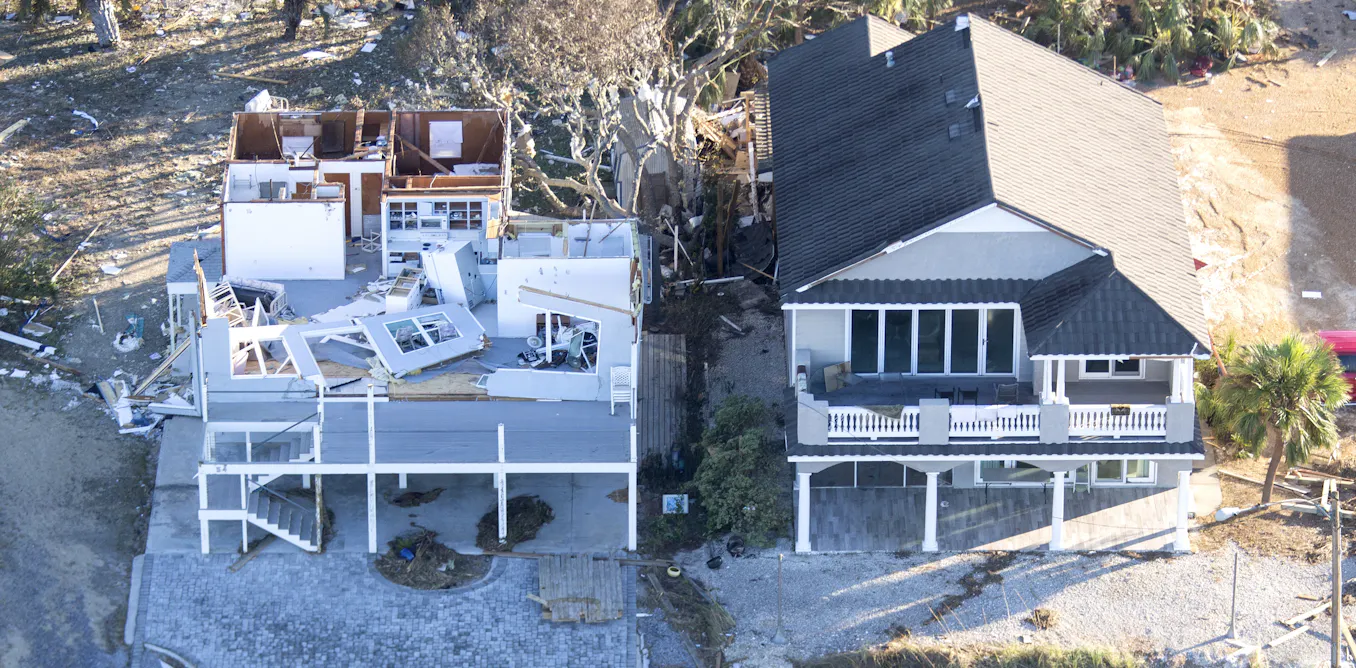
When Hurricane Michael tore through the Florida Panhandle in 2018, a beach house called the Sand Palace was left standing, while more than half the buildings around it were destroyed.
Its owners had built it to withstand roughly double the wind speed that Florida’s code required, with reinforced concrete walls on 40-foot (12-meter) pilings. The cost was about 15% to 20% more than standard construction, but the owners wanted a house that could survive storms.
Designers usually measure how “green” a building is by its carbon footprint – the greenhouse gases released making, transporting and running everything that goes into it. The Sand Palace’s extra concrete expanded its carbon footprint, making the house appear less environmentally friendly on paper.
But a green building has to last for its intentionally small carbon footprint to make a positive difference. Damage from a flood, a wildfire or a hurricane can require significantly more building materials to repair it, ballooning its carbon footprint over time.
As storms happen more often and with more intensity, considering the full life cycle of a building and its costs over time becomes increasingly important to get an accurate picture of how sustainable that building really is.
Insurance is leading the push for sustainability
Insurers may be the biggest force getting builders to consider durability.
Building codes are only beginning to take climate change into account. And green ratings like LEED – which encourage builders to make sustainable choices in exchange for the cache of the rating, which can increase property value – assess new buildings when they’re built, not after they’ve been battered by storms.
Insurers, however, have more incentive to look at the long-term costs. They often offer discounts of 15% to 30% off hurricane coverage for fortifying homes because they price a building’s risk over the life of a policy instead of just its condition on Day 1. For builders, that can mean building or retrofitting with reinforced roofing, impact-resistant windows and similar upgrades that meet independently verified wind standards.
Chandan Khanna/AFP via Getty Images
Studies that measure how much damage could be avoided from resilient design have found a similar payoff.
For example, a study of flood-prevention infrastructure in coastal Catalonia, Spain, found that flood barriers and channel improvements generated more greenhouse gas emissions during construction, but they prevented an estimated 58 metric tons of carbon-equivalent emissions per flood. Within 25 years, the emissions avoided from damage were expected to balance out the emissions from the improvements, well inside the infrastructure’s 50-year expected lifespan. Financially, the payback was far faster: about two years.
Getting resilience into the calculation
The next step is expanding that logic into standards that already shape most construction decisions.
Researchers, including myself, are proposing ways to bring resilience into the equation. Accounting for the materials, energy and disruption to a building during and after a disaster would show the true costs of a building that’s too damaged to function.

Stephen Morton/Getty Images
Three pieces are missing from that equation right now:
The first is the cost of keeping people and operations running while a damaged building is out of commission: temporary shelter, emergency generators, transportation for evacuated residents or relocated staff. None of that currently counts toward a building’s environmental footprint even though it’s a direct consequence of how that building was designed.
The second is the cost of adapting a building after an event – not just repairing it, but upgrading it to withstand the next one. That might include reinforcing a foundation that failed, elevating utilities that flooded, or replacing what was there with something built to survive next time. Each carries environmental costs that current assessments don’t measure.
The third is recognizing the damage, repairs and downtime that a resilient design choice helps a building’s owners and tenants avoid altogether. Examples already exist, like the coastal infrastructure case in Spain. What’s missing is automatically including these benefits into green-building and infrastructure assessments.
Together, these show up as real costs – in dollars, in carbon emissions and in the lives disrupted when a hospital or home loses functionality for months instead of days. They’re costs that insurers, the designers of building codes and ratings systems all have a reason to shrink.
We already know how to build homes like the Sand Palace that can stand up to disasters. What’s missing isn’t the engineering; it’s incentive to build for durability as the rule rather than the exception.
The post “The greenest building is the one still standing after a disaster” by Fernanda Cruz Rios, Assistant Professor of Civil, Architectural and Environmental Engineering, Drexel University was published on 09/01/2026 by theconversation.com