

For more than 2,000 years, scientists have scratched their heads over one of the most basic mysteries of the natural world: Where do birds go?
Billions of birds appear and disappear with the seasons every year. Early naturalists offered explanations for the disappearances that today seem fantastical: Birds transformed into other species, one theory went. Others suggested they hibernated underwater or even migrated to the moon.
The truth, that these small animals were traveling thousands of miles across the planet, must once have seemed just as improbable.
Then, in the early 1800s, dramatic evidence emerged supporting the theory of migration. White storks began appearing in Germany with African arrows embedded in their bodies. These birds became known as pfeilstörche, or “arrow storks.” They provided compelling evidence that birds disappearing from Europe were traveling all the way to Africa and back.
John Anderton/The Atlas of North America’s Migratory Birds
Almost two centuries later, scientists are still asking the same question, but our ability to answer it has been transformed.
For most of ornithological history, scientists understood migration through brief glimpses of a bird, a specimen collected somewhere else, or the rare instance of a banded bird recovered hundreds or thousands of miles from where it had been marked. From these fragments of intelligence, scientists reconstructed journeys that took place largely beyond their view.
Today, it’s possible to see the journeys themselves, almost in real time.
A century of following birds
Bird banding was the first tool used to attempt a systematic approach to connect these fragments of information. Since the early 1900s, researchers have placed uniquely numbered metal bands on birds and hoped someone, somewhere, would encounter them again.
Of more than 79 million birds banded, only about 6.5 million have been recovered. That generally told scientists just two things: where a bird was banded and where it was encountered again. Everything between them remained invisible.

John Anderton/The Atlas of North America’s Migratory Birds
Over the past quarter-century or so, the tools used to determine where birds go have changed dramatically.
Tracking devices can now be carried by increasingly smaller birds, recording their movements and communicating with land-based receivers or satellites orbiting the earth. Testing stable isotopes in feathers and other tissues can reveal where a bird originated. Genetic testing can distinguish populations.
At the same time, the extraordinary growth of bird-watching and citizen science has created another revolution.
Millions of observations by bird-watchers submitted to eBird, an online database to record the birds they see, show the distribution and abundance of birds across a continent throughout the year in ways early ornithologists could scarcely have imagined.
Collectively, these methods open an extraordinary new window into migratory birds and one of nature’s most remarkable behaviors: migration.

John Anderton/The Atlas of North America’s Migratory Birds
Discovering unknown migrations
More than 70% of North American bird species are migratory. Yet scientists have known surprisingly little about where specific populations go.
A species like the American robin may breed across thousands of miles of North America, with different breeding populations migrating to entirely different places for the winter. Birds breeding in one part of the continent may travel one route and encounter one set of environmental conditions, while members of the same species experience a completely different set of conditions along another route.

John Anderton/The Atlas of North America’s Migratory Birds
These connections between where a bird breeds and where it spends the winter is called migratory connectivity. They are critical for understanding everything from the consequences of climate change on birds to how avian pathogens and diseases spread, to a species’ basic ecology.
We are ornithologists and conservation scientists who have spent almost 15 years along with a team of contributors compiling this rapidly expanding knowledge on bird movement into The Atlas of North America’s Migratory Birds. The atlas, being published on Nov. 3, 2026, by Princeton University Press, covers the latest information on seasonal movements for nearly 600 species and combines a century of bird-banding data with eBird observations, tracking studies, stable isotope testing, genetics and other sources of information.
What emerges is a picture of migratory birds that is both more complicated and more remarkable than the simple arrows pointing between breeding and wintering ranges on a map.
Consider the yellow-billed cuckoo. These birds breed over a wide range of the eastern two-thirds of the U.S. but migrate to a relatively small wintering area in the Gran Chaco region of northern Argentina, Paraguay and southern Bolivia.

John Anderton/The Atlas of North America’s Migratory Birds
In contrast, peregrine falcons that breed in Alaska migrate almost directly south, dispersing across the Americas to wintering grounds that extend as far as southern South America.
Discoveries like these are accumulating rapidly. Collectively, they amount to a renaissance in our understanding of animal movement never before imagined.
Living masterpieces
The more clearly scientists can follow individual birds and populations across the planet, the more extraordinary these species can seem.
Migratory birds such as the arctic tern and northern wheatear cross oceans, deserts and mountain ranges. Some, like the bar-tailed godwits, fly thousands of miles without stopping. Others, like the American redstart, return year after year to remarkably precise breeding and wintering locations.

John Anderton/The Atlas of North America’s Migratory Birds
They navigate landscapes and respond to winds, weather, food and environmental conditions across enormous geographic scales.

Princeton University Press
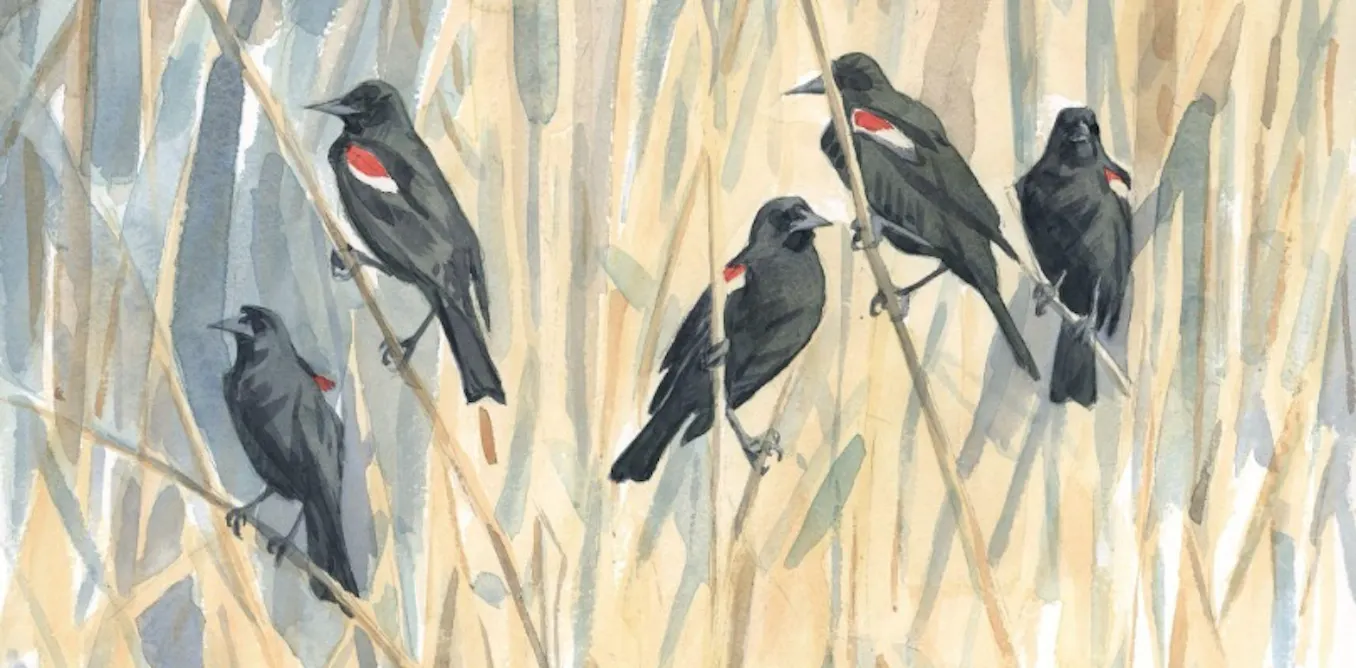
We see these species and their migrations as among evolution’s great living masterpieces. That’s why we combined science with natural history and artist John Anderton’s extraordinary illustrations of the birds themselves. The maps allow us to see where birds travel, and the art brings the species to life.
Together, they make visible something that humans could only imagine for most of our history.
A map for conservation
North America has lost about 3 billion birds during the past half-century, and many migratory species continue to decline.
To understand why a population is declining and help save it, researchers need to understand the species’ entire annual cycle: its critical stopover habitats, wintering grounds and threats along its migration routes.
For much of the history of ornithology, scientists studied birds primarily during their breeding season. That made practical sense. Birds are conspicuous then – singing, defending territories, building nests and raising young.

John Anderton/The Atlas of North America’s Migratory Birds
But a migratory bird may spend only a few months of its life in its breeding grounds. Conditions such as weather, food availability and habitat quality encountered during migration can determine whether an individual survives to breed again.
Drought thousands of miles away can affect a bird’s condition months later. American redstarts depart later after dry winters and produce fewer young. Declining horseshoe crab populations in Delaware Bay have reduced food availability for migrating red knots, contributing to lower survival.

John Anderton/The Atlas of North America’s Migratory Birds
The power of people
All of this knowledge has accumulated because people value birds and have devoted enormous time and effort to understanding them.
For more than a century, thousands of bird-banders have woken up before the crack of dawn to set traps, carefully place bands on birds’ legs and release them, often knowing the chances of ever learning what happened to those individuals were exceedingly small.
More recently, tracking technology has allowed researchers to follow individual birds across continents and oceans. Those tracks exist because scientists, students, technicians and others have spent countless hours attaching and recovering tags, and contributing and sharing their data.
Today, millions of bird-watchers contribute observations that, thanks to advances in data science, allow us to watch migration unfold across an entire continent.
We have spent much of our careers documenting the decline of birds, and we know the challenges facing migratory species are formidable. But we also have hope for these creatures’ survival. Scientists today know more about where migratory birds go, how populations are connected and what they encounter along the way than at any previous point in history. That knowledge is helping to identify where conservation efforts can make a difference for the future.
The post “For centuries, bird migration was a mystery – a tech revolution is changing that, and could help save these amazing creatures” by Peter P. Marra, Dean of The Earth Commons, Professor of Biology and the Environment, Georgetown University was published on 10/16/2026 by theconversation.com