

Secretary of state for the treasury, Scott Bessent, recently declared that the US is readying a comprehensive package of sanctions targeting Iran that in size and scale amounted to an “economic D-day”. Although a problematic analogy that does disservice to the memory of those Allied soldiers who landed in Normandy, Bessent’s choice of words does at least make clear that the events of June 6 1944 continue to have purchase in contemporary culture.
For the makers of Pressure, this is no doubt reassuring. Directed by Anthony Maras and cowritten with David Haig, the film revisits the well-known story of D-day but with a novel focus: the meteorologists who helped the generals make the decision on when exactly to land. It is beautifully shot and often engaging but flawed in key details and loses its way towards the end.
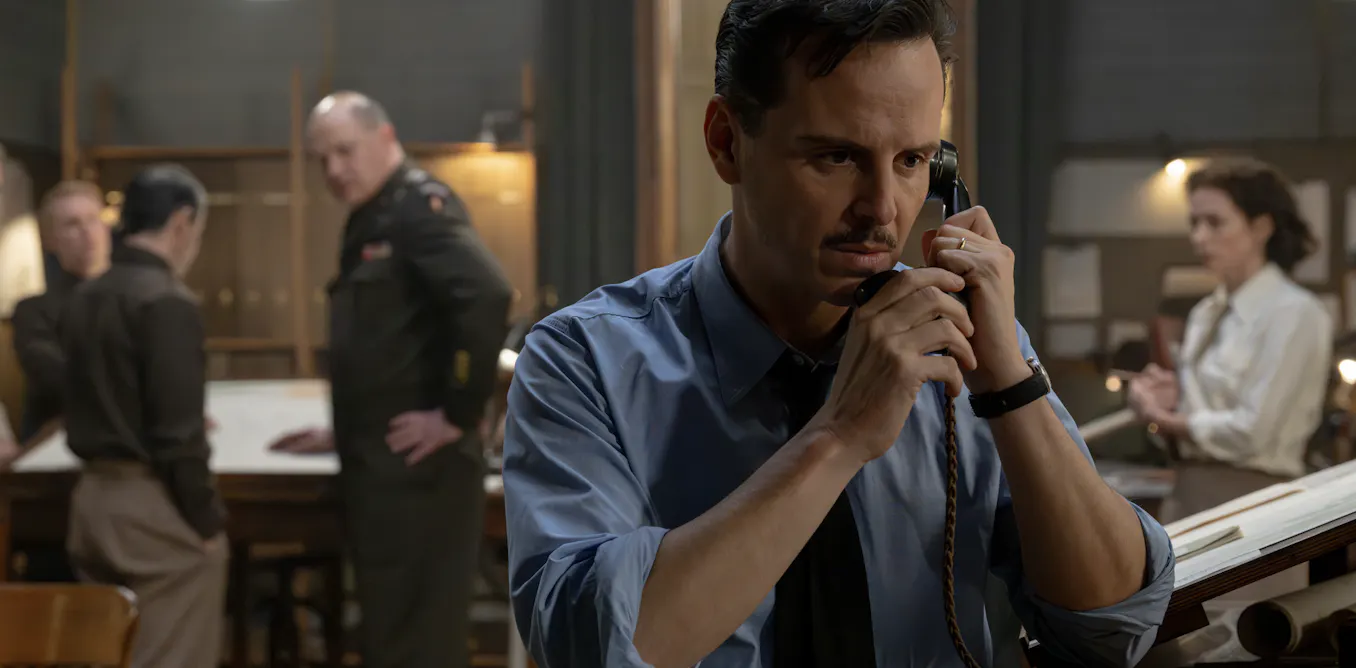
Pressure is an adaptation of Haig’s successful 2014 play of the same name. At its centre is the story of Group Captain James Stagg (Andrew Scott). Stagg was the RAF meteorologist responsible for the weather reports that helped the Supreme Allied Commander, General Dwight D. Eisenhower (Brendan Fraser), prepare for the invasion of France.
Eisenhower’s plan had several specific requirements deemed essential to success. These included a full moon, a low (but rising) tide, and calm seas. Accurate weather reports were an operational necessity. This was especially the case given the famously turbulent nature of the waters between Britain and France.
The film is at its best when it sticks closely to what had previously made the play such a success – the often tense interactions between humans dealing with enormous pressure. From the stately grounds of the Allied headquarters (Southwick House near Portsmouth), we see Stagg argue with his American subordinate Colonel Krick (Chris Messina) over the science of forecasting.
Stagg believes in using accurate real-time data from measuring stations far and wide. Krick believes that future weather cycles can be best predicted by looking at what similar pressure systems have done in previous years. On their dispute hangs the likelihood of a successful landing and also, therefore, ultimate victory in the war (or so we are told).
As the narrative builds to its expected crescendo (the invasion), we also see Stagg navigate the challenge of dealing directly with the intimidating figure of General Eisenhower. And in the background throughout is another significant pressure, one that the taciturn Stagg largely keeps to himself: the uncertainty regarding the whereabouts of his pregnant wife. He has lost contact with her following a German bombing raid on her hospital.
Alliance politics
The film offers two overall takeaways. First, that science is a complex and sometimes contested business. Eisenhower wants absolute certainty; Stagg can only offer the data together with his interpretation based on years of hard-won expertise. As he tussles with “Ike” – as Eisenhower was known – we are also given a welcome lesson in the importance of speaking truth to power, regardless of the pressure that results.
The second takeaway is that the success of the operation was at root the work of an alliance of Britons and Americans who worked together towards a common goal. As such, while we see plenty of disagreements and rivalries – Damien Lewis as a self-obsessed General Montgomery is particularly good – the Allies ultimately rally for what Eisenhower famously called the “great crusade”. Given today’s tensions in the transatlantic relationship this, too, is very welcome.
Studiocanal
For all its qualities, though, and for all Andrew Scott’s skill in his portrayal of Stagg, the film does have some flaws.
Like several other historically focused productions, Pressure overplays the extent to which it is delivering an “untold” story. After all, it is based on a successful play, while the contributions of Stagg to pre-D-day planning also received attention in both The Longest Day (1962) and, more recently, Ike: Countdown to D-Day (2004). Stagg himself also authored a 1971 account of his D-day role. The story of D-day’s meteorologists might not be widely known; but that’s not the same as saying it is “untold”.
There are also some problems with Fraser’s portrayal of Eisenhower. He successfully captures Ike’s famously short temper as well as the extent to which he almost drove himself to breaking point in the days before the invasion. We’re also given a tantalising glimpse of his close and complicated relationship with Kaye Summersby, his indispensable driver, assistant and confidante (brilliantly played by Kerry Condon).
But we see relatively little of those other qualities which made Eisenhower so well-suited to the job he’d been given. Ike was an instinctive diplomat who successfully managed a transatlantic command team that included a good quota of egos and primadonnas. Unfortunately, though, this does not really come through, and we’re often left with the sense that he brought to the role little more than a capacity to glare, shout, smoke and drink.
Studiocanal
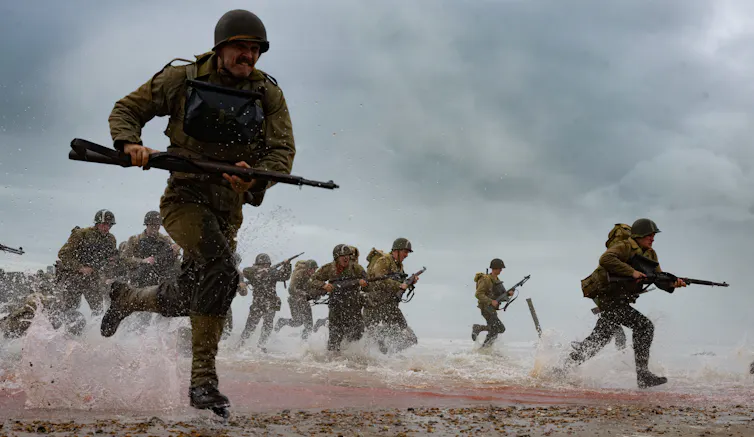
Perhaps the film’s biggest flaw, however, is in its final scenes which drift into what almost becomes a homage to Saving Private Ryan (1998). In doing so, Pressure loses sight of where its real contribution to the cinematic history of D-day lies. Not in revisiting the heroism of those brave souls who landed in the first waves, but in telling the story of those who worked steadfastly behind the scenes to give them the best chance possible of success.
The latest in a long line of D-day focused productions, Pressure is an engaging film that shines a welcome light on an important aspect of the Allied landings. But Maras would have done well to keep the focus throughout on the fallible humans working behind the scenes in England to meet the epic challenges that accompanied an epic operation.
The post “Pressure: Andrew Scott excels in D-day drama that gets caught between history and Hollywood” by Sam Edwards, Reader in Modern Political History, Loughborough University was published on 09/10/2026 by theconversation.com