

With climate change leading to more extreme and prolonged heavy rainfall across the northern hemisphere, flooding is a risk, especially in autumn and winter.
While concerns typically consider travel disruption and damage to housing, the top cause of death during flooding occurs from driving through floodwater. In England alone, there have been with several high-profile deaths in recent years in Derbyshire (2021), Liverpool (2023) and Lancashire (2024).
My team’s research investigates the factors affecting people’s decisions to drive into floodwater. We also explore what can be done to more effectively warn drivers about the dangers associated with floodwater.
Many drivers expect the worst that can happen is their car might be damaged. But driving through floodwater can lead to drowning due to the car floating and being carried downstream.
Our national survey of 185 drivers found widespread understanding that water depth is a critical factor. Around 80% correctly identified depths above 25cm as being not safe to drive through.
However, most of the drivers didn’t recognise the effect of fast-moving water during flood conditions. Even when directly asked how they would judge the speed of water, they typically responded in terms of water depth.
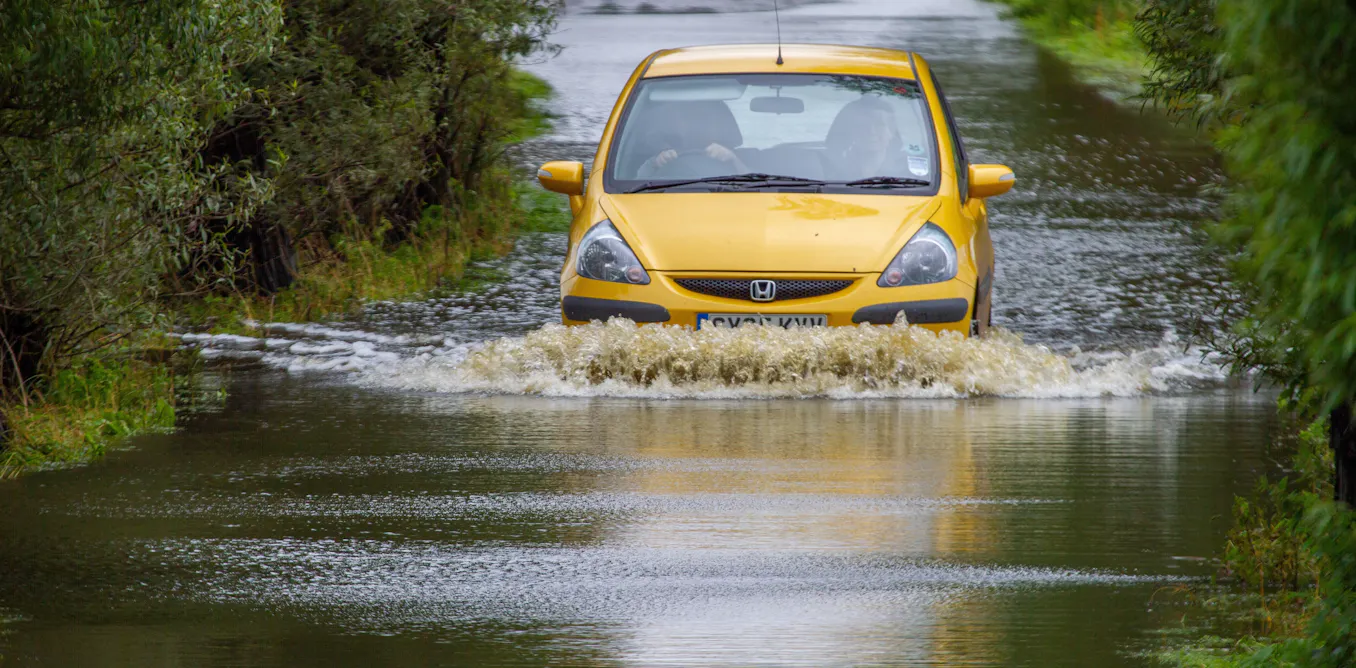
This is worrying. While deep water immobilises a vehicle, flowing water can take a car downstream, because modern cars tend to initially float due to being so well-sealed. Floating vehicles can lead to drownings, particularly if the car then hits an obstacle and turns over.
Philographer/Shutterstock
Drivers commonly judged their ability to drive through water based on the ability of another car to pass through the floodwater. However, it is more sensible to stop and check water depth based on roadside features such as water gauges at fords, or the distance water has risen up signposts, fencing and grass verges.
This is particularly important as even cars of the same size and height car move differently in water – because of the different positioning of air intakes on petrol and diesel cars, for example.
Drivers don’t trust static flood signage
There is not yet any guidance in the UK’s highway code on how to address floodwaters or drive through forded roads.
Static flood road signage is ineffective. Our research into how drivers respond to common road signs found they were more likely to obey the speed limit and stop signs than to turn around for a static flooding sign.
Drivers don’t trust static flood signage because it is often left out by councils and highways agencies long after floodwater has subsided.
So, we developed a dynamic LED signage system that alerted drivers to flooding in real time, to investigate whether it would be more effective.
We tested drivers’ responses using examples of ten signs in dynamic LED and static signage formats. Both inexperienced and experienced drivers found dynamic signage to be more effective and memorable for eight of the ten signs.
The biggest difference in effectiveness was for our prototype dynamic flood sign, with almost double the number of drivers fixating on the dynamic sign, compared with the static one.
If you are confronted with floodwater on a road, only drive through it if the depth of water is less than 10cm for a standard car, and no more than 30cm for an SUV. Bear in mind the deepest part might not be in the middle of the road.
Ripples on the water’s surface can be a sign that floodwater is moving quickly and is more dangerous to drive through. If you are in any doubt, the safest thing to do is turn around and find another way.
The post “Driving through water is the biggest cause of death during floods – here’s how it can happen” by Matthew Watkins, Associate Professor in Sustainable Product Design Engineering, Loughborough University was published on 09/17/2026 by theconversation.com