

Australians love a good reno.
Whether they revolve around a modest fixer-upper or a mansion makeover, renovation shows are among the most widely watched TV genres in Australia.
However, our houses are some of the least sustainable in the world. They produce about 10% of our nation’s total carbon emissions, are typically more expensive to run and can be uncomfortable to live in.
I’m a behavioural scientist who studies how people make decisions about sustainability and energy efficiency. For my latest research project, I looked at how a TV renovation program could encourage people to make energy-efficient upgrades to their own homes.
What is sustainable housing?
It’s difficult to define exactly what makes a house sustainable. That’s because architects, building scientists and energy efficiency experts can each have different priorities and opinions when designing a home that is sustainable.
However, they would generally agree a sustainable house is designed to:
-
suit its local climate
-
use natural sources of heating and cooling, through measures such as north-facing orientation and external shading
-
include energy-efficient appliances
-
incorporate materials that are more durable, and
-
use less water.
Danie Nilsson, Author provided (no reuse)
Why sustainable housing matters
In Australia, housing accounts for more than 10% of our total carbon emissions. Building and renovating our homes to be more sustainable is crucial to reach our national target of cutting emissions to 62-70% below 2005 levels by 2035.
But it’s not just the climate that benefits. Compared to existing houses, sustainable homes are generally cheaper to run and are more comfortable to live in. Many of Australia’s established homes could be described as “glorified tents” that fail to keep warm air in and cold air out, leaving homeowners with soaring power bills.
This is because millions of Australian homes were built before energy efficiency standards existed. More than 80% of established homes in Australia score two stars or less under the Nationwide House Energy Rating Scheme, which rates homes on a scale of zero to ten stars in terms of energy efficiency.
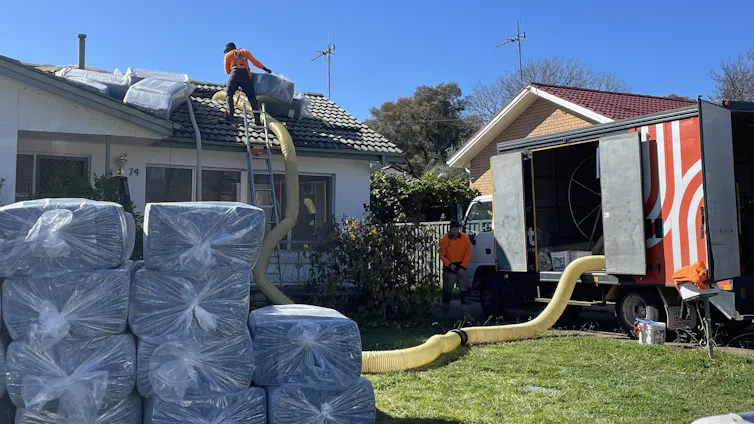
The good news is retrofitting these houses – say by installing insulation or adding window curtains – can cut their energy bills by up to 40%. That’s why many organisations are working to retrofit millions of existing homes across Australia.
Perhaps unexpectedly, they aim to do this through TV and other types of entertainment.
Read more:
‘A giant blanket’: how better insulation lowers energy costs for you and the grid
Television as a tool
The concept of “climate storytelling” is all about embedding stories, data and references to our changing climate in the mainstream media.
Rather than simply pumping out new documentaries, it’s about spotlighting climate in the films and TV shows people already love to watch. Consider medical dramas that examine how extreme weather could impact our health or political series that make climate policy a central part of their plot.
Even cooking shows can increase people’s confidence in more climate-friendly behaviours, including preparing plant-based meals and reducing meat intake.
Behind the scenes of ‘Big Little Reno’
My latest research project aimed to bring climate storytelling into the world of TV renovations.
Danie Nilsson, Author provided (no reuse)
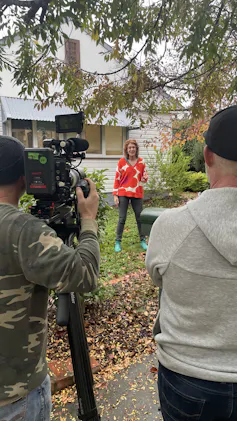
“Big Little Reno”, which premiered on Australian TV channel 9Life this week, is designed to help viewers upgrade their homes to be more energy efficient with a budget of A$50,000. It builds on our previous research on “Renovate or Rebuild”, another TV program that has been watched worldwide and is now in its third season.
“Renovate or Rebuild” aimed to increase demand for sustainable homes when building or buying. Our research suggests this program increased viewers’ desire for more energy-efficient homes. With “Big Little Reno”, we aim to get people to upgrade their existing homes to have greater energy efficiency.
The TV program itself is supported by a website and social media content. These resources focus on small-scale home energy upgrades – such as draught proofing and gap sealing – that viewers can quickly complete at low cost. By focusing on simple and affordable upgrades, we hope viewers will make these changes themselves and reap the benefits.
Read more:
Even in a housing crisis, Australians can’t get enough of renovation stories on TV. Why?
Little reno, big impact
It’s still early days for the “Big Little Reno” project. But I hope it will be an informative, engaging program that persuades people to upgrade their homes to be more energy efficient.
Importantly, it is also relatable, with the pilot episode featuring a young couple working with a modest budget of $50,000. After all, high upfront costs are a barrier homeowners face when attempting to make sustainable housing choices.
Another key obstacle is not having trusted, reliable tradespeople who can complete energy upgrades. That’s why we designed “Big Little Reno” to purposefully feature skilled tradespeople working and promoting behaviours that support Australia’s clean energy transition.
Danie Nilsson, Author provided (no reuse)
The post “We love TV reno shows. Could they help us build more sustainable homes?” by Danie Nilsson, Behavioural Scientist, CSIRO was published on 09/30/2026 by theconversation.com