

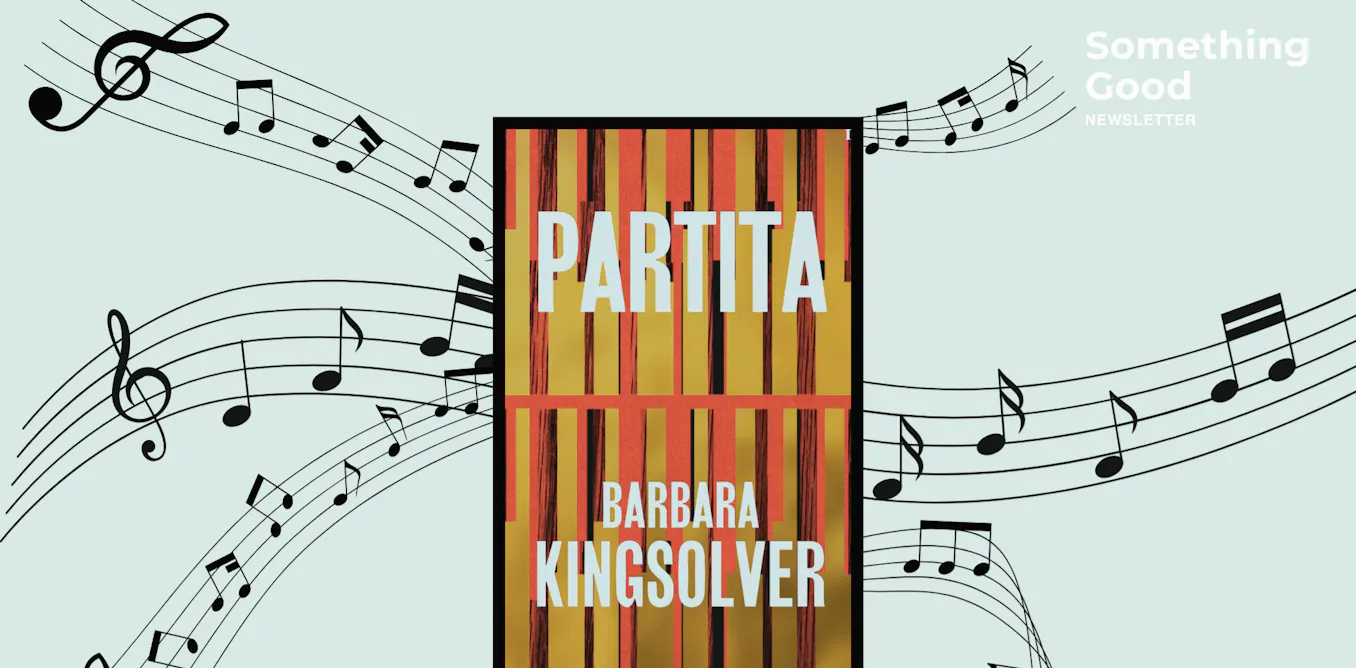
Barbara Kingsolver’s new book is a canny feat of art imitating art. Partita is about a pianist, Livia, looking back at her life and trying to understand what art means to her.
It’s structured the same way the composition from which it takes its name is. A partita consists of a series of dance movements, typically written for a solo instrument, that vary in pace and mood. All these parts must come together to form the whole. In much the same way, Livia and the reader must bring these movements together to achieve a sense of completeness and understanding.
Each chapter is named for the various elements common in musical compositions and they follow their moods and pace. For instance, the novel’s sarabande chapter is calm, reflective, or emotionally intense like it would be in a piece of music. In this way, the book doesn’t have a linear structure as various chapters serve as refrains (a rondo) or go back to the beginning (Da Capo).
The story alternates between formative events from Livia’s adolescence and early adulthood as well as the present when Livia is in her mid-40s. As the pieces come together, we see Livia as a whole. She was a prodigious young piano talent working hard to keep up her prestigious scholarship. She then gets pulled into the exciting world of an older trade unionist and starts questioning everything. In the present, she has become a middle-aged woman who is an inspirational local music teacher in Tennessee.
Our reviewer found Partita to be a virtuosic work that in its inventiveness creates a fascinating character study of a middle-aged woman’s life and relationships. This book is a testament to the importance of access to art and celebrates those who help provide it. In this vein, I really enjoyed the listening list of classical songs that Kingsolver provides to accompany your reading. This in itself is a quiet but lovely gesture, as our reviewer notes, “including [the reader] in a world that may feel out of reach”.
Partita by Barbara Kingsolver is out now
Painters of different persuasions
Another American who wanted us to questions our relationship to and how we consume art was Robert Ryman.
Ryman thought that “you cannot understand a painting by explaining something. You can only understand painting by experience”. And so, in his show, Robert Ryman: The Real Thing, at London’s Barbican you won’t find much information to go on. In fact, as our reviewer can attest to, there arnen’t even labels to identify the paintings.
Bringing together 68 works from the mid-1950s to the early 2010s, this is a show that demands your attention. There are a lot of white canvases, which if you glance over seem indistinguishable but you need to look closer. Every choice the curators have made – from the lack of information to the way the lighting is directed – forces the viewer to engage. This is a difficult show in a modern age where our brains refuse to sit still and I think it is a challenge many of us should take on.
Robert Ryman: The Real Thing is on at Barbican Art Gallery, London until February 28 2027
Read more:
Robert Ryman: The Real Thing at the Barbican – these mesmerising paintings must be seen in person
If you’re looking for something a bit more traditional then you can catch Renoir and Love at The National Portrait Gallery. Now the title would make you think you might be confronted with rooms full of his kistch nudes, however, this show is more a celebration of life’s many loves – from a good catch up with friends and a dance to that wonderful feeling you get after a very good meal.
It is an ambitious show bringing together his breakthrough impressionist paintings from the 1860s to 1880s. Our reviewer was in awe of Dance at the Moulin de la Galette (1876) in particular. Getting to see this impressive, large painting, he described the experience of seeing it in the flesh as startling.
Renoir and Love is on at The National Gallery, London until January 31 2027
Read more:
Renoir and Love is a wonderful celebration of the fleeting joys of life
Uncovering the truth
On the big screen this week comes the follow-up to The Social Network. The Social Reckoning shows a company and a CEO which have become very different beasts. There’s been a mutation of Mark Zuckerberg from awkward nerd (played by Jessie Eisenberg) to sinister billionaire CEO of tech conglomerate Meta (played now by Sucession’s Jeremy Strong). Meta is also now a company that in Zuckberg’s words sees itself as “post-government” and is doing untold damage to the world through social media.
The Social Reckoning is part of the growing genre of films about crusading journalists trying to break a big corruption story. Think Spotlight (2015) about Boston Globe journalists who uncover systemic cover-ups of sexual abuse within the Catholic Church. Here, we follow The Wall Street Journal reporter Jeff Horwitz and engineer Frances Haugen whose conscience drives her to whistleblow on some of the company’s most guarded secrets. Our reviewer thought it was remarkable, especially in how it reflects a world increasingly managed by Silicon Valley logic.
The Social Reckoning is in cinemas now
Read more:
The Social Reckoning is a true American horror story
On the small screen, we’re into the second week of Celebrity Traitors and boy are things already juicy. What was Richard E Grant thinking? If you’ve not caught up yet, that is all I will say.
In this piece, psychology scholar Paddy Ross explains what effect fame has on the game. What impact does being a fan of model Jerry Hall have on how trustworthy you think she is or how much you like the work of comedian Romesh Ranganathan? From the “big dog” theory to halo and the horn effect, Ross outlines who might benefit from being known.
Celebrity Traitors is on BBC One weekly
The post “Art imitates art in Barbara Kingsolver’s new book – what to read, see and watch this week” by Naomi Joseph, Arts + Culture Editor, The Conversation was published on 10/09/2026 by theconversation.com