

There’s no tree like the humble eucalypt.
Eucalypts play a pivotal role in forests, cycling nutrients, storing carbon and providing hollows and shelter for animals, including the elusive yellow-bellied glider (Petaurus australis) and aptly named glossy black cockatoo (Calyptorhynchus lathami). In particular large, old eucalypts are critically important for thriving ecosystems.
Eli Bendall
Tragically, eucalypt forests across the country have been ravaged by fire in recent years. In early 2019, fires in Tasmania killed many of Australia’s largest known eucalypts. A short time later, the horrific Black Summer bushfires of 2019-20 burned roughly seven million hectares of eucalypt forests across eastern Australia.
Our latest research examined eucalypt forests burnt by the 2019-20 bushfires. Our findings suggest large, old trees growing in wet forests were most affected. Our other research shows species growing at the dry edge of their natural range are most at risk of being wiped out by future severe fires.
From the ashes
More than 800 known species of eucalypts are found across Australia, from the arid deserts of Central Australia to Victoria’s high country. There are few environments to which they haven’t adapted.
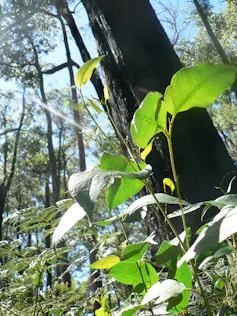
Following fire, many species can resprout by growing new leaves. A tree’s
“resprouting response” depends on several factors, including stem size, bark type, prior fire damage and fire severity.
Rachael Nolan
However, existing resprouting classifications for eucalypts don’t account for these factors. This means some populations or individuals of “resprouting” species might not recover in the expected way. For example, they may have greater rates of tree mortality than expected, and be reliant on new seedlings for the forest to recover.
What’s more, scientists don’t fully understand how eucalypts cope with fire if they are at the limit of their “climatic range”. Consider a tree growing at the extreme low-rainfall edge of its distribution. Could it struggle to resprout? Might it fail to produce seedlings?
The 2019-20 Black Summer fires ignited off the back of three devastatingly dry years, ominously known as the “Tinderbox drought”. Our current climate change trajectory suggests the conditions necessary for fires to spread through the landscape may become increasingly common.
In the wake of the Black Summer, scientists studied the amount of forest impacted by fire, including the amount that was severely burnt. Our latest research examined how this “one-two punch” – record-breaking drought followed by severe bushfires – transformed eucalypt forests across eastern Australia.
What we studied
We measured several variables that signal change in eucalypt forests. These included:
-
seedling recruitment, or the process in which seeds successfully germinate and grow into new trees
-
tree mortality, meaning the complete death of trees in a forest
-
“topkill”, where a tree’s trunk and branches are killed and the tree only survives by resprouting new leaves from its base.
We surveyed multiple forest types, ranging from dry eucalypt forests on poor soils to wet eucalypt forests on more fertile soils. We also took measurements across the climatic range of several different species, with field sites stretching from far northern New South Wales to Victoria’s East Gippsland region.
Dry forests growing on poorer soils proved surprisingly tough. Fewer large trees died and more young trees survived, compared to forests growing on wetter, more fertile soils. Wet forests lost many of their biggest trees, which were either topkilled or wiped out completely.
Two species, Eucalyptus dalrympleana and Eucalyptus radiata, suffered higher mortality and topkill at the dry end of their range. But a third species, Eucalyptus dives, held firm across its range, experiencing average levels of damage irrespective of the climate it grew in.
Recruitment of new seedlings was generally lower in drier areas, though results varied across species.
Big trees most at risk
Some forests are at risk of losing their big trees, and more trees in general. We may want to pay more attention to these forests, particularly when it comes to managing fire in the landscape. Eucalypt forests may take decades to regain their structure and complexity, or be at risk of more permanent changes if severe fires become more common.
Eli Bendall
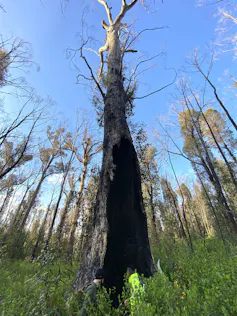
Our research suggests large trees with fire scar injuries are particularly vulnerable to severe fires. Fire scars can damage the structural and conductive tissues that help trees survive. They also allow fire, fungi and insects to enter the tree, creating cavities and increasing the tree’s risk of collapse.
Some eucalypt species suffered higher rates of topkill among large trees. While these trees did not die, they will likely need a long time to recover.
Other species generally resprouted from their trunks and branches, suggesting they may be capable of coping with the worst nature throws at them.
More work ahead
Our findings suggest forests adapted to drier, challenging conditions may be more able to withstand severe disturbance, at least structurally. Forests adapted to more fertile, moist conditions appear less able to cope with the double whammy of severe drought plus fire, losing more large trees.
Importantly, if we identify species that respond poorly to fire at the edge of their climatic range, we can factor this knowledge into forest management. For example, we could aim for longer fire intervals and lower fire severity where appropriate, to minimise impacts on sensitive tree populations. We must also rethink how we classify resprouting behaviour to account for tree size, climate and the severity of fire or other disturbances.
There’s still much we don’t know about how eucalypts recover from fire. But every bit of research will help us protect them from future blazes.
The post “While some eucalypts are hard to kill, climate change may test the ability of others to survive” by Eli R. Bendall, Postdoctoral Research Fellow, Plant Conservation and Climate Change Adaptation, Western Sydney University was published on 10/25/2026 by theconversation.com