

As Halloween approaches and screen audiences are saturated with the sights and sounds of screaming women in horror films and TV shows, it’s a great time to look at the women whose vocal artistry created genuinely effective screams on screen.
Behind every memorable cinematic scream lies a vocal performance that is often reduced to a natural, unreflective outburst. But that assessment obscures the women behind its most powerful manifestations. For example, think of the work of Shelley Duvall in The Shining, Janet Leigh in Psycho or Toni Collette in Hereditary.
Certain screen actors have made the scream their calling card to fame and notoriety, under the designation “scream queen.” These queens are the unsung heroes of the horror industry through their dedication to the vocal performance of the fear and terror in the many guises of horror.
Long live the (scream) queen
As onscreen horror proliferated in the 1970s, the term “scream queen” became popular, most notably through Calvin Beck’s 1978 book Scream Queens: Heroines of the Horrors. Later, in popular culture, “scream queen” applied to “any female star who has made a career playing women who survive extreme trauma or peril.”
Hollywood actress Jamie Lee Curtis qualifies to bear the mantle of “scream queen,” alongside others like Lin Shaye, Brinke Stevens, Michelle Bauer, and Linnea Quigley.
While Curtis is well-known, the other actors may be less familiar even though they collectively have hundreds of film credits to their names, predominantly in low-budget horror productions. Those films occupy a robust and commercially significant segment of the film market. The market has shown remarkable resilience, even during the COVID-19 pandemic that saw a spike in people watching horror films.
The onscreen scream
Screen horror has relied on the scream as a sonic marker since the advent of sound film, and even earlier in the form of the silent scream.
Screaming is a non-linguistic vocalization, like laughing and crying, rooted in ancient neural systems associated with survival. Its distinctive acoustic properties can engage subcortical mechanisms of threat detection, triggering heightened vigilance and lending the scream a particular communicative immediacy.
Filmmakers exploit the scream’s capacity to evoke terror, but it can also express delight at a surprising revelation (the announcement of the band Donna and the Dynamos in Mamma Mia!) or amusement over a comedic situation (when cross-dressing Robin Williams’ fake breasts catch fire in Mrs. Doubtfire). It can likewise signify pain, most notoriously embodied in the male “Wilhelm scream” that has found use in more than 400 films, including Star Wars and the Lord of the Rings.
Fay Wray: The original scream queen
Cinema of the early 1930s is rife with examples of horror, including Frankenstein (1931), Dracula (1931), The Mummy (1932) and King Kong (1933). It was in King Kong, however, that the prototype of the scream queen emerged through the vocal artistry of Fay Wray.
As she later recalled in her autobiography, Wray entered an RKO sound studio before the film was edited to record a repertoire of screams and moans for insertion into the soundtrack — she called it an “aria of agonies.”
Her screaming voice was heard in several other horror films of the time, establishing her reputation as the imperilled heroine, a historical precedent to later scream queens. Wray’s screams in King Kong subsequently entered the repertoire of sound effects (re-)deployed by sound engineers, reinforcing her status as a progenitor of the scream queen.
(RKO pictures)
Empowering modern scream queens
As horror cinema exploded into commercial prominence during the 1980s and ‘90s, the scream queen became one of horror’s defining female figures. Jamie Lee Curtis’ performance in Halloween (1978) was decisive not only for her career but for the evolution of the modern horror film and its female protagonist.
Alongside Curtis, other scream queens like Linnea Quigley, Michelle Bauer and Brinke Stevens, whose names are less well known, emerged. They helped move the genre from the “final girl” model toward a fusion of horror, camp and sex appeal.
The final girl refers to the trope of the last woman standing in a horror film; she’s the one who finally takes on the villain. Still, Curtis’s final girl proved enduring, evolving from a vulnerable survivor in 1978 into a formidable older heroine in the Halloween franchise’s later instalments.
The shift toward female strength is exemplified by the career of Lin Shaye, whose work has appeared in more than 100 films over a span of 50 years.
Shaye challenged the scream queen’s traditional association with youth and sexualized representations. She was most recently associated with the Insidious franchise, where she has served as the protagonist, psychic medium Elise Rainier.
Recognizing that “people attribute growing older to authority,” Shaye has redefined the conventions of the scream queen through her portrayal of an older heroine whose experience, knowledge and agency become sources of power. Her body of work reflects an ongoing resistance to constraints that age, gender and genre might impose on her.
She believes people want “to see a person…have strength rather than be a victim.”
Although Shaye continues to perform the screams associated with the genre, her portrayal of Rainier privileges authority over vulnerability, transforming the scream queen from a terrorized victim into an empowered agent.
A new era of scream queens
As the scream queen transforms from vulnerability to empowerment, another change is in the works. Historically, the scream queen casts were almost entirely white women. This raises the question: What kinds of bodies are privileged to scream on screen?
A diverse cast of scream queens may be making their way onto screens.
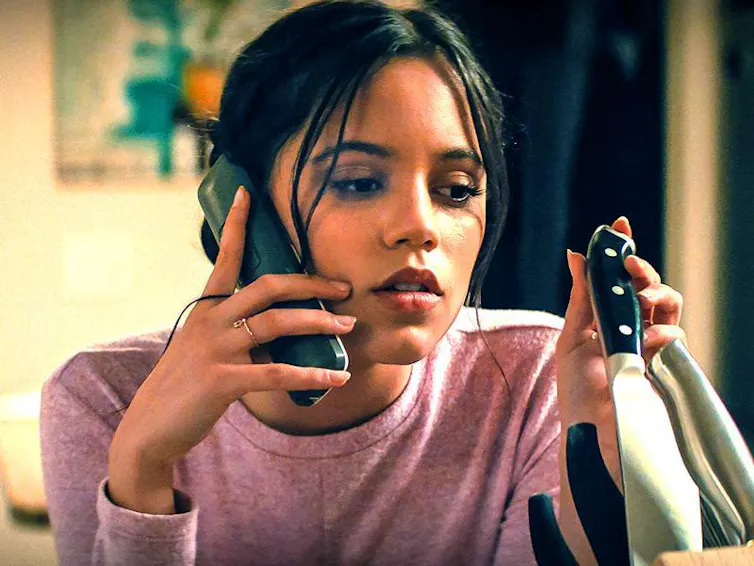
Recent horror movies have introduced a new generation of scream queens to the cultural zeitgeist. Actress Jenna Ortega has been called “Gen-Z’s Scream Queen”, with her high-profile characters in _
Wednesday_, X, and Insidious. Her work has been applauded for her raw emotion, strength and animalistic vocalizations.
(Paramount)
Ortega’s work, alongside that of British actress Mia Goth, signals a shift in the genre. These women have made greater space for racially diverse and complex representations of women in horror.
From victim to agent, the scream queen continues to draw and influence audiences. The scream was never just a simple reflex; it’s always been an artful cry.
The post “The female scream is now an all-powerful cry in horror films” by James Deaville, Professor of Music, Carleton University was published on 10/27/2026 by theconversation.com