

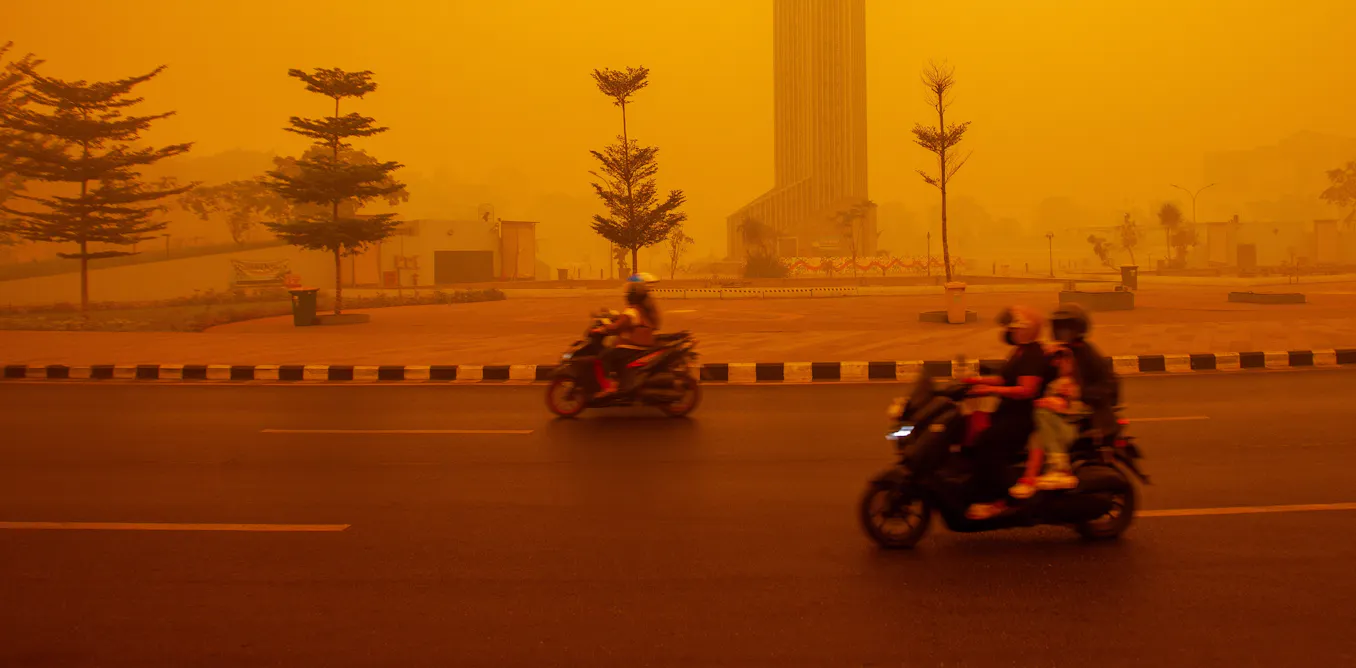
Right now, people in parts of Indonesia are inhaling what may be the most polluted atmosphere on Earth. As the historically large 2026 El Niño intensifies, parts of south east Asia have been plunged into an air quality crisis of catastrophic proportions.
Smoke from fires has driven concentrations of dangerous and tiny particulate matter, known as PM2.5, to extreme levels – creating a public health emergency threatening millions of lives.
The World Health Organization (WHO) stipulates a maximum breathable “safe limit” of 15 micrograms per cubic metre of PM2.5 across a 24-hour average. In haze affected parts of Indonesia, this year’s concentrations have routinely exceeded 500 micrograms, and even 1,000 in places – that’s more than 65 times the WHO maximum.
This is not the kind of polluted air you might find on a smoggy day in most parts of the world – it is a toxic atmosphere considered by the US Environmental Protection Agency to be “hazardous”. The delayed effects of breathing such air include increased risk of heart attack, stroke and a host of respiratory illnesses.
The roots of the crisis
The catalyst for this year’s crisis is a collision between meteorological events and decades of changes to Indonesia’s landscape. The historically intense El Niño has brought a punishing dry spell across the archipelago, leaving the landscape parched.
But the weather is only the match; land management practices provide the fuel.
Sipa USA
Historically, lowland tropical forests growing on peat soils were naturally resistant to fire because of their moist conditions. However, deforestation for agriculture, forest fragmentation and peatland drainage have drastically altered the landscape and increased its flammability.
The effects can extend beyond the areas directly cleared or drained: even untouched forest close to degraded areas will have lost some of its natural fire resistance. The El Niño-driven drought has supercharged these changes, making it easier for fires to take hold and spread.
The hidden cost of peat fires
Fire is widely used across the region, to help prepare land for agriculture, clear low-lying vegetation, or to burn household waste. Yet, when fires are set during a drought, they can ignite the drained peatland soil and escape into the surrounding landscape.

Martin Wooster
A peat fire does not simply flame and pass; it also smoulders downwards into the ground, sometimes burning for weeks or months. An alarming consequence of peat fires is the release of ancient carbon—organic matter that has been safely locked away for hundreds of years. This carbon generally won’t be reabsorbed by future forest growth, as the land has been repurposed for agriculture. It is a permanent transfer of carbon from land into the air.
This year alone, Indonesia’s fires have released an estimated 175 million tonnes of carbon, equivalent to three-quarters of the country’s annual fossil-fuel CO₂ emissions and exceeding the combined annual fossil-fuel and industrial CO₂ emissions of the UK and France.
The scale of the 2026 fire and haze marks a setback after some years of progress. There has been a promising downward trend in regional fire activity, due in part to improved fire management and efforts at “re-wetting” peatlands to make them less flammable.
The severity of the current El Niño has interrupted this good work. Satellite analysis indicates more than 120,000 fire hotspot detections across Indonesia so far – fewer than in 2015 (another El Niño year), but seven times as many as in 2025.
The human and economic cost of the resulting haze is staggering, and many will likely perish from the effects of the toxic smoke. The haze has also drifted beyond Indonesia, at times blanketing neighbouring Malaysia, Brunei, southern Thailand and Singapore.
The health effects of wildfire smoke extend around the world. Globally, exposure contributes to a million or more premature deaths each year, including almost one in ten deaths of children under five.

Martin Wooster
From detection to prevention
Worryingly, the number of fires in Indonesia could actually be underestimated as satellites are less effective at detecting the lower temperatures of smouldering peat fires. New technologies designed to better detect these fires could help authorities identify them sooner and respond more quickly, provided the data can be rapidly delivered to those who need it.
But better detection and fire suppression can only do so much. In many areas, the key action is to restore drained peatlands so they are less vulnerable to fire in the first place. A new national peatland and mangrove management agency is being established with this remit.
For now, the immediate prognosis remains bleak. It is hard to extinguish underground peat fires once they have taken hold, and the 2026 El Niño is projected to intensify until the end of the year. The immediate crisis will eventually end, but reducing the risk of future disasters will require Indonesia to restore and protect its peatlands with renewed vigour.
The post “Indonesia’s El Niño-driven peat fires are choking the region – and releasing centuries of stored carbon” by Gareth Roberts, Associate Professor, School of Geography and Environmental Science, University of Southampton was published on 10/27/2026 by theconversation.com