

Fantasy accounts for only about 28 minutes of Pan’s Labyrinth’s 119-minute running time, yet these supernatural scenes are what many viewers remember most about Guillermo del Toro’s 2006 film. A rewatch 20 years on makes it easy to see why.
Despite everything del Toro has achieved since, including his Oscar success for The Shape of Water (2017), Pan’s Labyrinth remains for many (including me) his magnum opus.
The film weaves together the brutality of a war drama with a dark, mythic undercurrent. Set in 1944, five years after the Spanish civil war, the story follows General Francisco Franco’s regime as it brutally suppresses lingering Republican resistance. The grim reality is filtered entirely through the eyes of a child, Ofelia (portrayed by Ivana Baquero).
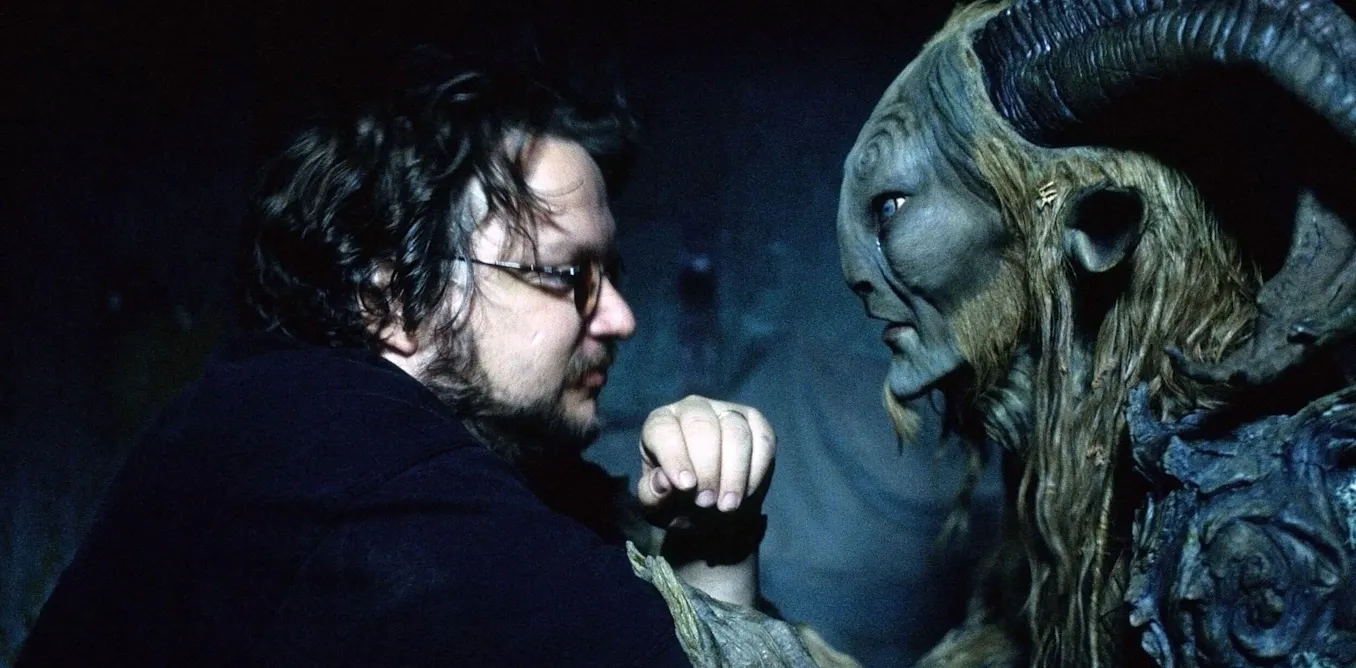
Described this way, it is difficult not to think of the Upside Down world in Stranger Things (2016-25). Particularly given the striking visual similarities between the Demogorgon and del Toro’s iconic Pale Man (played by Doug Jones, who also plays the Faun and has appeared in six of the director’s films).
In a recent rewatch of Pan’s Labyrinth, I was reminded of the film-maker’s expertise and the dark beauty I had remembered so vividly back in 2006. What I hadn’t remembered, however, was just how sparse the overtly supernatural elements are, occupying less than half an hour of the total run time. Their relative scarcity confirms just how powerful and arresting del Toro’s imagery is, and how less can be more when expertly applied.
The monstrous Pale Man, for example, an anthropomorphic beast with eyes in the palms of his hands who gorges on children, occupies surprisingly little screen time. Yet it came to dominate my memory of the film. Publicity stills probably had something to do with that – but the lasting trauma the Pale Man represents is also testament to del Toro’s skilful layering of two parallel worlds.
The fairytale world mirrors the horrors of Francoist Spain during the summer of 1944, predominantly experienced through the eyes of 11-year-old Ofelia.
The nightmarish Pale Man finds a real-world echo in Ofelia’s military stepfather, Captain Vidal (Sergi López). He’s an authoritarian narcissist and avatar of Francoist power. Vidal is dedicated to hunting down the Spanish maquis (anti-Francoist guerrilla fighters) and subjecting them to horrific cruelty. He exerts a different but no less suffocating form of control over Ofelia and her pregnant mother. He regards her unborn baby less as a child than as an heir, destined to continue his name and legacy.
This theme of legacy extends into the film’s mythical realm when the Faun reveals Ofelia’s true identity as a lost princess. To reclaim her throne, she must complete three quests that directly mirror the horrors of her everyday world. In one trial, Ofelia retrieves a key from the belly of a giant toad – a task that runs in parallel with the maquis rebels’ desperate bid to steal Vidal’s storeroom key for food and supplies.
A maze of cinematic influences
The film echoes Jim Henson’s Labyrinth (1986), which turns 40 this year. As in Henson’s film, Ofelia’s journey into a mysterious world becomes a test of growth, doubt and temptation.
Ofelia’s quest to heal her mother and save her brother recalls Sarah’s mission in Labyrinth. Other moments echo classic 1980s dark fantasy. A chalk portal brings Tim Burton’s practical effects in Beetlejuice (1988) to mind. Meanwhile, the final chase through the maze evokes Stanley Kubrick’s The Shining (1980).
Read more:
Why Jim Henson should be recognised as one of the foremost creators of fairytales on screen
Yet del Toro has been careful to distinguish his labyrinth from other mazes. In an interview around the film’s original release, he observed that “a maze is a place where you get lost”, whereas “a labyrinth is essentially a place of transit”. This distinction is key to appreciating del Toro’s complex vision. The film is rich because it charts a transitional moment for Spanish society, while Ofelia’s journey embodies hope, agency and choice against a backdrop of fascism, which del Toro described as an “institutional lack of choice”.
FlixPix
Choice, obedience and temptation come vividly to the fore in the iconic Pale Man sequence. Warned by the Faun not to eat anything from the creature’s table, Ofelia, like Eve, succumbs to temptation and chooses to eat two grapes from its banquet. This moment of choice, along with many others, also evokes del Toro’s complex relationship with religion.
Raised Catholic but later describing himself as “lapsed”, the influence of religion reveals itself throughout del Toro’s work and in many of his artistic choices. For example, the imagery of a young girl and a faun in Pan’s Labyrinth may bring C.S. Lewis’s The Chronicles of Narnia (1950) to mind, yet del Toro had already declined the opportunity to direct 2005’s The Lion, the Witch and the Wardrobe, in part because he was uncomfortable with the explicit Christian resurrection of Aslan
In Pan’s Labyrinth, religious symbolism is instead appropriated into something altogether murkier, becoming entangled with ambiguous structures of power. The wounds in the Pale Man’s palms evoke the stigmata, while Ofelia’s temptation by the forbidden feast recalls the forbidden fruit and subsequent expulsion from Eden.
Yet neither offers a straightforward Christian allegory. Del Toro instead twists familiar religious ideas into something strange and unsettling, intertwining them with structures of power, while allowing his child protagonist to question obedience.
Del Toro’s uncompromising vision ultimately meant waiving his director’s salary to get the film made as he wanted rather than sacrifice his artistic choices. Twenty years on, Pan’s Labyrinth remains every bit as rich, unsettling and powerful as I remember it feeling in the cinema.
This article features references to books that have been included for editorial reasons, and may contain links to bookshop.org. If you click on one of the links and go on to buy something, The Conversation UK may earn a commission.
The post “Pan’s Labyrinth at 20: how Guillermo del Toro created his timeless dark fairy tale” by Daniel O’Brien, Lecturer, Department of Literature Film and Theatre Studies, University of Essex was published on 10/29/2026 by theconversation.com