

Organisms are products of the environments they live and evolve in. While the physical world is governed by universal laws like thermodynamics and gravity, there are few laws of biology. An open question for biologists like me is how environmental conditions shape what organisms look like and dictate how they live, breathe and move.
Organisms can adapt to survive in a wide variety of conditions, from salty water to extreme heat or cold and changing climates. Most eukaryotic organisms that have been studied with cell types similar to our own live at temperatures close to those of the human body, with an average of 95 degrees Fahrenheit (35 degrees Celsius).
Organisms thriving at temperatures higher than this range, known as thermophiles, could help directly answer what effect temperature has on the rules for life. These rules can help scientists learn more about where life could exist. In a study published in September 2026, our research team identified a new thermophile that can survive at hotter conditions than any other previously recorded.
SmallRex/Wikimedia Commons, CC BY-SA
Discovering life at a new extreme
Eukaryotic cells, like the ones found in our bodies, contain organelles like nuclei and mitochondria. Eukaryotic organisms are reported less often than bacteria in extreme conditions, and based on observations from fungi at 140 F (60 C), scientists had theorized that eukaryotic life is not physically possible beyond 143 F (62 C).
In our new study, our team isolated and characterized a unicellular eukaryote, Incendiamoeba cascadensis, which is able to reproduce at 145 F (63 C). This finding marks the highest temperature yet recorded for eukaryotic life.
Our team found Incendiamoeba cascadensis in geothermal springs in Lassen Volcanic National Park, in Northern California, but we suspect it might also be found in other geothermal areas worldwide.
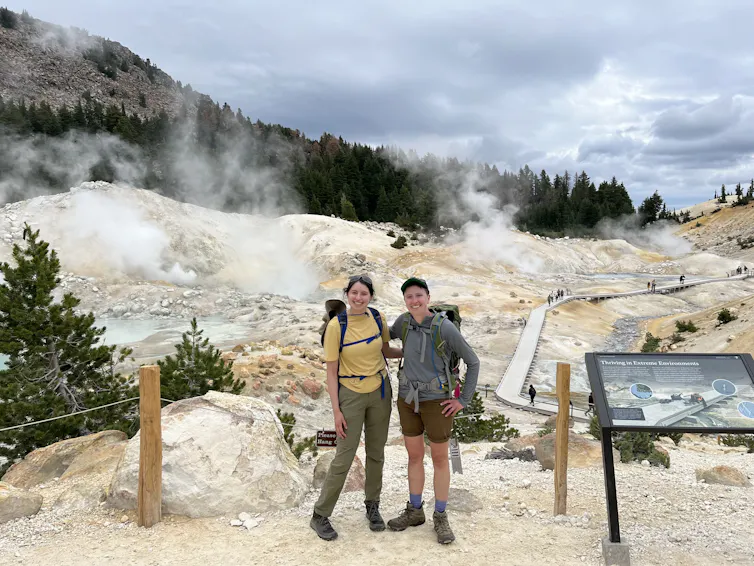
A.M. Oliverio, CC BY
Like many amoebae – cells that change shape as they move – Incendiamoeba is a forager. It can move around in search of food and favorable conditions. It actively crawls at 147 F (64 C), but a few degrees more and it will enter a protective hibernation-like state.
What sets thermophiles apart?
While bacteria have been recorded living up to 212 F (100 C), it is unclear why eukaryotic cells are less amenable to high temperatures and other extremes. Many theories abound: Our cells have more protective membranes, including several membranes within each cell, surrounding their organelles. We also have complex molecular machinery that maintains our large genomes, and a dynamic cytoskeleton: a network of proteins that allows our cells to move.
Like other eukaryotes, Incendiamoeba has organelles, an active cytoskeleton and a relatively large genome, so what allows it to persist where others cannot? So far, Incendiamoeba has revealed that we don’t yet know which parts of eukaryotes are generally incompatible with high temperature.
As someone who investigates phenomena at the molecular level, I am always thinking about how molecules move and how motion increases with temperature. At higher temperatures, the velcrolike bonds holding proteins together can unfold, preventing them from performing their vital functions. Eukaryotes have evolved protein helpers called heat shock proteins, which detect protein unfolding and help refold them.
So, could Incendiamoeba simply have more of these helper proteins? Our team found that it does have a large reservoir of heat shock proteins, but making these proteins requires a lot of energy, and they must be folded themselves, so more helper proteins probably isn’t the full answer.
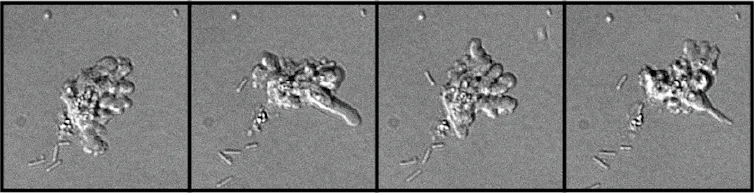
K. Skruber, CC BY
Incendiamoeba also has a unique set of protein building blocks that are good at holding proteins together. Yet this composition may only make up for the fact that proteins degrade more easily with increasing temperature.
We can look at Incendiamoeba’s genes, which turn on – or up – when temperature rises. Many of these genes are unknown. It is possible that one of these mystery genes is the key to its ability to withstand high temperatures. However, it is more likely, and in my mind, much more interesting, that there exists a symphony of small changes this organism has evolved, which confer its unique abilities.
By investigating Incendiamoeba and finding others like it, we can determine those changes and learn about the key principles for how life works on our environmentally diverse planet.
The post “We discovered an organism that lives at blistering temperatures – but what allows it to take the heat?” by Kristen Skruber, Assistant Professor of Biology, Gonzaga University was published on 10/29/2026 by theconversation.com