

More than 800 years ago, a combination of environmental and societal challenges led some Mississippian people to leave Cahokia, a massive archaeological site that was once home to 20,000 people near modern-day St. Louis. Just south of Cahokia, another archaeological site is taking shape at Centreville, Illinois, as modern-day people abandon their homes in the face of 21st-century climate and cultural changes.
My anthropology colleague Sissel Schroeder and I studied both sites to learn how people react to climate change when it hits home.
Archaeological sites forming in a modern community
During the 1960s and 1970s, economic downturns and the movement of white residents out of diversifying neighborhoods made Centreville into a majority-Black community that faced challenges such as mismanaged drainage infrastructure. Yet in interviews with a community group, residents reported that people had no major problems with living there until the floods came.
From the 1960s to the 2020s, average annual rainfall in the St. Louis region has increased by 10 inches (25 centimeters) to 44 inches (112 cm) a year. That has led to more frequent flooding, including in Centreville, where stormwater and sewage systems have not been significantly updated since they were built in the 1960s. The rains bring floods, which back up raw sewage into people’s kitchen sinks, and seep up through the ground, covering residents’ lawns as well as public streets and sidewalks.
Many people who can afford to move away from Centreville have done so, leaving a mostly older population and many abandoned homes. Essentially, a community is becoming an archaeological site before our eyes.
White and Schroeder, 2026.
An ancient city
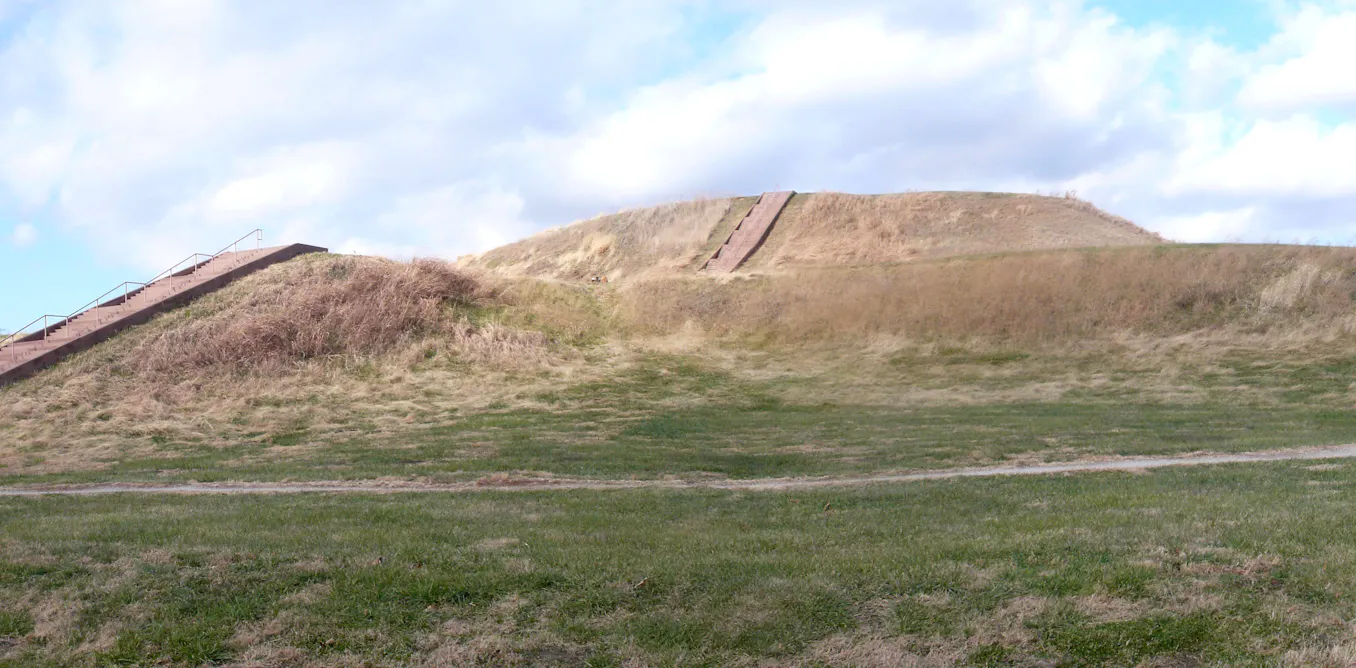
Nine hundred years ago, Cahokia occupied the same floodplain as Centreville does today. At its population peak around 1100 CE, over 100 burial, residential and ceremonial earthen mounds stretched from one end of the valley to the other, with its core centered on Monks Mound.
Monks Mound is the largest prehistoric earthwork in the Americas. It is 950 feet (290 meters) long and 775 feet (236 meters) wide, and its platform rises 100 feet (30 meters) above the floodplain. Decades of archaeological excavation show that surrounding Monks Mound are plazas that held great feasts and possibly sporting events – including chunkey, something like bocce ball with spears – timber monuments likely for ritually observing astronomical events, and other mounds containing elaborate burials.
Possibly up to 20,000 people lived at Cahokia at the start of the 12th century, but by the end of the century, the city had entered a population decline that continued for 200 years. Archaeologists have long debated the cause of Cahokia’s depopulation before European explorers and colonists arrived, putting forward a range of societal and environmental theories.
Climate change at Cahokia
In other research, several colleagues and I previously found that Cahokia experienced several natural disasters during a warming period known as the Medieval Climatic Anomaly. In the second half of the 12th century, Cahokia experienced a large Mississippi River flood and drought conditions that stretched for several decades. Our study argued that the site’s depopulation was related to those climatic changes.
Climate change at Cahokia didn’t look like catastrophic scenes in movies like “The Day After Tomorrow.” There’s no evidence to suggest widespread destruction or death. Departures began at a time that coincided with climatic changes of the 12th century, but people continued to gradually leave the site through the 13th and 14th centuries.
As people left, life in Cahokia changed. After 1200 CE, archaeological evidence suggests Cahokians ceased or reduced communal feasting and mound building. They also contributed less to public granaries, moving agricultural surplus to private spaces. But it only became harder to live there for some people: Larger houses and status symbols became more prevalent, perhaps indicating a larger gap between the rich and poor.

White and Schroeder, 2026.
The past and future of climate change
To understand the relationship between social and environmental changes at Cahokia, I look at what is happening at Centreville in the 21st century.
People are not leaving all at once; instead, the accumulation of years of flooding-related failing infrastructure, repair costs and health problems have pushed some away from the community. Others have stayed, like resident William McNeal, who told a local news outlet, “I’m not going to abandon my house. It’s all I got.”
Additionally, what’s happening in Centreville reveals that climate change is experienced unequally – some people are more affected than others. All of the St. Louis area has received increased rainfall and flooding in recent decades, but the residents of Centreville face some of the worst consequences because they live in a floodplain with outdated infrastructure.
At Cahokia, people would have also experienced the environmental events of the 12th century in different, unequal ways. Those with farms in the lower floodplain were most exposed to crop loss from flooding, but plots in the uplands were safer. During drought conditions, fields in well-drained soils likely retained less moisture and fared worse than plots with poorly drained soils.
People who lost crops may have struggled to contribute to communal feasts and shared food storage. I believe some may have become indebted to neighbors whose resources remained intact, while others may have decided to leave. Over time, these individual responses could have changed the relationships and inequalities that structured Cahokian society.
If that’s what happened, climate change did not cause a sudden and dramatic exodus from Cahokia. Instead, its uneven effects altered the social status quo; some benefited, some lost, and some left.
Today, some consequences of climate change can be major and immediate, such as sudden massive floods. But in communities like Centreville, the effects of repeated flooding accumulate over years, producing gradual societal changes that are harder to recognize than the aftermath of a sudden catastrophe.
Climate models are useful for estimating future conditions, but they reveal nothing about how people might experience or respond to those conditions. Events and people’s reactions may unfold quickly, even suddenly, or they may play out quietly over long periods of time.
Regardless, the result may be the stillness of an archaeological site.
The post “Ancient Cahokia was transformed amid droughts and flooding – climate change is reshaping modern communities in similar ways” by AJ White, Assistant Professor of Anthropology, Indiana University was published on 11/25/2026 by theconversation.com