

There is nothing unusual about fans wanting to express their enthusiasm for the celebrities they adore. But there are always a few who take their devotion to unexpected extremes.
The musician Taylor Swift received a turtle shell with her face painted on it. The Harry Potter star Emma Watson was sent a slew of bibles. Unlucky singer Harry Styles was mailed a sanitary pad with his name written on it.
Stories like these reinforce perceptions of fandom as parasocial – one-sided and borderline obsessional. Such gestures cross social boundaries in a way that many people find uncomfortable. Famous or otherwise, who really wants to be gifted an item designed for personal use from a stranger?
As a teenager, I was obsessive about classical music. Where my friends spent their pocket money on clothes, I spent mine on CDs of Bach, Beethoven and Mendelssohn. I once borrowed a DVD from my violin teacher of my then-idol the Russian-American violinist Jascha Heifetz, which I watched repeatedly. Partly because I hoped that one day my bow control would be as good as his (it never was), but also because to watch it was to enact my interests. It gave me a good feeling of being me.
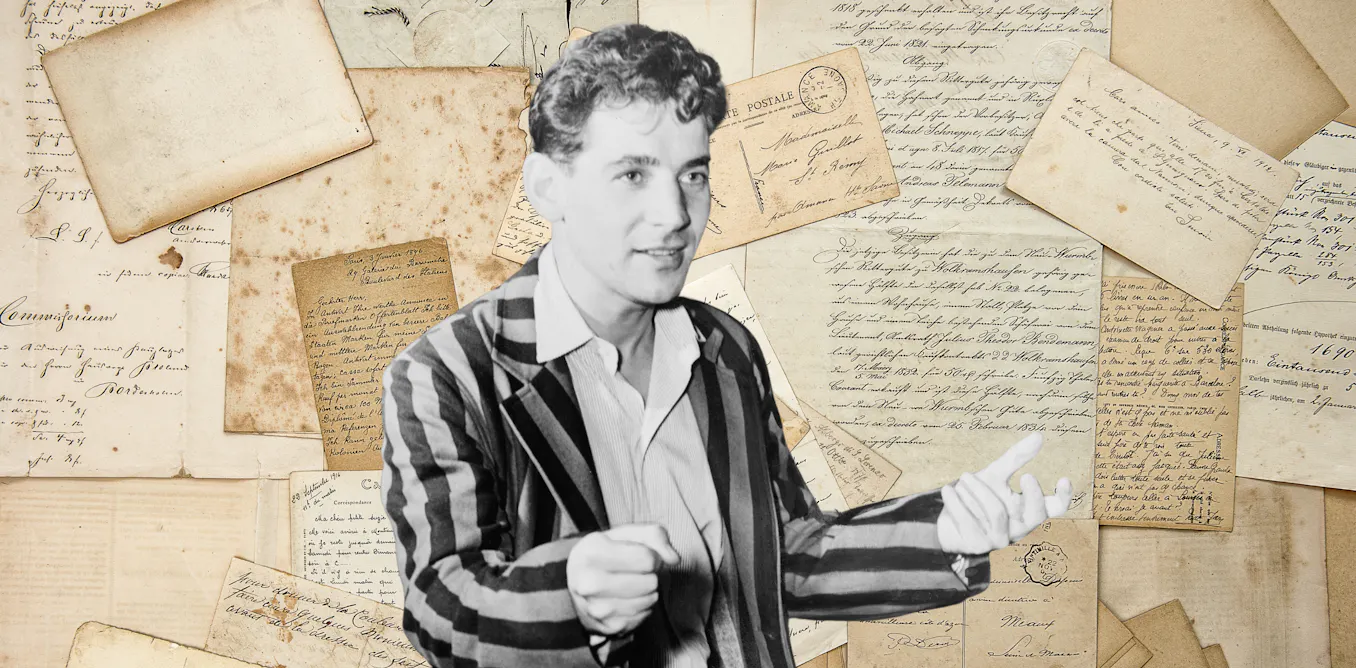
I am not the only person who has been an obsessive classical music fan. I’ve spent a lot of time reading and analysing fan letters in the conductor and composer Leonard Bernstein’s archive. On March 4 1951, a Californian woman wrote to Bernstein:
My dear Mr. Bernstein, I have already thanked you for the extreme pleasure your San Francisco concert has given me. […] However foolish, I feel a need to return a gift that may give some small pleasure and it pleases me this once to indulge myself. My gift is personal but, I believe, pertinent – not impertinent. Its design is to meet the need conductors often have for assistance in coping with that personal physical and emotional perspiration during those minutes between demands on stage.
Enclosed with her note was a handkerchief. She hoped to see him using it, as this would make her feel close to him.
There’s a whole archive of such letters to Bernstein, today remembered as the composer of West Side Story, but in the 1950s, more widely known as an American television personality and conductor of the New York Philharmonic.
Another woman wrote to recommend that he rub “Harriet Hubbard Ayer Cream deodorant” over his face before every performance. An elderly man shared “inspirational poems” which he had composed, typeset, printed and stapled into a booklet. A group of nuns sent him photographs of a Bernstein-themed table setting they had created. A blind couple requested he send them a real china tea cup and saucer.
Tribes
These stories from the classical music world are particularly jarring. It’s easy to stomach the idea of Swifties doing what they do: that’s part of their culture. But classical music fans have long cultivated an image of sophistication. Many wouldn’t even identify as “fans”. Labels like “classical music lover” or “music appreciator” seem to better reflect their highbrow interests.
More than cultural hierarchies are at stake here. Fundamentally, fandom provides a means of identifying with other people – of finding your tribe. This is why the most successful fan collectives adopt names and thrive on rituals. To be a “Swiftie” is to belong to an imaginary community. For members, this community is symbolised by the friendship bracelets they exchange. To belong is to know that when watching Swift perform live, you sing “one, two, three, let’s go bitch!” before the first verse of Delicate. It is to switch your phone light on for performances of Marjorie – and more importantly, to know why you do so.
Bernstein’s fans might not have had a nickname to unite them, but they were equally part of a community with its own customs and bar for belonging. To belong was to turn up early to concerts, not to bag the best space, but so that you didn’t disturb others once the performance had started. It was to know that you didn’t rustle candies during the performance but rather listened attentively. It was to refrain from clapping between the movements – and, more importantly, to know why you did so.
Just like those family traditions that seem totally normal to members and utterly bizarre to everyone else, fan cultures can be as alienating as they are welcoming. Tribes define themselves in opposition to one another. The classical music lover might be a snob to the Swiftie. The Swiftie might be an overly enthusiastic, emotional teenage girl to the classical music lover.
We tend to believe that what we like is normal. It would be more honest to admit that what we like is a bit weird. It’s the possibility of sharing that weirdness with other people that makes fandom so attractive.
The post “Classical music lovers can be as fanatical as Swifties – just read their letters” by Kate Guthrie, Senior Lecturer in Music, University of Bristol was published on 08/21/2026 by theconversation.com