

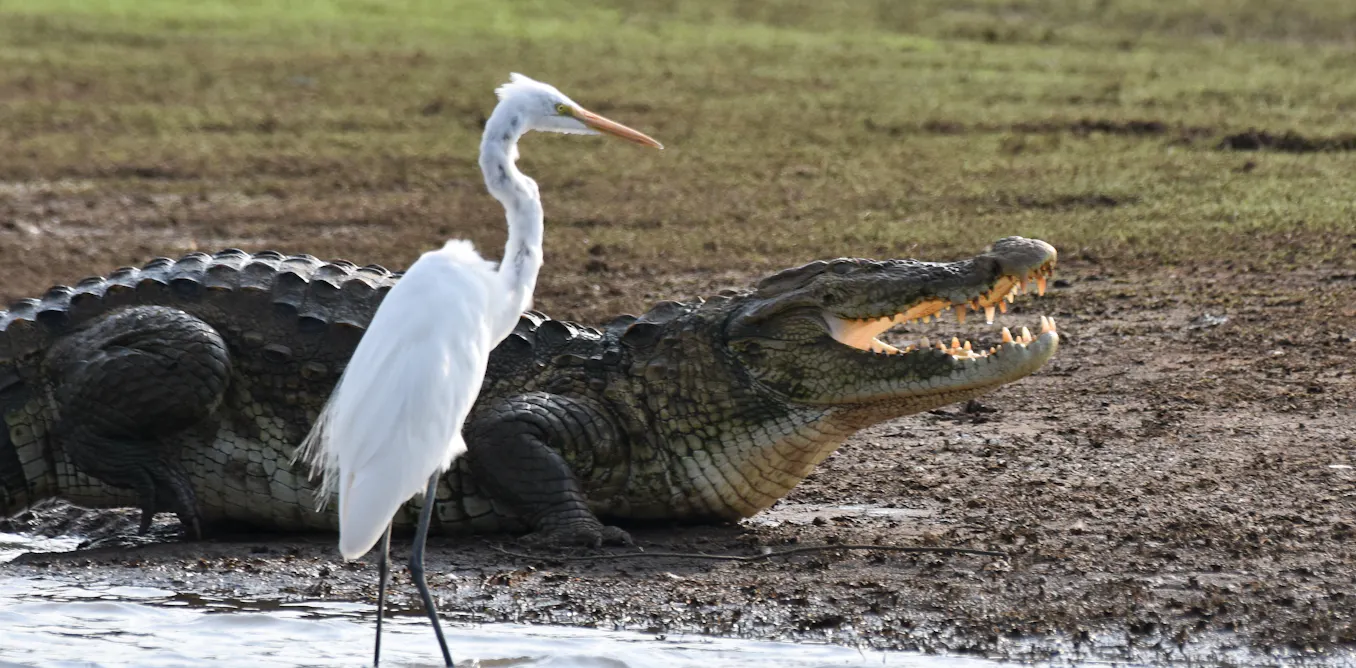
The closest living relatives of crocodiles and alligators are, perhaps surprisingly, birds. They are both archosauriforms, a group of species that originated about 250 million years ago near the beginning of the Triassic period.
The group soon split into two lineages: one led to crocodiles (Pseudosuchia), while the other led to dinosaurs and then birds (Avemetatarsalia). This means there is a combined 500 million years of evolutionary change between modern birds and crocodiles.
The aeons have erased almost all evidence of shared ancestry. Crocodiles are cold-blooded (called ectotherms by physiologists). Their body temperatures are determined by the environment, and they have low metabolic rates (the speed at which their bodies turn food into energy). They appear sluggish, except for occasional brief flurries of powerful activity while drowning prey or fighting among themselves.
Birds are warm-blooded (or endotherms). They have high metabolic rates, producing energy quickly enough to warm and stabilise their body temperatures and to undertake sustainable, strenuous exercise of flight. Birds don’t fatigue and fall out of the sky.
Even if crocodiles somehow had wings, the metabolic difference in power alone would mean they could never fly.
How did birds and crocodiles become so different? The conventional assumption has been that their common ancestor was more like a crocodile than a bird – but our new research shows the opposite is most likely the truth.
The conventional picture
Scientists have assumed that warm-blooded animals evolved from cold-blooded ones, not the reverse. As warm-blooded creatures ourselves, we have had a habit of thinking warm-blooded animals are physiologically superior to cold-blooded ones.
By this logic, if a group of animals evolved to become warm-blooded, it could never revert to a cold-blooded state without quickly going extinct.
From this view, it makes sense to believe the crocodile lineage had been cold-blooded all the way from its origin. Scientists thought warm-bloodedness had appeared only in the dinosaur-bird lineage.
Roger Seymour, CC BY
The new picture
Our first clue that the crocodile lineage was originally warm-blooded was that living crocodiles have four-chambered hearts. The only other groups with such hearts are warm-blooded birds and mammals, and there is a functional connection with warm-bloodedness.
High metabolic rates in warm-blooded animals require high rates of blood flow and high blood pressure. Four-chambered hearts completely separate low-pressure blood, going through pulmonary arteries to the lungs, from high-pressure blood travelling through systemic arteries to the rest of the body.
This pressure separation is vital to prevent high-pressure blood from reaching the lungs. If it does, it can cause a potentially fatal buildup of fluid which blocks oxygen uptake.

Roger Seymour, CC BY
So modern crocodiles have a warm-blooded-style heart but produce the low blood-flow rates and pressures we would expect for their cold-blooded nature. This suggests their hearts were once evolved for warm-blooded life.
Because warm-bloodedness is associated with high rates of blood flow, we searched for fossil evidence of large blood vessels to accommodate high flow. We had earlier found that the holes in the the leg bones that pass blood vessels through the bones of living mammals were relatively much larger than those in living cold-blooded reptiles.
We checked this against these holes in ten species of dinosaurs, and confirmed that they too were warm-blooded. But we had no measurements from the earliest archosaurs, nor any from ancient members of the crocodile lineage.
Our new study of the hole size in fossil leg bones focused on the earliest archosaur relatives from both lineages we could find. Starting in 2018, we assembled data from 81 species, which showed that both the crocodile and dinosaur-bird lineages had high metabolic rates until relatively recently – perhaps around 66 million years ago, at the time most dinosaurs died out – when crocodiles abandoned it in favour of a cold-blooded metabolism.
These results are consistent with several other lines of evidence regarding the evolution of metabolism in the crocodile and dinosaur-bird lineages and also among mammals.
From active land-dwellers to watery ambush predators
The new view of the history of the crocodile lineage starts in the Triassic period, with them as active land-dwelling warm-blooded animals, in many cases even running on two legs. They diversified into hundreds of species over the Jurassic and Cretaceous periods, living on land, in salt and fresh water, and in between. However, they apparently remained warm-blooded until recently.
Why did their metabolisms slow down? We think it may have been related to their current behaviour as ambush predators in water. The low metabolic rates that come with being cold-blooded allow them to hold their breath longer to remain hidden while waiting for prey animals, and while drowning them.
There are no warm-blooded ambush predators in water alive today. Warm-blooded animals simply cannot hold their breath long enough.
Reversion to a cold-blooded metabolism may have saved the crocodile lineage from extinction 66 million years ago when an asteroid ended the lines of most dinosaurs, except, of course, the birds.
The post “Crocodiles can’t fly. Birds can. Scientists have finally figured out why” by Roger S. Seymour, Professor Emeritus of Physiology, Adelaide University was published on 08/14/2026 by theconversation.com