

Do you sometimes wish that you had telepathic or other supernormal powers?
Around a hundred years ago, some of the greatest minds in philosophy thought there were people who had such abilities. In fact, they even suggested that perhaps horses and dogs could have them too.
At the turn of the 20th century, many great scientists, psychologists and philosophers became fascinated by the possibility of “psychic phenomena” like telepathy, clairvoyance or ghosts. Many of them, like J.J. Thomson, the 1906 winner of the Nobel prize in physics, performed experiments to test mediums. Others, like the philosopher C.D. Broad, attended seances and thought about the possibility of precognition – the ability to foresee future events.
These weren’t just marginal charlatans. Many of them had an impact on philosophy and science in the 20th century. Many of the concepts philosophers of time still argue over today trace back to C.D. Broad, such as the growing block theory, which says that the past is real, the present is real, but the future does not yet exist.
Most of their focus was on the psychic abilities of humans. However, some of these “psychic researchers” went even further and began wondering about the possibility of telepathy in animals.
The philosopher Friedrich Canning Scott Schiller (1864-1937), who spent most of his career at the University of Oxford, was an active member of the Society for Psychical Research (SPR). He was one of the founders of pragmatism, the philosophical view that the truth of a theory can be judged based on whether it works in practice.
Schiller engaged in heated discussions about the psychic abilities of animals. His article on “psychical research” for the Encyclopedia Britannica has a section about “equine mathematicians” – horses with supposedly paranormal mathematical abilities that they demonstrated by tapping out solutions to equations with their hooves.
In 1914, Schiller wrote an article for the SPR about Rolf, “the thinking dog of Mannheim” (in south-west Germany). Rolf was credited with the ability to tap out answers to mathematical problems with his paw. And, with the help of a spelling code for letters and syllables, Schiller even claimed that the dog managed to produce entire sentences.
On one occasion, Schiller alleged that the dog professed its Catholic faith to a priest.
The case of Rolf (and other “thinking dogs” who suddenly started cropping up elsewhere) caused a dilemma for psychical researchers. Some thought this proved that animals have hidden intellectual powers just like humans. Others, like the Russian scientist Vladimir Bechtereev, suggested that the whole thing can be explained by telepathy.
Bechtereev went on to make major discoveries about memory and brain structure. In his view, the dog’s owner telepathically communicated all the information to him.
Schiller believed that his theory of pragmatism could help settle these disputes. He thought there was no point discussing these things in the abstract. What matters is whether either of the theories can be shown to have practical consequences for how the animal behaves. If Rolf was really so skilled at arithmetic, why does he not use mathematics in everyday life? And if he is a confessed Catholic, why does he not go to church?
Francis Wickware
Joseph Banks Rhine (1895-1980) and his wife Louisa (1890-1983) are widely considered to be the founders of the controversial field of parapsychology. They published the influential volume Extra-Sensory Perception (1934) and founded the Parapsychology Laboratory at Duke University, which has since been shuttered. Their approach of using a large number of tests with multiple subjects has been closely connected with modern statistics.
In 1929, the Rhines published an article about the horse Lady Wonder. This horse was seemingly able to make predictions, work out answers to mathematical problems, and tell time, all of this by touching lettered and numbered blocks with her nose.
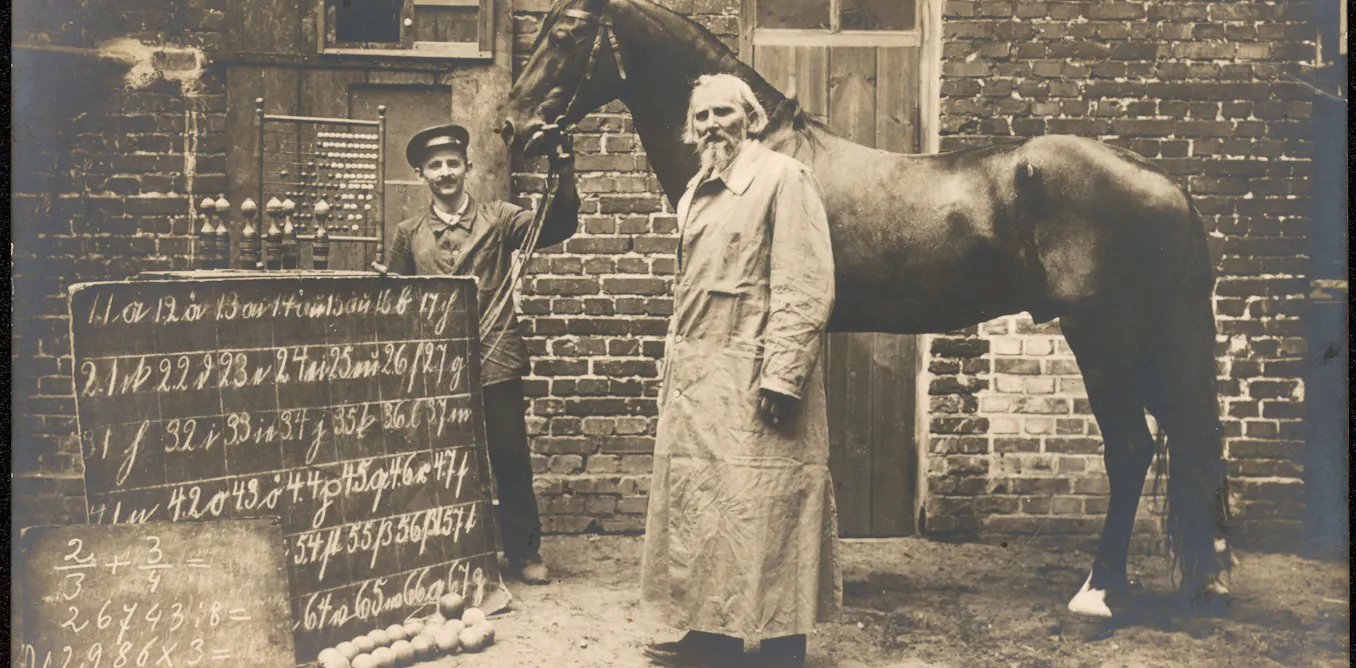
The most famous of these mathematically gifted horses was Clever Hans. Just like Lady Wonder in the US, Hans attracted huge crowds to his native Germany, who were eager to witness his arithmetic abilities. This included psychical researchers curious to see whether Hans had supernormal powers, as well as Carl Stumpf (1848-1936), one of the fathers of modern psychology.
It was Stump’s research assistant Oskar Pfungst who eventually got to the root of Hans’s miraculous powers. Pfungst observed that Hans could only provide the correct answer when his owner, standing nearby, knew the answer to the question asked – and only when Hans could see him.
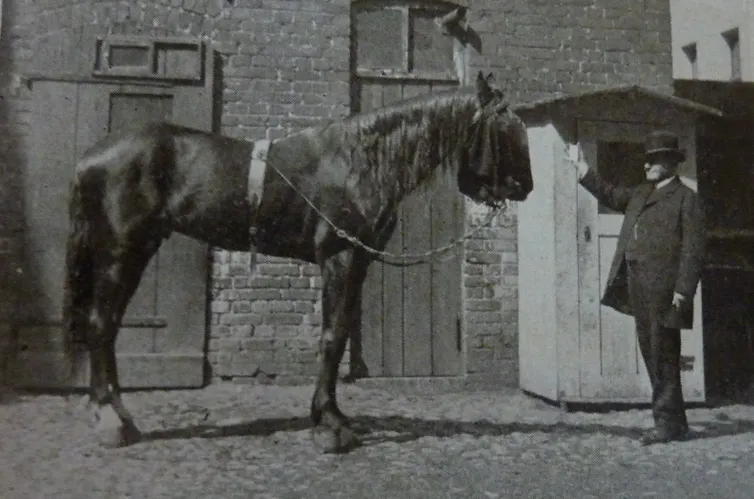
Karl Krall
This led Pfungst to conclude that Hans was simply responding to involuntary signals from his owner, signals that his owner did not even realise he was providing. Pfungst thereby discovered the so-called Clever Hans effect. This describes situations where the bad set up of an experiment causes the experimenter to unintentionally influence the subjects they are studying.
Pfungst’s explanation got rid of the need to appeal to supernormal abilities and partially contributed to the gradual disappearance of psychical research from universities. Like many other psychic phenomena, modern psychology could explain what was going on.
Although it turned out that these horses and dogs had no such mathematical powers, the studies conducted by psychical researchers helped uncover new knowledge. One surprising example is the development of randomisation in experiments.
Randomisation means deciding the order or allocation of things in an experiment by chance, rather than allowing the researcher or participant to choose. It is now a basic part of good experimental design because it helps prevent expectations from influencing the results. Surprisingly, attempts to test telepathy helped drive its development. Researchers realised that if people knew what answer was expected, even tiny unconscious cues could affect the outcome.
The case of Clever Hans and other “telepathic” animals shows just how turbulent this period of time was for modern science and philosophy. The telephone suddenly made it possible to contact someone on the other side of the world, and the X-ray allowed you to see inside the body. So perhaps it’s not that surprising that some of the greatest minds began to investigate telepathy in animals.
The post “How a ‘psychic’ horse named Clever Hans changed the way we do science” by Matyáš Moravec, Lecturer in Philosophy, Queen’s University Belfast was published on 08/27/2026 by theconversation.com