

Over the last decade, blue carbon ecosystems, such as mangroves and seagrasses, have taken centre stage in global discussions on tackling climate change, and Indonesia — home to 17 per cent of the world’s mangroves and seagrasses — has become a key actor in this agenda.
Yet, while global attention often centres on restoration targets, carbon markets, and blue finance, far less discussion has focused on a more fundamental question: who will actually deliver this transition?
A recent study shows that blue carbon is not merely about quantifying how much carbon these ecosystems store, capture and release, a process called ecosystem carbon accounting.
It also deeply involves valuing co-benefits and addressing trade-offs across governance, finance, policy, and on-the-ground practice. Consequently, successful implementation depends not only on policy and investment, but also on supporting people and developing their unique skill sets to implement a more holistic approach to blue carbon.
Yet, workforce readiness may be one of the most overlooked enabling conditions for building a sustainable blue economy.
As a key global player in the blue carbon transition, Indonesia has the opportunity to successfully drive this work by developing competency standards across skills ranging from monitoring and accounting to inclusive engagement with coastal communities.
Who will deliver the blue carbon transition?
“Blue carbon” refers to the capacity of coastal and marine ecosystems to absorb carbon dioxide (CO₂) from the atmosphere and store it for long periods of time.
For Indonesia to successfully drive sustainable blue initiatives, it will require expertise across numerous fields—not only scientists who study coastal ecosystems, but also restoration practitioners, policymakers, financing experts, and community facilitators.
In practice, many practitioners work across these overlapping spaces — for instance, a marine biologist can also work with community engagement to design sustainable and responsive blue carbon projects that meet local needs.
These practical applications highlight the crucial role of cross-disciplinary collaboration in defining what blue carbon work actually means in practice.
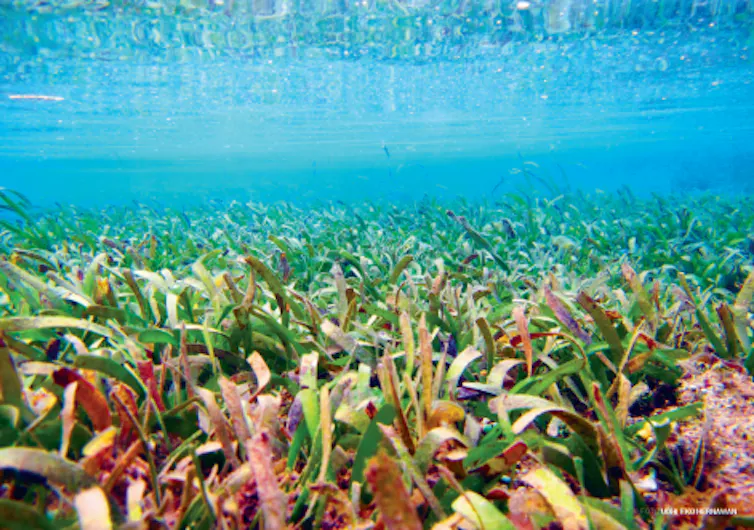
BRIN
However, only a handful of studies have explored practitioners’ perspectives on blue Nature-based Solutions (NbS) initiatives, leaving a major gap in our understanding of the skill sets required for the future.
While the existing blue carbon literature heavily focuses on ecological processes, it rarely addresses the complex social and economic challenges on the ground.
Beyond technical skills
Competency standards are widely used across sectors to clarify the knowledge, technical skills, and professional capabilities associated with specific areas of practice. It serves as a framework providing guidance on what a person needs to learn and master in order to work professionally.
In the context of blue carbon, competency standards can help establish clearer training pathways, improve project consistency, strengthen professional development, and progressively increase the quality and integrity of implementation.
Indonesia already has a number of guidelines. For example, the Mangrove Blue Carbon Measurement Manual and existing SKKNI (Indonesian National Occupational Competency Standards) for specific areas of work (e.g. mangrove monitoring and forest carbon inventory).
However, they often work in silos. As a result, there’s currently a lack of a comprehensive policy tool that integrates and further develops these existing resources into a consolidated framework.
Blue carbon projects demand interdisciplinary competencies. Practitioners technical expertise, such as monitoring, reporting and verification (MRV) to generate robust carbon data, alongside strong interpersonal skills for meaningful community engagement on the ground.
Read more:
Sea of opportunity: protecting mangroves and seagrass could boost Indonesia’s new climate targets
Technical expertise alone is rarely enough for effective blue carbon implementation. Because blue carbon ecosystems are deeply intertwined with local livelihoods and cultural values, community engagement work is critical to ensure sustainability, equity, and inclusivity considerations are brought to the forefront.
The future blue carbon workforce will likely be required to possess not only scientific and technical competencies but also strong public participation skills.
The latter plays a key role in determining the success of blue carbon projects by enabling equitable benefit-sharing, securing a social license to operate, and ensuring long-term sustainability.
Read more:
Sea of opportunity: protecting mangroves and seagrass could boost Indonesia’s new climate targets
Building a future-ready blue carbon workforce
Indonesia’s push for an ocean-climate agenda is just one part of its broader shift toward a sustainable blue economy — a journey that will inevitably bring new challenges.
But with these challenges comes an opportunity to pave the way for more interconnected career paths, targeted training, and widespread capacity building.
How can workforce development keep pace with shifting ocean-climate priorities? Which skills will take center stage over the next ten years? And how do we keep future competency standards flexible without sacrificing quality and credibility?
These are crucial conversations worth starting today among the diverse stakeholders involved in implementing blue carbon projects.
Indonesia already boasts a strong network of practitioners on the ground. The next step is investing in the people and skill sets needed to turn ambition into action. Inclusive and adaptive competency development can play a vital role in building a sustainable blue economy.
Ultimately, this development is just one part of a much larger, more complex process. It should not be viewed as a prescriptive solution, but rather as an enabling mechanism that fosters a capable, interdisciplinary, and future-ready workforce for Indonesia’s evolving blue economy.
The post “The missing link in the blue carbon agenda: The workforce” by Carolina Contreras, Senior Analyst – Ocean Policy, Climateworks Centre was published on 07/17/2026 by theconversation.com