

Water is an amazing substance. The human body is made up of more than 50% water. Approximately 70% of the earth’s surface is covered by water. We drink it, bathe in it, cook with it, clean with it. It is also used to cool data centres, which is an increasing draw on what is a scarce resource in many parts of the world.
The boom in artificial intelligence (AI) has been fuelling the construction of new data centres worldwide. This is driven by the massive computing workloads required to train and run generative AI models. AI data centres are specialised facilities with the infrastructure needed to support the increased computational demands.
A recent UN report warned that water used by AI data centres is expected to equal the everyday water needs of 1.3 billion people by 2030. Currently, air conditioning systems carry cool air to the server rooms housing the electronic equipment. Water is then used to carry away waste heat from the air to the environment.
But are there other potential ways to cool these facilities, ways that may not consume as much water?
For engineering purposes, water has extraordinary thermal properties. It has a very high specific heat capacity (the energy required to raise its temperature). It also has an exceptionally high latent heat of evaporation (the energy required to turn liquid water into water vapour).
Latent heat is what cools you when sweat evaporates from your skin, an astonishingly powerful cooling mechanism. These properties make water the ideal medium to transport heat, for applications ranging from automobiles and home heating, to large scale thermal power stations.
If you step inside a data centre, your senses are struck by the noise of cooling fans and the feel of swirling airflow on your skin.
The reason that air is used for direct cooling of the equipment is that it is safe, compared to a liquid like water, which could leak and damage electronics. In comparison with water, however, air is very poor at transporting heat even when given a helping hand by noisy cooling fans and churning air flows. The energy required to cool data centres is comparable in scale to the energy consumed by the electronic equipment itself.
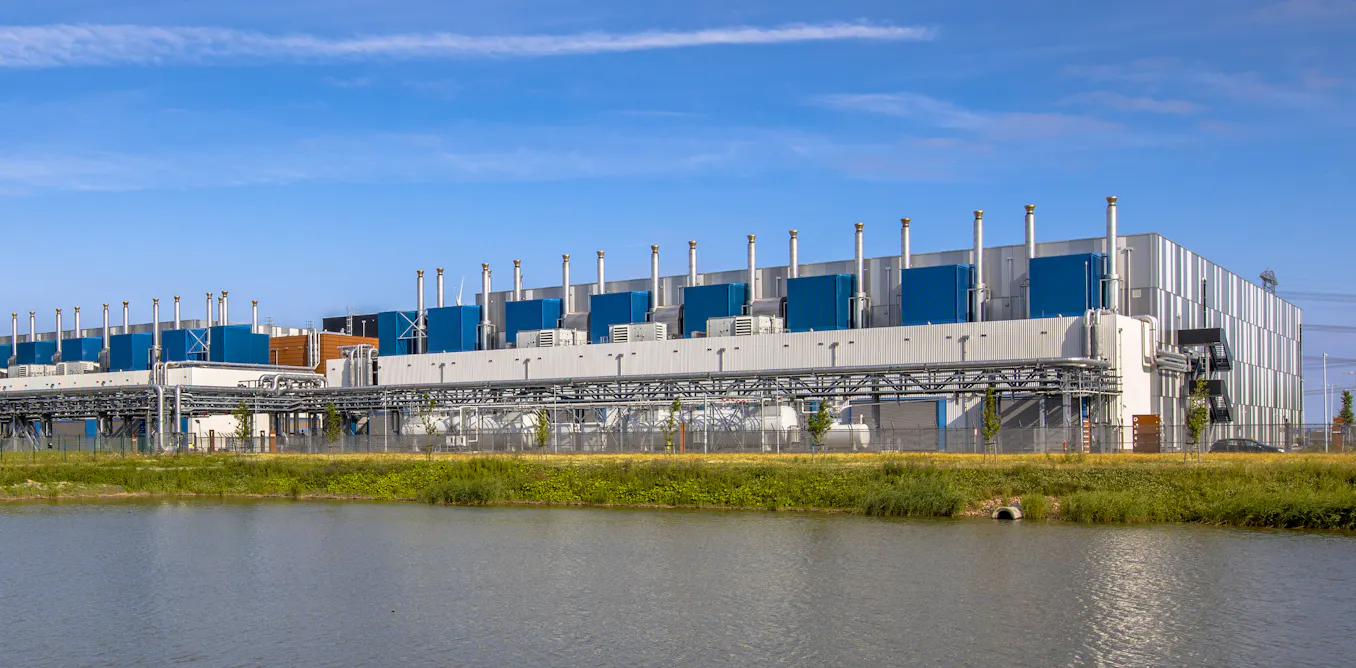
Water is used to extract the waste heat from the air conditioning system through something called a chilled water loop. Hot air from the servers is passed over cold water coils. The now warm water is then piped outside the server hall.
A structure called a cooling tower is used to remove this heat from the chilled loop. The water to be cooled is brought in contact with ambient air as a spray, and a portion of it evaporates.
This cools the rest of the water, which is then recirculated. There are other flavours of data centre cooling which also exploit the latent heat of water – using the direct and indirect evaporative cooling of outside air. However, these also consume lots of water.
T. J. Breen et al. (2011)
Is water consumption a bad thing?
Evaporative cooling places a demand on water supplies, but it also serves to reduce electrical energy consumption of the overall cooling infrastructure. In this context, it is important to note that electricity generation itself also requires water.
I am a professor at the University of Limerick, so for Ireland’s mix of energy sources, approximately 0.1-2 litres of water are required per unit of electricity (L/kWh).
Hence, by reducing electricity demand, evaporative cooling could be regarded as a “least bad” option in terms of the overall consumption of energy and water resources.
Of course, sufficient sources of water are required – clearly a critical factor in many parts of the world – and water stress is an issue even in rainy Ireland. However, there is some evidence of collected rainwater being used to reduce the demand on the water network here.
The use of air as the primary coolant for the electronic equipment significantly influences the overall energy consumption of a data centre. Because air is such a poor coolant, it only heats up by 5-20°C when it passes through the equipment.
The cooling infrastructure has to remove large quantities of thermal energy at relatively low temperatures – in the range of 25-40°C. Heat transfer is driven by temperature differences, hence the cooling plant is large, and it requires a lot of electricity to run the associated fans, pumps and compressors.
What if liquid was used to cool the electronic equipment using a “direct-to-chip” scheme? In this case, sealed pipe networks bring the coolant into the equipment, to extract heat from the power-hungry CPUs and GPUs (microprocessors and graphics processors) at the heart of servers.
Here, because a liquid such as water is far superior to air, the water being piped away from the equipment is hotter – closer to the component temperature limits, and potentially 60°C or higher.
Direct-to-chip schemes do reduce the cost of cooling, and offer opportunities to make use of waste energy in the form of heat carried away by water from the server equipment.
So why haven’t all data centres moved to this technology? Some are already using direct liquid cooling, but there may be some resistance to retrofitting an “air driven” facility. The replacement of electronic equipment in data centres is fairly frequent (between 2-7 years), allowing the transition to “direct-to-chip”. But there are costs involved in making the switch and some air cooling needs to be retained for certain classes of equipment.
Direct-to-chip systems would require a smaller, more frugal infrastructure.
Data centres now draw such vast quantities of electrical energy – over 7.5 TWh in today’s Ireland, almost a quarter of metered consumption – that it is imperative to reduce consumption and reuse the resource where possible.
The post “There’s a better way to cool data centres that cuts their huge thirst for water” by Jeff Punch, Professor, School of Engineering, University of Limerick was published on 08/19/2026 by theconversation.com