

The Canadian government launched its first-ever National Food Security Strategy in June 2026. The strategy aims to invest $750 million to increase year-round Canadian production of fruits and vegetables, including on so-called vertical farms.
These multi-storey towers and warehouses filled with fresh produce glowing under artificial light may seem like the future of food. Promoted as climate-resilient, land-saving and a positive form of urban development, vertical plant factories, commonly referred to as vertical farms, are drawing investment from governments and venture capital alike.
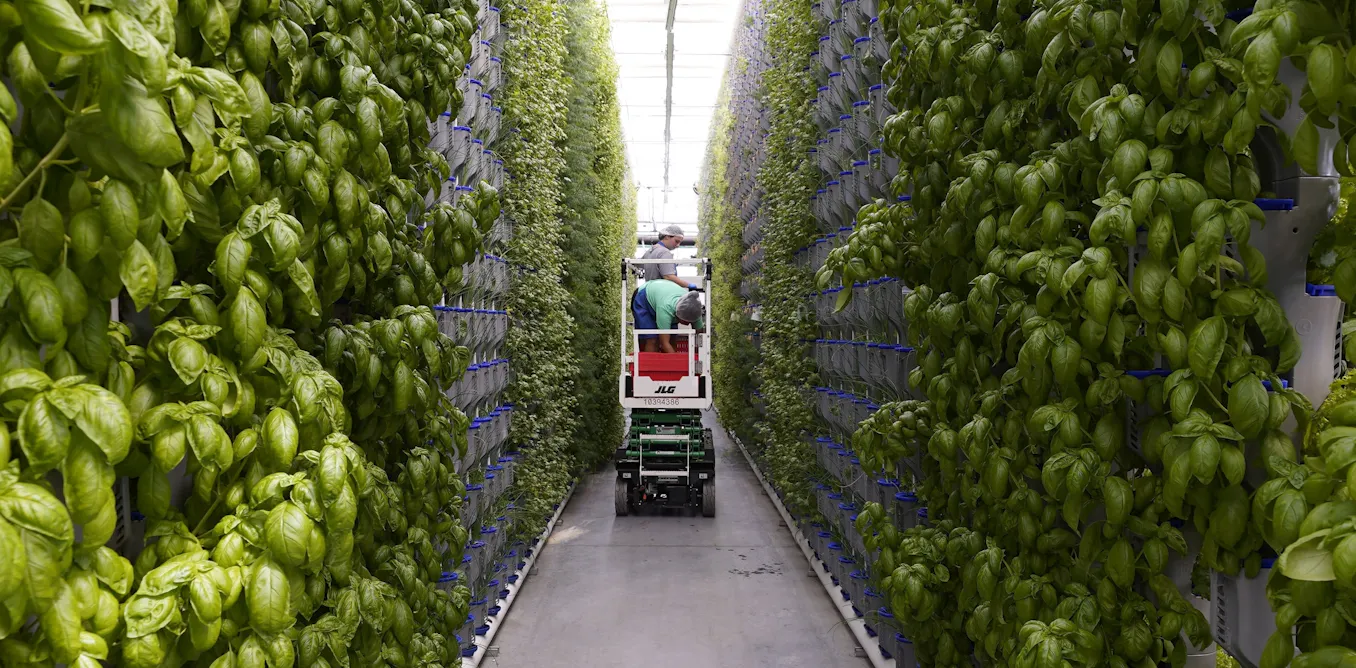
What we refer to as vertical plant factories are fully enclosed buildings or warehouses where artificial lighting, wiring, plumbing, engineered substrates and climate control systems replace sun, soil and seasons. These systems are largely oriented toward producing leafy greens and berries.
We recently took a closer look at the claims made about vertical plant factories. We examined the claims made by leading Canadian vertical farm developers and how those claims have been covered in major Canadian news outlets.
We argue that vertical plant factories are not a solution to the problems of industrial agriculture. Instead, they represent a problematic continuation of its contradictory logic.
High costs
Vertical plant factories are widely promoted as a sustainable response to mounting environmental crises and future food security challenges. They are also touted for using less water and less land.
Yet, they often require enormous amounts of energy and extensive digital infrastructure that monitors and controls production, while replacing functions otherwise provided by ecological processes and farmer knowledge.
Growing plants in a sealed building means replacing the free energy of sunlight with high-powered LEDs and temperature and ventilation systems that run around the clock. Furthermore, equipment like lighting, wiring, tubing, microchips and so on must be frequently replaced as they break down or get outdated. The result is a far more material- and energy-intensive system of production than is typically conveyed.
THE CANADIAN PRESS/Christinne Muschi
An important limitation of vertical plant factories is that they cannot grow staple crops. Instead, many focus on high-margin items like lettuce, microgreens and berries.
These high prices per volume are required to pay the enormous energy and infrastructure costs associated with plant factories. In fact, several high-profile bankruptcies in recent years have plagued the industry.
The types of fresh produce grown are often nutritionally limited foods that are prohibitively expensive for low-income consumers. So claims vertical plant factories can help address food insecurity into the future are misleading.
The fact that the Food and Agriculture Organization of the United Nations does not include leafy greens in global hunger statistics is telling.
Enough food is produced globally to feed the population, but prioritizing distribution remains a problem.
The politics of continuity
Why, then, do these systems continue to attract support from investors and policymakers?
Part of the answer lies in what Sharon Stein and Evan Bowness call the “politics of continuity.” They use this to describe the struggle over what contemporary societies seek to preserve amid deepening environmental instability, what they are willing to do to achieve these ends and who bears the costs.
In the food system, the politics of continuity is visible in efforts to maintain existing expectations of abundance even as the ecological conditions and resource intensity that make them possible become more uncertain.
Canadians have grown accustomed to supermarket shelves stocked year-round with fresh produce. Vertical plant factories promise to sustain this expectation instead of adapting food systems and consumption patterns to ecological limits.
Vertical plant factories are a vivid example of the politics of continuity. Our point is that enormous technological and material investments are being mobilized to preserve the expectation that a particular version of the present can be sustained into an increasingly unstable future.

(AP Photo/David Goldman)
Proponents of vertical plant factories argue they promote growth and preserve consumption habits without sacrifice. This is a compelling sales pitch. For governments, they promise sleek, high-tech solutions that can serve to divert public resources toward speculative systems, while ecologically sound and community-based food alternatives remain overlooked.
Vertical plant factories command extensive energy and resource budgets — for example, 4.4 kilowatt-hours per kilogram of lettuce produced. They also command attention, policy space and imagination.
One of the great risks in this sort of capital-intensive response is that it draws attention away from better and more feasible solutions, such as the urgent need to improve access to land for new farmers. They also replace farming knowledge and labour with increasingly automated systems.
In short, attempts to preserve things as they are can foreclose other possible futures. Rather than asking how food systems might become more ecologically grounded, fair and resilient, vertical plant factories frame the question in narrow terms: how can technology allow us to meet our current expectations of abundance?
Supporting feasible alternatives
This does not mean vertical plant factory technology can never be useful. In Canada’s North, at relatively small scales (inside shipping containers, for example) and using solar power instead of diesel fuel, it could be possible to produce fresh greens in ways that make economic and environmental sense and reduce the reliance on long-distance shipping. However, broader claims about plant factories cannot credibly invoke food security or be cast as a response to the harms of industrial agriculture.
If governments are serious about building a better food system, they need to stop chasing technological fantasies and start supporting more grounded alternatives. That means investing in farmers, land access and place-based knowledge rather than capital- and material-intensive towers of leafy greens and berries.
The challenge is not to decide which technologies can keep the existing food system going, but to ask what is worth carrying forward, what needs to change, and whose futures our choices make possible.
The post “Why ‘vertical farming’ is not a fix for our food system” by Richard Bloomfield, PhD Candidate, Geography and Environment, Western University was published on 10/08/2026 by theconversation.com