

KEY TAKEAWAYS
-
Social policies, such as support for small businesses, and a shorter working week without a loss of pay helped president Lula to turn around Brazil’s election.
-
Street protests and social media strengthened Lula’s campaign amid allegations of election interference by Meta favouring Flávio Bolsonaro.
-
Major challenges lie ahead as Lula faces a right-leaning Congress, opposition from the Bolsonaro movement and pressure from the Trump administration.
Luiz Inácio Lula da Silva won Brazil’s presidential election with 51.79% of valid votes, unexpectedly reversing the first-round result won by Flávio Bolsonaro, a first in Brazilian presidential elections. Between the two rounds, he gained about 10.4 million additional votes.
Defeated, right-wing challenger Flávio Bolsonaro announced that he would ask for the election to be annulled. The next day, his party, the Liberal Party (PL), acknowledged the result.
Brazil’s nonalignment sounds a warning to the global far right
Beyond halting the advance of Donald Trump’s and Secretary of State Marco Rubio’s influence in the region, Brazil’s election result points to strategies by which far right success in other countries can be contained. It is also a personal defeat for Trump, who invested energy and influence without openly declaring his support, but with the objective of returning the Bolsonaro family to power.
Lula’s victory can be attributed to three equally important factors. The first is a package of social measures: an increase in Bolsa Família, the government’s flagship cash-transfer program; the announcement of measures benefiting individual microentrepreneurs (MEI), who account for nearly 70% of active businesses in Brazil; and, above all, the approval, during the second-round campaign, of the government’s bill reducing the working week from six to five days with no loss of pay.
In a poll conducted four days before the vote, this legislation was the news item that mattered most in determining voters’ choice (17%). It was followed by reports of Supreme Federal Court (STF) justices’ involvement in the Banco Master corruption case (14%), politicians’ involvement in the same case (13%), and the Lula government’s lifting of the ban on online betting houses, known as “bets” (11%).
Between the two rounds, Lula raised his government’s approval rating, particularly among higher-income voters (+6 p.p) and right-wing voters outside of bolsonarismo (+12 p.p), i.e. groups that make up Flávio’s voter base. Over the same period, fear of the Bolsonaro family’s return to power overtook fear of Lula’s reelection (44% to 42%).
Taking to the streets and digital power
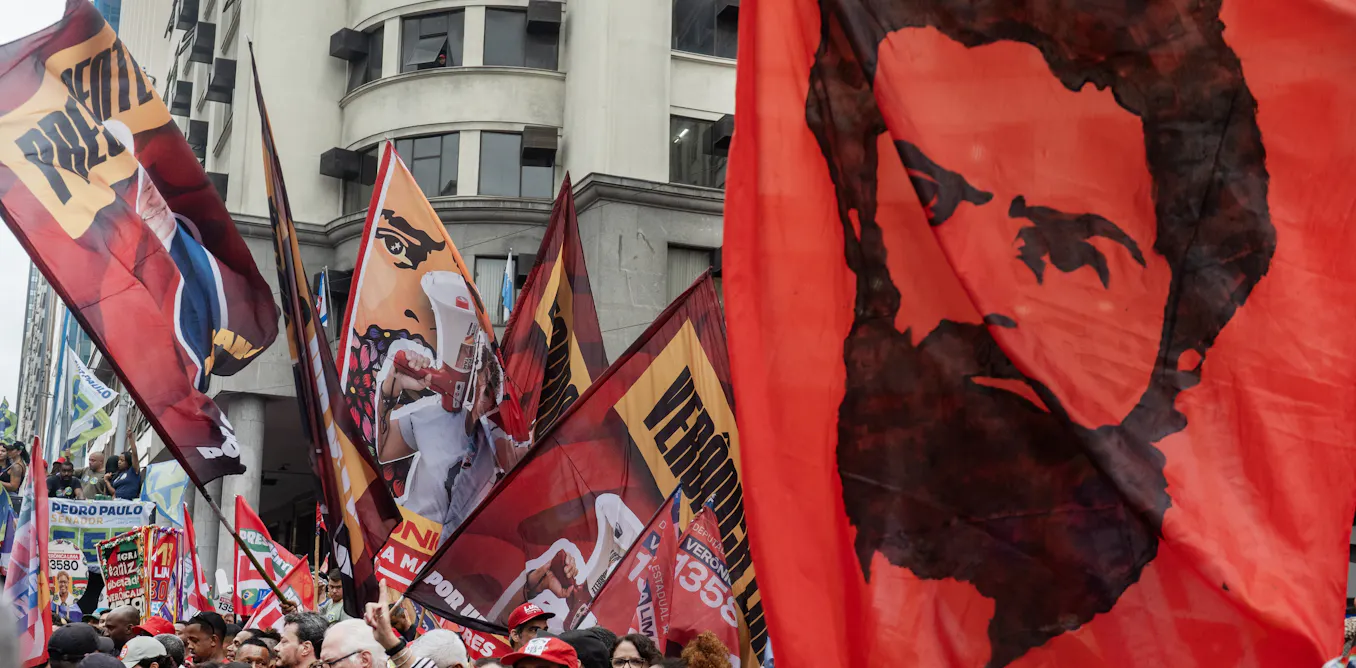
Such a turnaround was driven, in large part, by mass mobilisation of Lula’s supporters in the streets and on social media. Large rallies called by students and other mostly young people brought millions of people on the streets, breaking the chill seen in the preceding weeks. The largest rally in support of Lula took place in São Paulo on October 24. Demonstrators sang the Independence Anthem of Brazil, a clear reference to Brazil’s independence from Trump’s interventionist policy.
Part of this interventionism was attributed to the actions of Meta, the parent company of Instagram, Facebook and WhatsApp. During the second-round campaign, allegations grew that the company had favoured Flávio Bolsonaro and other far-right candidates by manipulating its algorithms. While Meta denied any favouritism, blaming technical failures, internal messages revealed by Folha de S. Paulo revealed that Lula’s campaign had been unable to boost posts for nearly 24 hours in October.
In reaction to the far right’s domination of the digital environment, one of the major landmarks of the second round was the creation of the “Lula’s Army”, a WhatsApp channel set up by a federal deputy that gathered more than 10 million members in just a few days. Its mission focused on social media engagement, with the aim of organically boosting the profiles of Lula’s campaign and his supporters. The army called its members soldiers, with a general and a marshal (Lula), appropriating the far right’s own vocabulary. It managed to push themes of interest to the left onto the agenda, while drawing attention to a series of scandals involving Flávio, including police investigations and contradictions in his proposals.
Both the street movement and the social media mobilisation re-energised Lula’s support base as rarely seen in the country. They point to a path by which democracies can resist the rise of the far right.
Who granted Lula a fourth term?
As flipping votes away from his rival would be a herculean task, given Lula’s extremely high rejection rate, the campaign’s strategy was to call upon first-round abstentionists. That goal was seen as nearly impossible right after the first round. Traditionally, the abstention rate remains stable and is concentrated in poorer areas, often far from polling stations, which hurts Lula’s vote.
To win, then, Lula, above all, needed to address electoral alienation to increase turnout in those areas, and that is what his campaign did: 3 million people were added to the electorate, bringing the abstention rate to its lowest level in 20 years at 19.2%. Another 1.8 million people who had cast blank or spoiled ballots three weeks earlier decided to choose a candidate, another historic shift between the two rounds. Blank and spoiled votes fell to 3% of total votes in the second round, compared with nearly 10% in 2018. Of the additional valid votes received by the two candidates, 74% went to Lula, which explains the size of the shift.
Geographically, such gains were not concentrated in any one area. Lula won 51.6% of the country’s municipalities. Five of the 26 states, plus the Federal District, gave Lula at least a significant increase of 7 percentage points more than in the first round. The South-East provided a great deal of the influx of new voters for Lula, accounting for nearly half of those.
The profile of Lula’s and Bolsonaro’s voters, however, largely remains the same as before. Since 2018, new patterns of electoral alignment have emerged in Brazil, and they have consolidated in this year’s election. Sociodemographic groups that previously showed only intermittent or candidate-specific effects on vote choice have become consistently aligned with one political camp. Evangelicals are the clearest case. Their distinctive voting behaviour dates back to before Bolsonaro, but since 2018 it has aligned with the evangelical Christian rhetoric of bolsonarismo. Among this group, 60% said they would vote for Bolsonaro ahead of the runoff.
Gender is another important factor in far right voting in Brazil. A significant gender gap emerged in 2018, motivated by Jair Bolsonaro’s misogynistic rhetoric, and it has since persisted at around 9 percentage points, both in 2018 and 2022, with 2026 polls confirming a similar gap. Today, Flávio’s rejection rate among women stands at 58%. In the final days before the vote, Lula also saw his support grow among low-income and less educated voters. It is too soon to establish whether Lula’s coalition will be able to keep his new voters in the future.
What to expect in the next four years
With this result, the far right will remain in opposition, but ever stronger than before. To govern, Lula will need the support of right-wing parties. Although Brazil’s political system is designed to operate through coalitions, building one was already a challenge for Lula, a centre-left president, during his current term. It will be even harder with a Congress further to the right. That Lula won by a margin of 3.6 percentage points over Flávio Bolsonaro, almost twice his margin of victory over Jair Bolsonaro in 2022, may give him stronger popular support as he begins his fourth term.
Moreover, Lula will likely continue to face pressure from the Trump administration. Trump’s policy of treating the Americas as a sphere of U.S. influence became explicit in late 2025, formally set out in what has been called the “Trump Corollary”. The day after the election, the U.S. president said it appeared rigged, but also that he gets along well with Lula. Rubio said he saw signs of electoral fraud in Brazil.
The day after the election, Brazil woke up watching for signs of an antidemocratic reaction from the far right, already scarred by the attempted coup of January 2023. Even so, it is in Congress that the revenge is expected to play out.
As for bolsonarismo, the challenge is to hold on to the support of the right-wing and centre-right parties that backed its campaign (and its family) until now. The family is now in the middle of the storm. With Jair Bolsonaro in prison, Eduardo a fugitive in the United States and Flávio under criminal investigation, the Bolsonaros will have to try to preserve their enormous electoral capital. The question is whether bolsonarismo, which attracted nearly half of the country, can survive without them.
A weekly e-mail in English featuring expertise from scholars and researchers. It provides an introduction to the diversity of research coming out of the continent and considers some of the key issues facing European countries. Get the newsletter!
The post “Brazil: Lula’s presidential win puts the brakes on the rise of the far right in Latin America” by Roberta Picussa, Cientista política e pesquisadora de pós-doutorado no Instituto Nacional de Ciência e Tecnologia em Representação e Legitimidade Democrática (INCT ReDem), Universidade Federal do Paraná (UFPR); Sciences Po was published on 10/27/2026 by theconversation.com