

The recent wave of protests in Europe have left us with two striking, viral spectacles of violence and joy. As Limoges’ historic town hall went up in flames, the Orchestre du Nouveau Monde was playing classical music in Paris’ central Place de la République (until the musicians were teargassed by police, that is).
Lucas Destrem/Wikimedia Commons, CC BY-SA
Both scenes offer radically different ways of seeing the protests. The burning town hall offers a powerful image of destruction; the orchestra, of anti-authoritarian collective solidarity. Neither tells the whole story, but their contrast raises important questions: which image will come to represent the protests, and who decides what we see?
France’s demonstrations began with students protesting deteriorating school conditions, including staff shortages and dilapidated buildings. But they quickly intersected with broader anger over living costs and public services.
The unrest also formed part of a wider European moment. On the same weekend, people took to the streets in Spain, Italy, Belgium, Portugal and Albania. Grievances include low wages, rising energy prices and unaffordable housing, each within its own national context.
These were separate mobilisations, not a single coordinated movement. Yet they reveal how different struggles are being represented in an age where everything – including a mass protest movement – can go viral.
A rally or a riot?
The battle over meaning starts with language.
On October 19, the European Commission condemned looting as “unacceptable” while stressing that peaceful protest must be protected.
In the European Parliament, the centre-right European People’s Party, backed by the European Conservatives and Reformists, has framed the unrest as an ideological threat, proposing a debate titled “France, Italy and Belgium: Latest anti-democratic violence by radical far-left groups”.
These interventions reflect a broader contest over whether demonstrations should be understood primarily as expressions of social grievances, or as challenges to public order. Political leaders across Europe have sought to steer this debate.
In France and Italy, Emmanuel Macron and Giorgia Meloni distinguished between people’s right to demonstrate and violent delinquents.
However, other politicians such as French far-right leader Marine Le Pen have blamed the far left and immigrants. In Spain, Madrid’s regional leader Isabel Díaz Ayuso pointed to the “anti-democratic left”, while Albania’s socialist Prime Minister Edi Rama described the protesters as being radicalised by “antifa”.

Jorge Jaramillo/Wikimedia Commons, CC BY-SA
The name we give to these gatherings – rally, riot, protest – matters greatly, as it shapes public and policy perceptions of what is legitimate in democratic societies. This, in turn, decides what kind of response – in particular what level of violence and repression – people will accept in addressing them.
Disruptive protests are typically presented negatively in both political discourse and in the mainstream media, regardless of an outlet’s political stance. This happens by connecting protest to violence, ideological extremism and threats to democratic legitimacy, thus discrediting protesters and their demands.
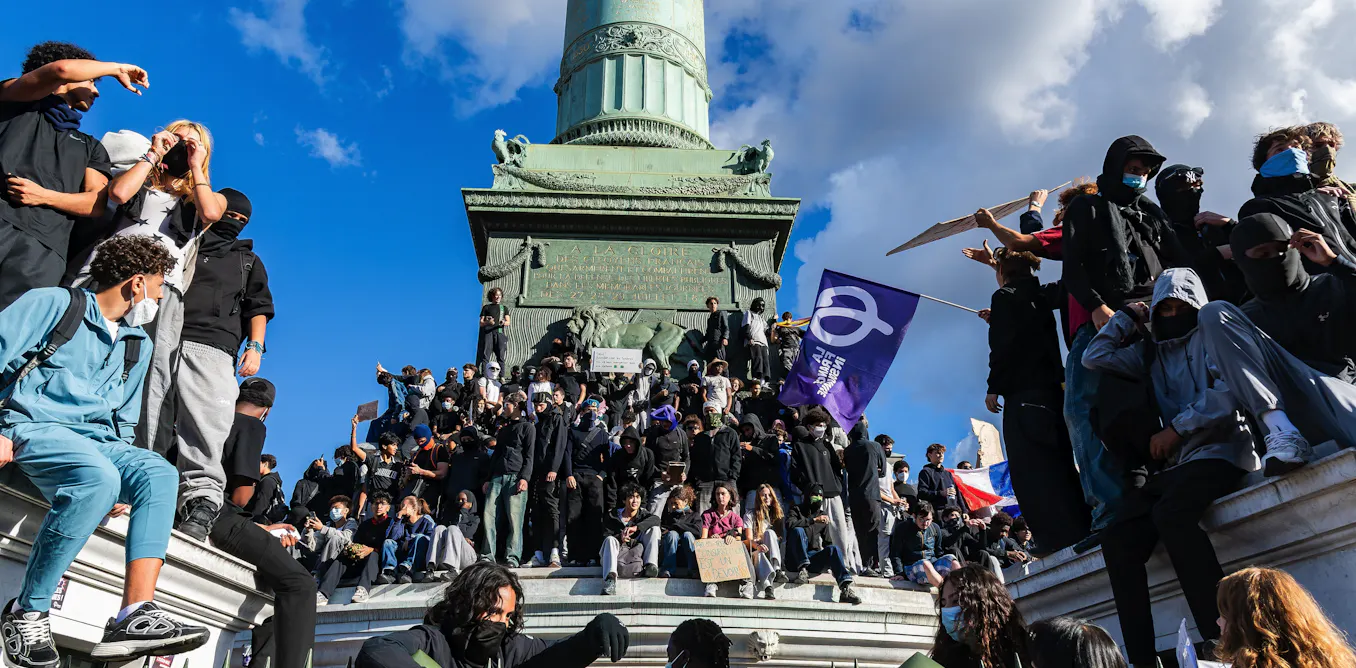
This means isolated violence can come to represent an entire demonstration or movement. On October 17, over half a million protesters took to the streets across France, but these historic, peaceful demonstrations have been completely eclipsed by media coverage of the looting that ensued.
Read more:
France’s ‘casseurs’: why the term fails to do justice to the extent of looting and spiralling unrest
Gen Z protest symbols
At Place de la République, the Orchestre du Nouveau Monde brought together hundreds of musicians to play popular, well-known pieces like the anti-fascist anthem Bella Ciao, along with songs from The Avengers and The Hunger Games.
The concert did not, of course, make the conflict disappear. What it offered was another way to see it, not simply as a confrontation between police and disorderly crowds, but as a collective performance of resistance.
Gen Z’s cultural symbols have also played a key role in generating viral spectacles. In France, students have appeared dressed as Batman, Chucky and other anime characters. People have protested dressed up as Pepe the Frog or holding the One Piece pirate flag, connecting Europe’s demonstrations to the symbols of global Gen Z protests, from Portland to Kathmandu.
Read more:
From anime to activism: How the ‘One Piece’ pirate flag became the global emblem of Gen Z resistance
Some students attending the October 17 protests told Le Monde “there’s no point in getting angry, so we might as well do it with a smile”. And that is precisely the point: both memes and spectacle can put joy, humour and playfulness at the centre, making grievances visible on the protesters’ own terms and generating viral images that compete with negative media coverage.
The fire in Limoges and the orchestra in Paris are not competing truths, and neither should cancel the other out. What these events have in common is the framing of protests as viral spectacles, staged for the cameras, digital platforms and distant audiences.
A burning building and a massive concert are easy to capture on camera, while struggles over housing, the cost of living and the deterioration of public services are not. Understanding protest therefore means looking beyond the image that travels furthest, fastest and most easily. It means asking who selected them, and whose account they serve when they go viral.
A weekly e-mail in English featuring expertise from scholars and researchers. It provides an introduction to the diversity of research coming out of the continent and considers some of the key issues facing European countries. Get the newsletter!
The post “French students are showing us what protest looks like in the age of viral spectacle” by Sara García Santamaría, Assistant Professor in Journalism Studies, Universitat de València was published on 10/21/2026 by theconversation.com