

I visited a family of 19 in Sierra Leone in 2015. By the time I arrived, eight had died. The other 11 were left to live with the grief and fear of what might happen next.
I am a medical doctor and epidemiologist, and at that time I was serving on an African Union Ebola response mission. The 2014-16 epidemic in West Africa caused more than 28,600 cases and 11,300 deaths. Over roughly six months in Sierra Leone, I saw how quickly the disease could overwhelm families and health services.
That’s also when I learned that good medical advice can fail if people do not trust those delivering it. Some families buried relatives secretly, despite warnings. In certain communities, funeral practices included washing the body and sprinkling water on mourners, which risked exposing people to infected bodily fluids.
Simply repeating instructions did not help. But those of us working in the field found that working with families to make burials safer while respecting their grief helped them to mourn their loss while stopping the virus from spreading.
More than a decade later, those experiences have returned to my mind. The Ebola outbreak now sweeping across parts of Central Africa is different from the one I responded to. Still, one lesson remains: Timely international support makes a huge difference.
A growing outbreak
The current outbreak was declared in the Democratic Republic of Congo, or DRC, in May 2026. By Oct. 28, 2026, the U.S. Centers for Disease Control and Prevention reported 10,305 confirmed cases and 4,996 deaths across five countries, with new updates daily. The DRC accounts for nearly all of those cases and deaths.
This is already the second-largest Ebola outbreak ever recorded, after the 2014-16 epidemic.
The current outbreak is caused by the Bundibugyo virus, whereas the 2014-16 epidemic involved a different Ebola virus. No vaccine or specific treatment is currently approved for Bundibugyo.
The World Health Organization warns that late detection, deaths outside health facilities and sustained transmission in the DRC remain serious concerns.
The DRC has extensive experience with responding to outbreaks, and African institutions are coordinating a continental response. Africa has the expertise and leadership. What it needs right now is sustained support that reaches the front line – quickly, safely and accountably.
Crossing borders
Ebola follows human movement. In October, Kenya reported infections linked to a traveler who had passed through Uganda from the DRC. Nigeria also reported an imported case around the same time.
Symptoms can appear between two and 21 days after exposure, and people are generally not infectious before symptoms begin. A traveler may therefore pass a temperature check and become ill days later.
These events show why countries need to share information quickly, verify travel histories and maintain contact tracing across borders.
Abbas Dulleh/AP
What international support looks like now
International partners are, in fact, contributing. In September 2026, the United States reported US$887 million in Ebola-related health and humanitarian assistance. The U.K. announced a contribution of roughly £78 million ($104 million).
In October, the World Bank described $426.6 million in current and planned financing for the DRC and neighboring countries. And Africa Centres for Disease Control and Prevention reported nearly $3 billion in international pledges following a September mobilization effort.
But pledges are not the same as supplies delivered or services provided, and these contributions are coming late in the outbreak.
In 2014, Britain helped expand treatment and safe-burial operations in Sierra Leone. The U.S. mobilized logistics capacity in Liberia, while France assisted Guinea. And African Union health workers served alongside local teams and other partners.
That cooperation saved lives, though the global response was slow to scale up. It has been discouraging for me to see that today’s response has not built on that experience without waiting for the outbreak to grow further.
According to the WHO, massive cuts to international aid over the past year diminished a quicker response.
The success of international collaboration will be measured in how many contacts are reached, how rapidly patients are tested, how many health workers have protective equipment and are consistently paid, whether women can still deliver babies safely, and whether remote communities can get care.
Building connections with everyday people
My experience in Sierra Leone in 2014 taught me that trust is essential to outbreak control. Families need credible explanations, timely information and opportunities to ask questions. Local health workers, faith leaders, survivors and community organizations can help bridge the gap between an emergency response and the people it seeks to protect.
That gap can be large even when a disease is widely known. A colleague and I conducted a study involving 440 secondary school students in Nigeria in 2014, and we found that 95.4% had heard of Ebola. Yet only 42.3% identified fever as a possible symptom, and only 33.2% recognized the risk associated with certain burial practices. Seeing that awareness of the disease alone was not enough, we subsequently began Ebola education activities in local Nigerian schools.
The need for reliable information from trusted sources remains in 2026. Risk messages must be consistent, culturally sensitive and practical. This works only when communities are partners in recognizing illness, seeking early care, contact follow-up and safe, dignified burials. Even in times of emergency, health workers cannot treat communities simply as audiences for instructions.
Reaching affected communities
In August 2026, Africa CDC and the WHO jointly called for expanded laboratory and treatment capacity and faster delivery of supplies.
But in the DRC, insecurity and displacement due to ongoing conflict, in addition to poor roads, can prevent supplies and patients from reaching treatment centers. These obstacles may also keep laboratories from receiving samples and contact-tracing teams from visiting households.
The ministry of health is not equipped to resolve these problems. The response therefore requires cooperation among health authorities, humanitarian agencies, local government, transport services and those responsible for civilian safety.
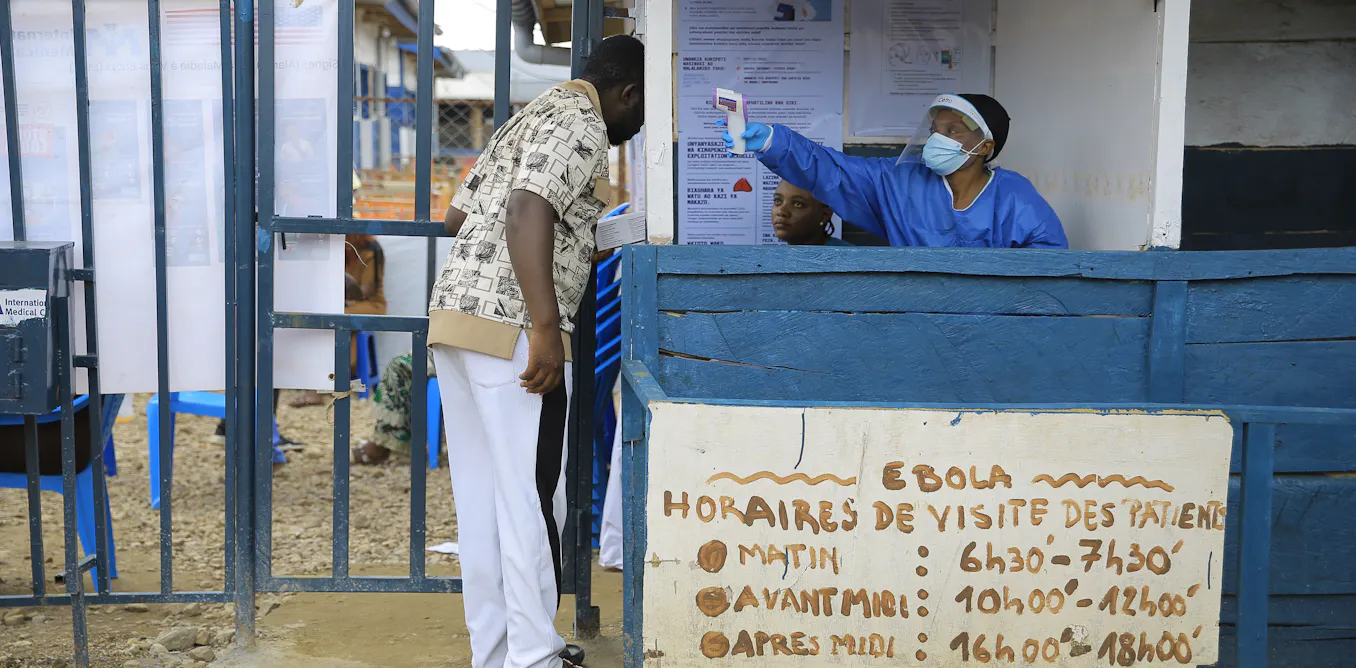
There are signs that investments in these services are helping. In October, the World Bank reported that supported detection timelines in the DRC had improved. This meant new cases were being detected within one or two days by September, a huge improvement from the 10-day detection timeline early in the outbreak.

AP Photo/Dieudonne Dirole
Looking to the future
Because Bundibugyo virus lacks an approved vaccine or specific treatment, this outbreak also demands carefully conducted research. The Tumaini vaccine trial, begun in Bunia, DRC, in October 2026, is an important step toward a potential vaccine.
The hope is that this effort will prevent more families from experiencing loss.
I still remember the 11 survivors in that Sierra Leone household I visited back in 2015. I never learned what ultimately happened to them, but more than a decade later, I still think about them.
The post “Delayed international support has hampered efforts to contain and treat Ebola in the Democratic Republic of Congo” by Olayinka Stephen Ilesanmi, Assistant Professor of Healthcare Administration, Fayetteville State University was published on 11/05/2026 by theconversation.com