

School recess has long been considered a standard part of children’s education in the United States. But it’s more than just a fun break from sitting at a desk.
Daily recess is necessary for supporting young children and adolescents’ learning, as well as their physical and mental health.
It’s so important that the American Academy of Pediatrics notes that reducing the amount of time set aside for playing, running and exploring in order to fit in more academic work could actually be counterproductive.
But in recent decades many schools have cut back on recess, which many states do not require.
As a scholar who researches childhood play, I have studied and witnessed the benefits of play in children’s lives, including the significant social, emotional and cognitive impacts it has on students’ overall well-being.
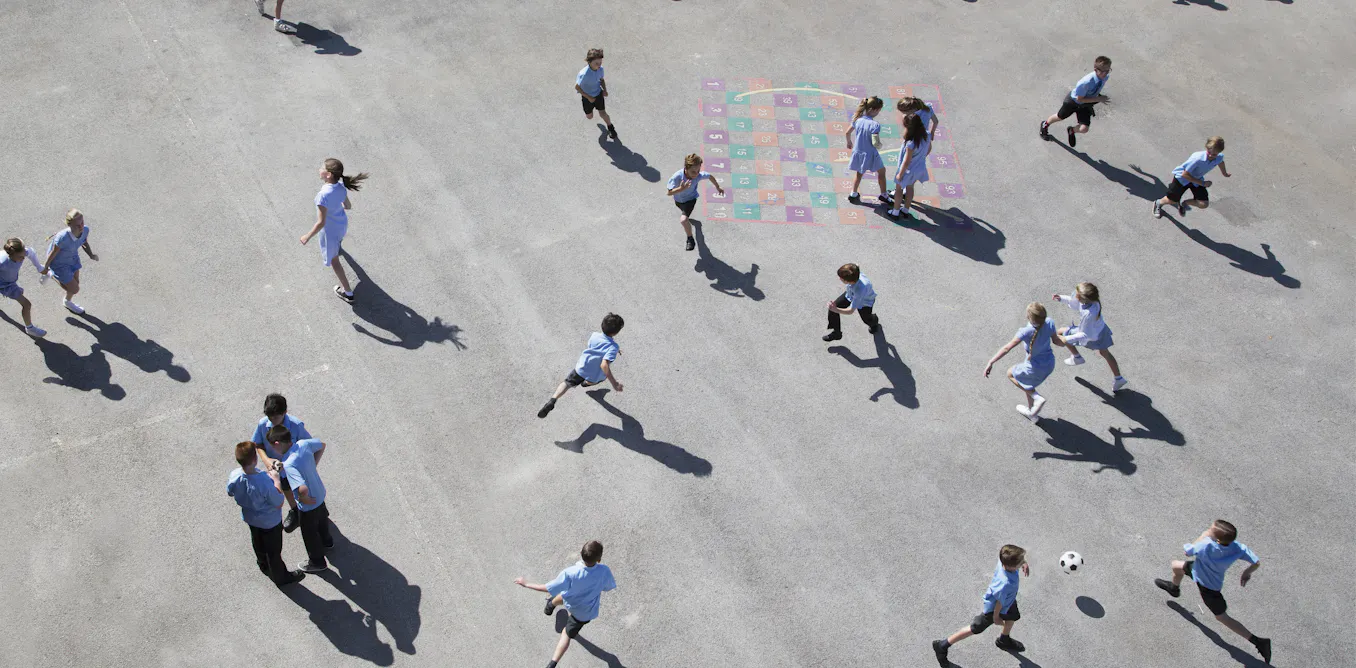
John P Kelly/Stone via Getty Images
The many benefits of recess
The U.S. Centers for Disease Control and Prevention recommends that children and adolescents get at least 60 minutes of physical activity per day.
The CDC also defines recess as a “regularly scheduled period in the school day for physical activity and play that is monitored by trained staff or volunteers.”
Recess can look different across various schools – while some kids play outside on play structures or in grassy fields, others might play indoors during inclement weather.
Research also shows, for example, that children living in lower-income communities have fewer opportunities than their peers in higher-income communities to play outside.
Unlike physical education classes or participating in organized sports, recess gives students the time to engage in physical activity and interact with their peers however they like.
This time for unstructured play can offer much-needed relief from the mental focus that students need to maintain throughout the school day. It can also support their cognitive development and overall emotional and physical well-being.
Research also consistently shows that giving children breaks each day for recess has immense benefits for their mental health and the executive functioning skills that support academic achievement.
This includes benefits for students’ focus and creativity, as well as their memory and executive function.
Some states, but not all, require recess
Most states do not mandate that schools have recess every day or spell out a minimum amount of time students must spend moving their bodies.
A 2025 report from the Johns Hopkins Bloomberg School of Public Health found that 11 states have laws addressing school recess. This ranges from Arizona’s requirement for 40 minutes of daily recess to Georgia, Indiana and Kentucky all requiring recess, but with no minimum duration.
Massachusetts is one of the nearly 40 states without any laws regarding recess time. A recent article in The Boston Globe reported schools in Cambridge having 25 minutes of recess, while other schools across the state had only 15 minutes per day.
Overall, there has been an uptick in state legislation aimed at preserving mandated daily school recess time, thanks partly to a new parent-led advocacy group called Say Yes to Recess. This group is pushing for schools across the country to provide a minimum of 60 minutes of protected school recess time each day.
Started by three Tennessee moms, Say Yes to Recess has also helped advocate for Tennessee legislation that increased the state’s mandated daily school recess time from 15 to 40 minutes in July 2025.
A moving target
During the 2001-02 school year, elementary school students from 349 school districts spent on average 36.8 minutes per day at recess.
By 2025, the CDC found that students were spending 27 minutes on average in recess each day.
It’s also hard to track how much physical activity students get at school because public school districts and private schools often do not record and report this information.
While the benefits of recess are not just isolated to young children, a 2026 international study showed that the amount of daily recess time across U.S. schools declines from a mean of 39.3 minutes per day for 6- to 7-year-olds to 24.5 minutes per day for 12- to 18-year-olds.
Making way for play
I conducted research at the Project Zero research center for creativity, ethics and the arts at Harvard University and highlighted the significance of play and the arts within urban public schools.
This 2024 study showed how play with materials supports both children’s and teachers’ creative learning. As someone who designs and studies children’s play spaces, I worry about what could happen if schools continue to reduce school recess because of staffing issues, budget cuts or prioritization of students’ preparation for high-stakes tests focused solely on literacy and numeracy.
Research shows that this trend of not prioritizing recess could have significant effects on children’s and adolescents’ mental health, cognitive development and overall enjoyment of school.

Maskot/Digital Vision via Getty Images
School are well intended but under strain
The decline in time for recess comes at a moment when many schools and districts are under increasing pressure as a result of declining student enrollment, pressure to meet state learning standards and budget cuts.
For some schools, reduced staffing and the costs of maintaining outdoor play equipment to meet safety requirements have made it difficult to offer school recess.
For other schools, an assumption that more time for instruction equals a higher-quality education may be driving decisions to minimize or eliminate time for unstructured play.
Another factor that influences recess is when schools deny students recess time as a form of punishment – a policy that some scholars and educators are trying to block through legislation.
As childhood health, social and cognitive research demonstrates, the amount of time school recess is given matters in children’s development as whole human beings. I believe it is up to schools, districts and parents to advocate for and ensure children’s right to protected school recess time every day.
The post “I research play – and here’s why recess is much more important than just a fun break” by Louisa Penfold, Professor of Education, Harvard University was published on 11/05/2026 by theconversation.com