

Imagine it’s the dead of night. Your phone pings with a text – it’s a government emergency alert: “Leave your home immediately! Only take with you enough supplies for the next three days.” What would you want in your go-bag?
Our new survey of UK adults (results not yet published) has found a surprising number of people prioritised sentimental belongings such as a childhood teddy bear.
In the face of climate change and growing geopolitical instability, governments have started to advise citizens to prepare now for disaster. In 2024, the UK government launched its Prepare initiative. This was followed by preparEU, a flagship EU project which argued: “Today’s threats are fast, complex and interconnected; our response must be more proactive.”
These initiatives typically recommend that people should have enough food, water and medicine to last 72 hours. In addition, they need ready access to documents, cash, batteries or power banks and a wind-up radio, plus a working knowledge of emergency support in their local area.
But when that message pings in the night, will you already be packed, with documents, food and medicine in a go-bag? Or will you be scrambling to find things, hoping you have enough essentials to keep you going?
In April 2026, as part of the After the End project – a Wellcome Trust-funded research project exploring how people experience and recover from crises – we surveyed 1,000 UK adults to understand how prepared they were for a sudden crisis or disaster.
We found that most people have less than half of what is recommended by the UK government and the US Federal Emergency Management Agency. Only four out of 1,000 people reported being fully prepared.
Our findings echo the 2025 UK Public Survey of Risk Perception, Resilience and Preparedness, which found that of 10,536 adults, only 13% felt largely or totally prepared.
Withstanding the emotional toll of crisis
However, the focus on practical items and supplies may not capture what people need to withstand the emotional toll of crisis and disaster.
When asked what other items they would take with them during a crisis, many participants felt that personal items would be critical to their post-disaster wellbeing. They expressed a strong desire to keep sentimental items such as jewellery, family photographs and objects from their childhood close to them during crisis.
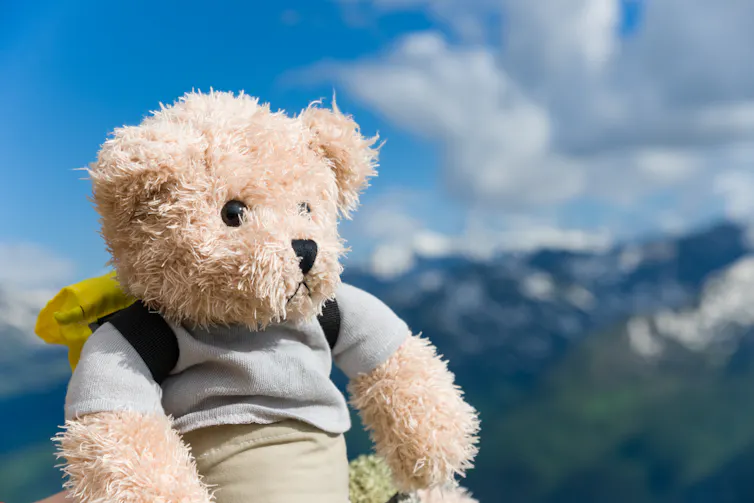
As one participant wrote: “My childhood teddy bear. He is going to the grave with me. Apart from that, nothing matters much.”
Pets also featured heavily in people’s responses. Animals such as cats and dogs were often described as members of the family. Some participants even found comfort in the idea of taking the ashes of deceased pets with them if they needed to flee in an emergency.
A concept in psychology called extended self theory explains why these types of items hold such importance during everyday life – and also during crisis. It suggests that our sense of self is fragile, and continually built and maintained through our connections with the world around us.
Ira.foto.2024/Shutterstock
In this way, the things we surround ourselves with do more than serve practical functions. They help us construct, stabilise and make sense of our identity. Consciously or subconsciously, our possessions become part of who we are.
A childhood teddy bear, therefore, becomes a possession imbued with memories and emotions which tell a tale of who we are, where we have come from, and who we care about. Objects can reinforce continuity of identity over time and space.
A strong sense of self
Having a strong sense of self can be beneficial during times of crisis. If we enter such a period with a sense of identity that is stable and coherent, it can act as a psychological anchor. A strong identity helps us cope in a challenging situation, and reduces the likelihood of ruminating about negative experiences.
Research also suggests that our ability to connect with items from pre-disaster periods influences our ability to cope and recover psychologically following an emergency. So, salvaging photographs and other items of sentimental value during disaster could help to preserve and rebuild our memory and identity.
If everything around us falls apart, a treasured item can help us maintain some sense of normality. This is perhaps why survivors of the 2011 Japan tsunami frequently described the loss of family photos as one of their greatest emotional losses.
Sentimental items can maintain or even improve our belief that we are capable of achieving our goals. Psychologists refer to this as self-efficacy. And research suggests higher levels of self-efficacy are associated with greater preparedness for, and better coping after, a disaster – particularly in vulnerable groups such as those with disability.
Our analysis found that people who reported greater self-efficacy also said they had more of the items and knowledge recommended by the UK’s Prepare initiative.
varuna/Shutterstock
Sentimental items can also help to rebuild communities. Heirlooms and meaningful everyday items from before a crisis become points of storytelling afterwards. So, remember to save a little space in your backpack for something that means something to you.
Whether it is a childhood teddy bear, your late mother’s engagement ring or a beer coaster from a first date, these items are more than just “things”. When so much else is uncertain, the small objects that remind us who we are may be among the most valuable items we can take with us.
The post “When prepping for disaster, don’t forget to pack your teddy bear” by Ruth Ogden, Professor of the Psychology of Time, Liverpool John Moores University was published on 09/17/2026 by theconversation.com