

One in ten children aged seven to nine years is living with obesity in Europe. In England, childhood obesity rises from around 10% of children in reception to around 22% by year six. While we know there are many complex and inter-connected biological, social and environmental causes of childhood obesity, a good start is to tackle this with what we know works: better diets are linked to better health.
Studies have shown that healthy diets in children are associated with better physical health. High quality diet patterns, containing whole foods such as fresh fruit and vegetables, are linked with better mental health in early adolescence. We also know that poor dietary patterns and childhood obesity are linked with cardiovascular disease in adulthood.
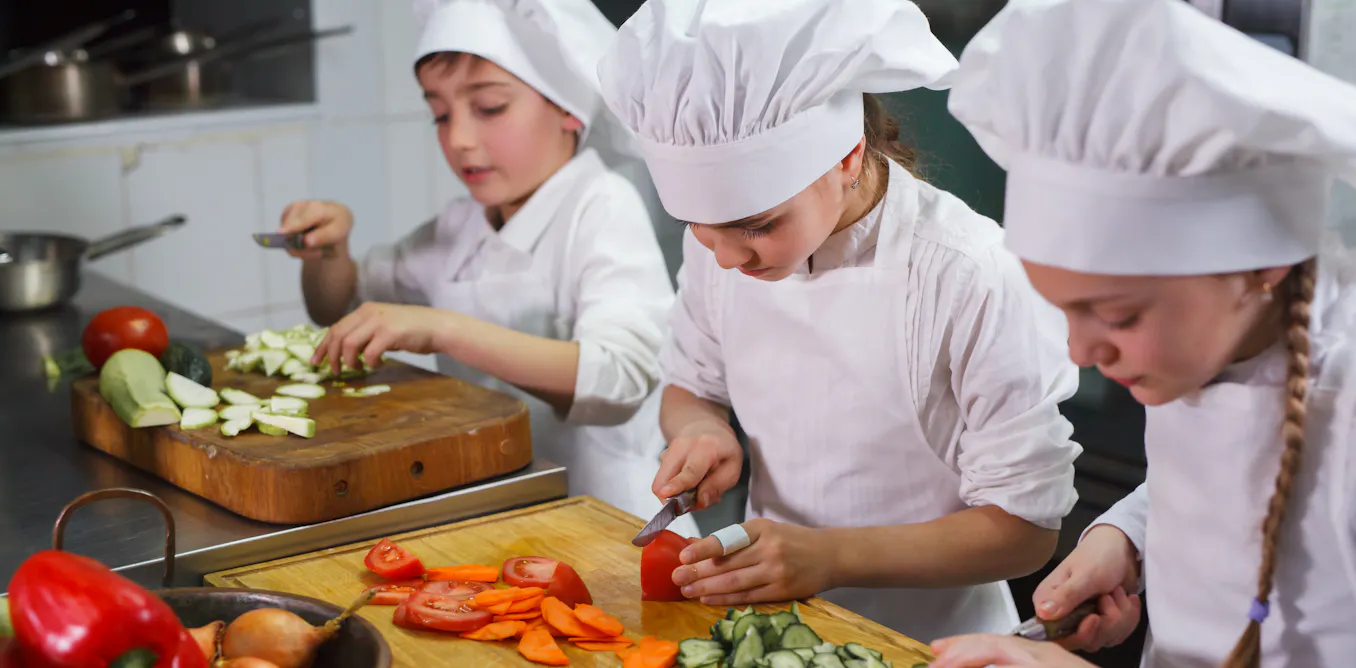
One important but neglected way to encourage children to eat better diets with fresh fruits and vegetables is to teach them cooking skills. My recent research with colleagues has found that that younger children with more experience of learning food skills tend to have slightly higher fruit and vegetable consumption.
Preparing meals from scratch involves more fruits and vegetables, which are rich in the nutrients and fibre we need to keep us healthy. Children can learn vital food skills at a young age – the earlier the better to shape future habits and behaviour.
MIA Studio/Shutterstock
In our study involving 19,736 European children aged from six to nine years, we found that children who were able to able to peel fruit and vegetables with a peeler were 15% less likely to have obesity. However, overall, our analysis showed that children who participated in more food preparation skills at home had a slightly higher risk of having obesity.
Skills at school
This doesn’t mean that cooking at home causes obesity. Correlation is not causation. Reverse causation is also possible. Children who are already living with obesity may have food-seeking appetite behaviour, and are therefore more interested in helping with meals at home. On the other hand, when parents prepare food at home with children, this might include cooking foods high in sugar and fat, such as cakes.
This is why learning food skills at school is important. In Japan, the Shokuiku programme makes diet and food a key and integrated part of the curriculum. Japan has a strong nutrition education policy linked to school meals, and has an obesity prevalence of 4.4% for young people aged five to 19, compared to the world prevalence for this age group of 8.2%.
It is easy to assume this learning should happen at home, but that relies on parents having the time, confidence and knowledge to teach it. Many do not. Without structured support, the gap only widens.
Schools already treat some life skills as essential. Swimming, for example, has mandated hours, clear outcomes and national expectations. Children are required to swim for 25 metres by age 11, and schools are given guidance on how much lesson time should be devoted to swimming.
Food skills have none of this, despite their long-term impact on health. The World Cancer Research Fund recommends five hours of nutrition and food skills education a week, but this is unrealistic. Schools need cooking equipment, food for cooking lessons, training for teachers to deliver whole class cooking lessons and more time available in the curriculum.
A more achievable approach would be around 24 hours of food skills teaching each year in primary and lower secondary school – for example 12 two-hour lessons across the 39-week school year. Regular, practical sessions focused on preparing simple savoury dishes, especially those using vegetables, would build confidence, familiarity and healthier habits. Skills such as peeling, chopping and cooking are not luxuries. They are foundations for long-term wellbeing.
The national curriculum for food teaching in England was last updated in 2015. Since then, evidence on children’s food skills has grown, but policy has not kept pace. Children acquire skills through observation, practice and reinforcement, building up competence as they repeat tasks.
This is especially relevant for nutrition education, since children acquire food skills in a complex learning environment shaped by their perceived cooking confidence and the support they receive from parents and teachers.
If we want healthier diets, we must prioritise skills as well as knowledge. A shift towards a skills-based curriculum would equip children to navigate their food environment, with benefits that last far beyond the classroom.
The post “Why food skills belong in the school curriculum – not left to chance at home” by Karen L. Vaughan, Researcher in Nutrition, University of Leeds was published on 07/14/2026 by theconversation.com