

Our national parks are a haven for humans, plants and animals alike.
Protected areas such as national parks are a cornerstone of our efforts to conserve nature. But these unique ecosystems can still bear the scars of past fires, floods and other natural disturbances.
Our new study examines how repeated bushfires have changed, and continue to change, one of Australia’s iconic national parks.
Tom Fairman
Located on Australia’s southernmost tip, Wilsons Promontory or “the Prom” is one of Victoria’s most popular national parks, famous for its wombats, rosellas, mountains and coastlines.
But in the first half of last century, the Prom was repeatedly burnt by intense bushfires. This pushed thousands of hectares of eucalypt forests towards collapse. And as our climate changes, bushfires will only become more frequent and severe.
The history of the Prom may provide a preview of what our forests could look like in a warmer, more fire-prone future. It could also give us clues about how to protect them.
Fire and forests: a delicate balance
Over millions of years, Australia’s eucalypt forests have evolved to both survive and recover from bushfires.
For many species, this includes their ability to resprout new stems and leaves from the sides of charred trunks – a process known as “epicormic resprouting”.
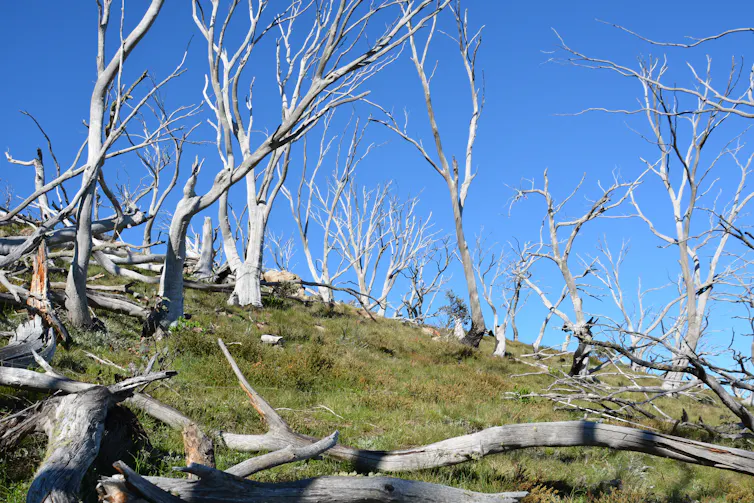
Even so, resprouting eucalypts need time to recover before they can withstand another fire. If they’re burnt by back-to-back bushfires, eucalypts may start to die.
Tom Fairman
At its most severe, this can lead to “ecosystem collapse” – where an area loses all forest cover and only patches of dense, short shrubs remain.
This has serious consequences for the entire ecosystem, including less habitat for wildlife, less carbon storage and potentially increased bushfire risk. But we still don’t fully understand how long these changes last, and what the longer-term implications may be.
Our new research aims to provide some answers.
What we studied
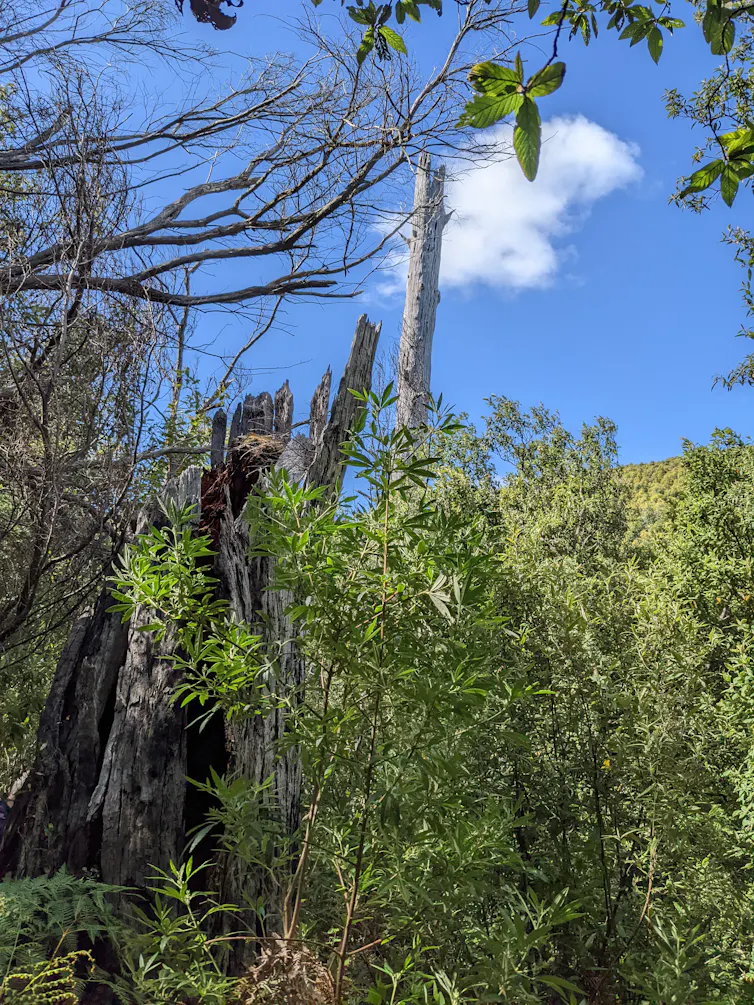
After multiple successive bushfires in the early 1900s, the Prom’s eucalypt forests failed to recover and resprout, and became “collapsed forests”. They have stayed that way for the past 70 years.
Our study compared areas of collapsed forests with nearby areas of “intact forests”, where eucalyptus trees are still growing, at the Prom.
We found collapsed forests had 97% fewer large trees and were dominated by shrubs. Large trees provide areas for birds to build nests and possums, gliders and microbats to shelter in hollows.

Aaron Heap
We also found collapsed forests have 40% fewer fallen trees and trunks, compared with intact forests. These logs act as shelter for native ground-dwelling mammals such as the long-nosed potoroo and the pookila, also known as the New Holland mouse. They also provide food and other resources for various types of fungi and insects.
Collapsed forests store 60% less carbon than intact forests. In collapsed forests, carbon is mainly stored in short, dense shrubs. This type of vegetation is more likely to be burnt up in future fires, meaning any carbon they store is released back into the atmosphere.
So, what can we do?
Given these collapsed forests have persisted for 70 years, the only way they may be restored is if we intervene. This is possible through forest management strategies such as reforestation or reseeding.
But before we try to restore these forests, we must consider several questions:
-
how much should we intervene in national parks? Is it our responsibility to reforest these areas, or should we expect to see more collapsed forests in protected areas?
-
should we restore these collapsed forests to what they were in the 1900s, or prepare them for a more fire-prone future by introducing more drought- and fire-tolerant trees?
These are complex questions. We need more research to know how to best protect our national parks and other vulnerable ecosystems from future fires, floods and other natural disturbances. We must also ensure our national parks are reliably funded.
The Prom shows us forest collapse is not inevitable. But it’s an urgent reminder of the importance of actively managing and investing in our national parks, particularly as the warming climate threatens their very survival.
Tom Fairman

The post “Wilsons Prom has been scarred by bushfires. It may help us protect other fire-prone forests” by Aaron Heap, PhD candidate, The University of Melbourne was published on 07/06/2026 by theconversation.com